







Question: Discrete math question about Hamiltonian path. Consider the graph G whose vertices V consist of all the positive integer divisors of n = 2 -
Discrete math question about Hamiltonian path.
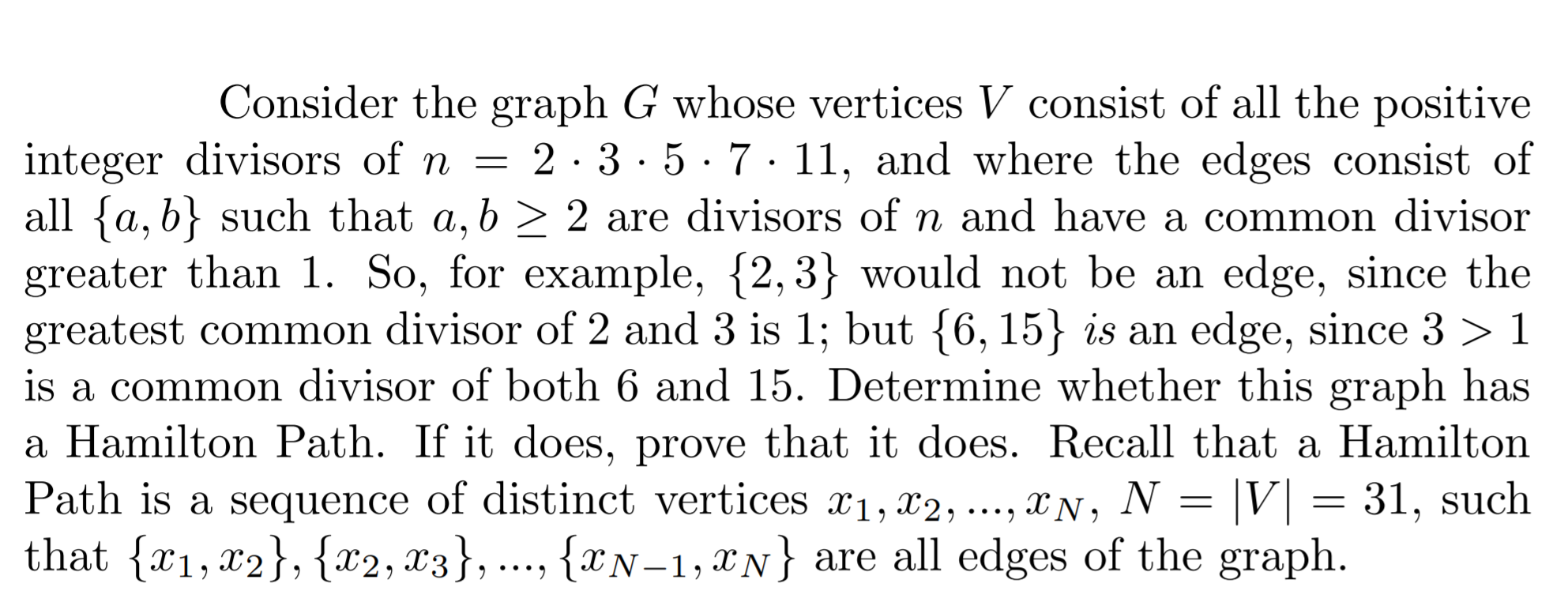
Consider the graph G whose vertices V consist of all the positive integer divisors of n = 2 - 3 - 5 - 7 - 11, and where the edges consist of all {a, (9} such that a, b 2 2 are divisors of n and have a common divisor greater than 1. So, for example, {2, 3} would not be an edge, since the greatest common divisor of 2 and 3 is 1; but {6, 15} is an edge, since 3 > 1 is a common divisor of both 6 and 15. Determine whether this graph has a Hamilton Path. If it does, prove that it does. Recall that a Hamilton Path is a sequence of distinct vertices $1,932, ...,wN, N = |V| = 31, such that {$1,332}, {$2,363}, ..., {:IJN_1,36N} are all edges of the graph
Step by Step Solution
There are 3 Steps involved in it

Get step-by-step solutions from verified subject matter experts
 Study Help