







Question: Discrete math question Problem 2. (30%) Solve the following double summation problems using the interchange-order-of-sum trick. Again, for both questions, you are not required to
Discrete math question
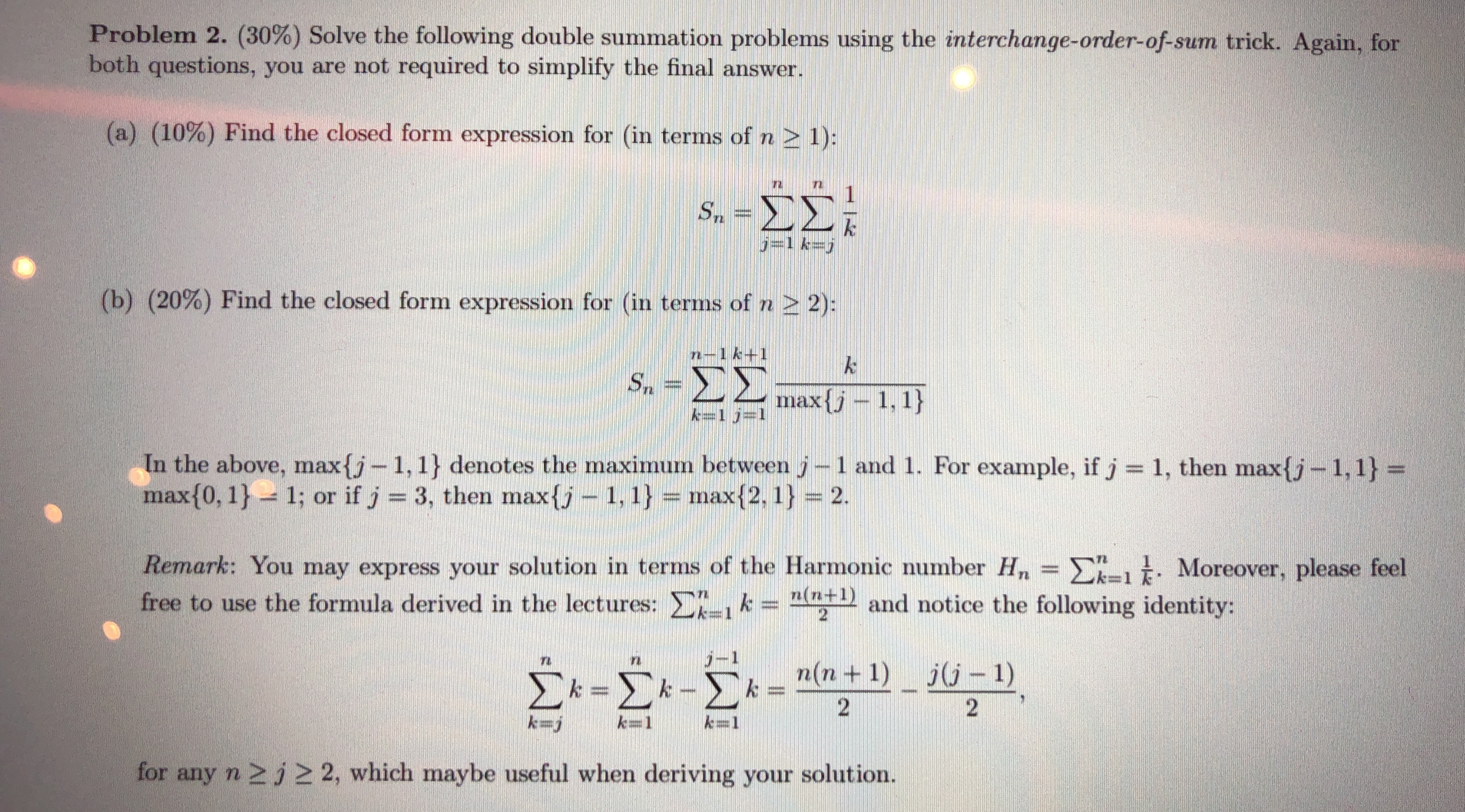
Problem 2. (30%) Solve the following double summation problems using the interchange-order-of-sum trick. Again, for both questions, you are not required to simplify the final answer. (a) (10%) Find the closed form expression for (in terms of n 2 1): K K - 'S -1 k=j (b) (20%) Find the closed form expression for (in terms of n > 2): n-14+1 max {j - 1, 1} In the above, max{j - 1, 1} denotes the maximum between / - 1 and 1. For example, if j = 1, then max{j - 1, 1} = max {0, 1} - 1; or if j = 3, then max {j - 1, 1} = max { 2, 1} = 2. Remark: You may express your solution in terms of the Harmonic number H, = >_, 1. Moreover, please feel free to use the formula derived in the lectures: _ k = = and notice the following identity: n [* = [k-Yx = (n+1) j(j - 1) k = 2 2 for any n 2 3 2 2, which maybe useful when deriving your solution
Step by Step Solution
There are 3 Steps involved in it

Get step-by-step solutions from verified subject matter experts
 Study Help