







Question: Discrete Math - Set Theory and Predicate Logic 3. Translate the following, well-established rules in set theory into predicate logic (2 marks each) a. If
Discrete Math - Set Theory and Predicate Logic
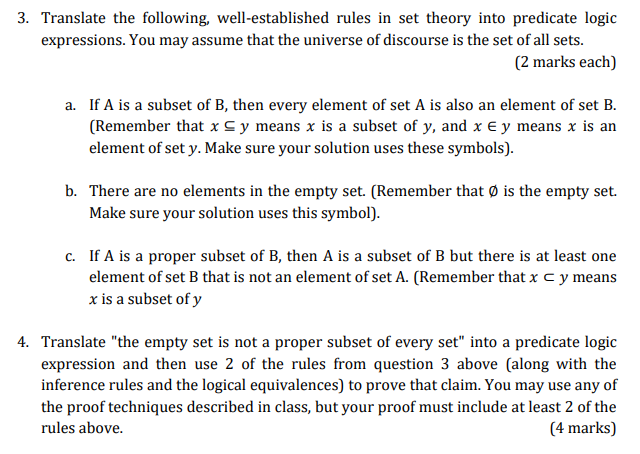
3. Translate the following, well-established rules in set theory into predicate logic (2 marks each) a. If A is a subset of B, then every element of set A is also an element of set B. expressions. You may assume that the universe of discourse is the set of all sets (Remember that x S y means x is a subset of y, and x E y means x is an element of set y. Make sure your solution uses these symbols). b. There are no elements in the empty set. (Remember that 0 is the empty set. Make sure your solution uses this symbol). C. If A is a proper subset of B, then A is a subset of B but there is at least one element of set B that is not an element of set A. (Remember that x c y means x is a subset of y 4. Translate "the empty set is not a proper subset of every set" into a predicate logic expression and then use 2 of the rules from question 3 above (along with the inference rules and the logical equivalences) to prove that claim. You may use any of the proof techniques described in class, but your proof must include at least 2 of the (4 marks) rules above. 3. Translate the following, well-established rules in set theory into predicate logic (2 marks each) a. If A is a subset of B, then every element of set A is also an element of set B. expressions. You may assume that the universe of discourse is the set of all sets (Remember that x S y means x is a subset of y, and x E y means x is an element of set y. Make sure your solution uses these symbols). b. There are no elements in the empty set. (Remember that 0 is the empty set. Make sure your solution uses this symbol). C. If A is a proper subset of B, then A is a subset of B but there is at least one element of set B that is not an element of set A. (Remember that x c y means x is a subset of y 4. Translate "the empty set is not a proper subset of every set" into a predicate logic expression and then use 2 of the rules from question 3 above (along with the inference rules and the logical equivalences) to prove that claim. You may use any of the proof techniques described in class, but your proof must include at least 2 of the (4 marks) rules above
Step by Step Solution
There are 3 Steps involved in it

Get step-by-step solutions from verified subject matter experts
 Study Help