



Question: Discrete Mathematics - It would be great if a full explanation would be provided. Thank you in advance. 2) If we let the domain be
Discrete Mathematics - It would be great if a full explanation would be provided. Thank you in advance.
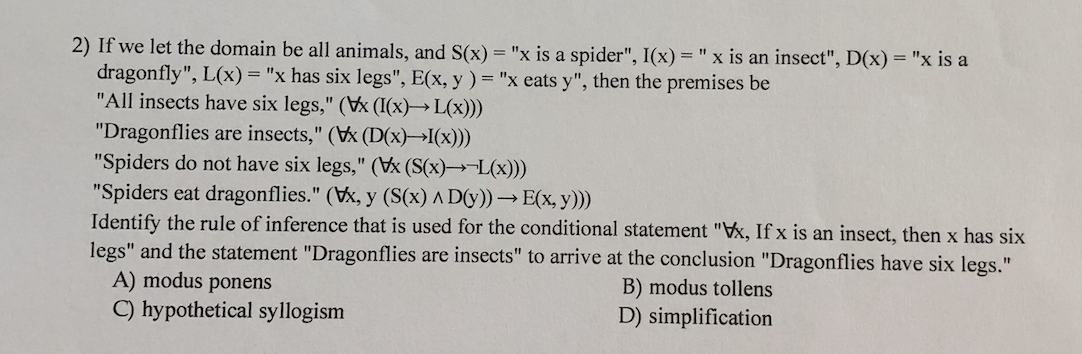
2) If we let the domain be all animals, and S(x) = "x is a spider", I(x) =" x is an insect", D(x) = "x is a dragonfly", L(x) = "x has six legs", E(x, y ) = "x eats y", then the premises be "All insects have six legs," (Vx (I(x)=L(x)) "Dragonflies are insects," (Vx (D(x) >I(x))) "Spiders do not have six legs," (Vx (S(x)+-L(x))) "Spiders eat dragonflies." (Vx, y (S(x) AD(y)) E(x, y))) Identify the rule of inference that is used for the conditional statement "Vx, If x is an insect, then x has six legs" and the statement "Dragonflies are insects" to arrive at the conclusion "Dragonflies have six legs." A) modus ponens B) modus tollens C) hypothetical syllogism D) simplification
Step by Step Solution
There are 3 Steps involved in it

Get step-by-step solutions from verified subject matter experts