







Question: Discrete Mathematics Problem 1: Compute f(A) and f1(B) in each of the cases below: (a) f:NN,f(k)=k(mod5),A={1,2,3,,10},B={1,3,7} (b) f:NN,f(k)=k(mod4),A={2,4,6,,10},B={1,3} (b) f:NN,f(k)=k(mod6),A={1,17,34,52},B={0,3,4} Problem 2: Prove that the
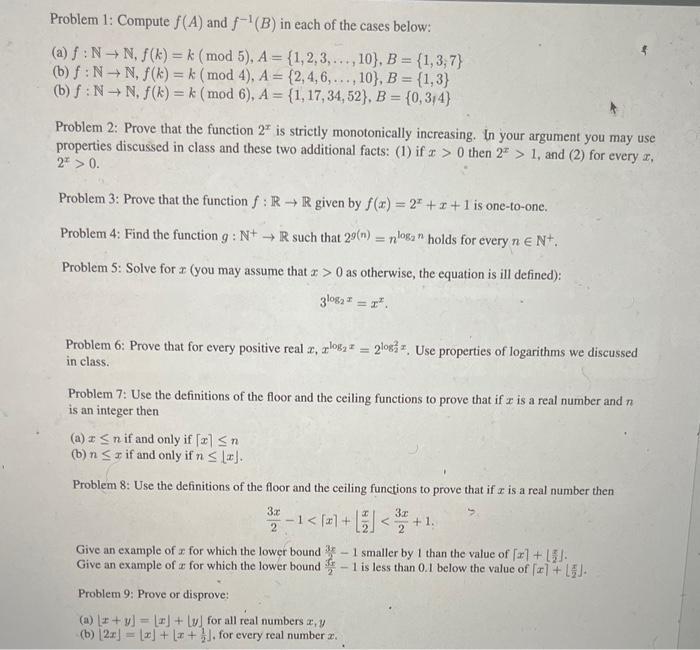
Problem 1: Compute f(A) and f1(B) in each of the cases below: (a) f:NN,f(k)=k(mod5),A={1,2,3,,10},B={1,3,7} (b) f:NN,f(k)=k(mod4),A={2,4,6,,10},B={1,3} (b) f:NN,f(k)=k(mod6),A={1,17,34,52},B={0,3,4} Problem 2: Prove that the function 2x is strictly monotonically increasing. In your argument you may use properties discussed in class and these two additional facts: (1) if x>0 then 2x>1, and (2) for every x, 2x>0. Problem 3: Prove that the function f:RR given by f(x)=2x+x+1 is one-to-one. Problem 4: Find the function g:N+R such that 2g(n)=nlog2n holds for every nN+. Problem 5: Solve for x (you may assume that x>0 as otherwise, the equation is ill defined): 3log2x=xx. Problem 6: Prove that for every positive real x,xlog2x=2log22x. Use properties of logarithms we discussed in class. Problem 7: Use the definitions of the floor and the ceiling functions to prove that if x is a real number and n is an integer then (a) xn if and only if xn (b) nx if and only if nx. Problem 8: Use the definitions of the floor and the ceiling functions to prove that if x is a real number then 23x1
Step by Step Solution
There are 3 Steps involved in it

Get step-by-step solutions from verified subject matter experts
 Study Help