Question: Discrete structures I have provided the question and solution please just inform me weather this is the correct solution thanks !! Problem 6) (2 points):
Discrete structures
I have provided the question and solution please just inform me weather this is the correct solution thanks !!
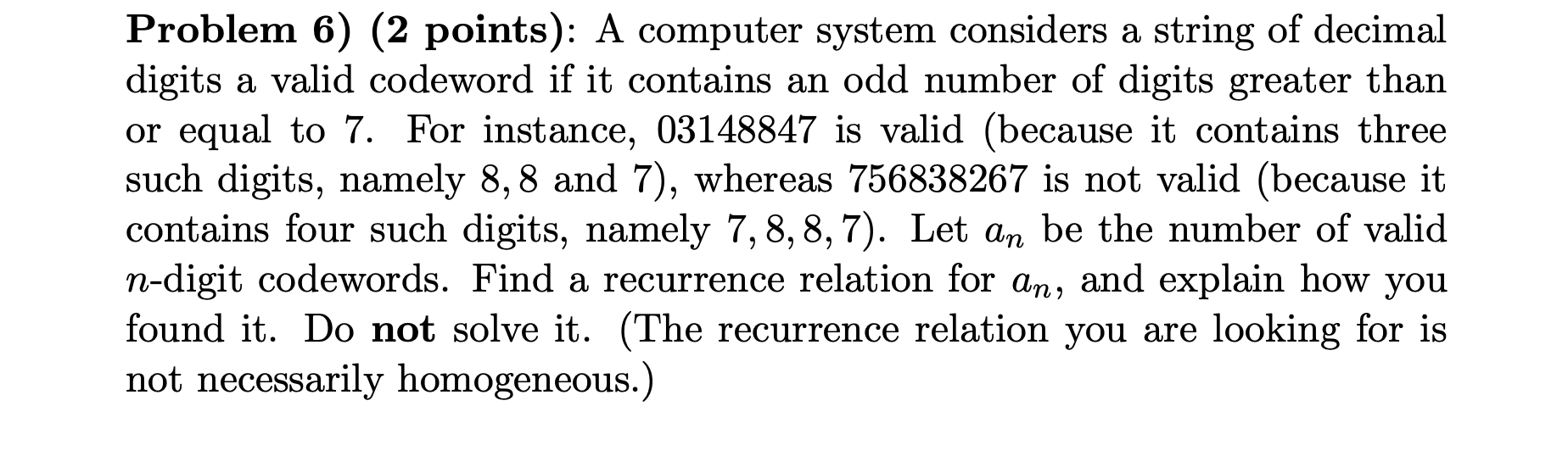
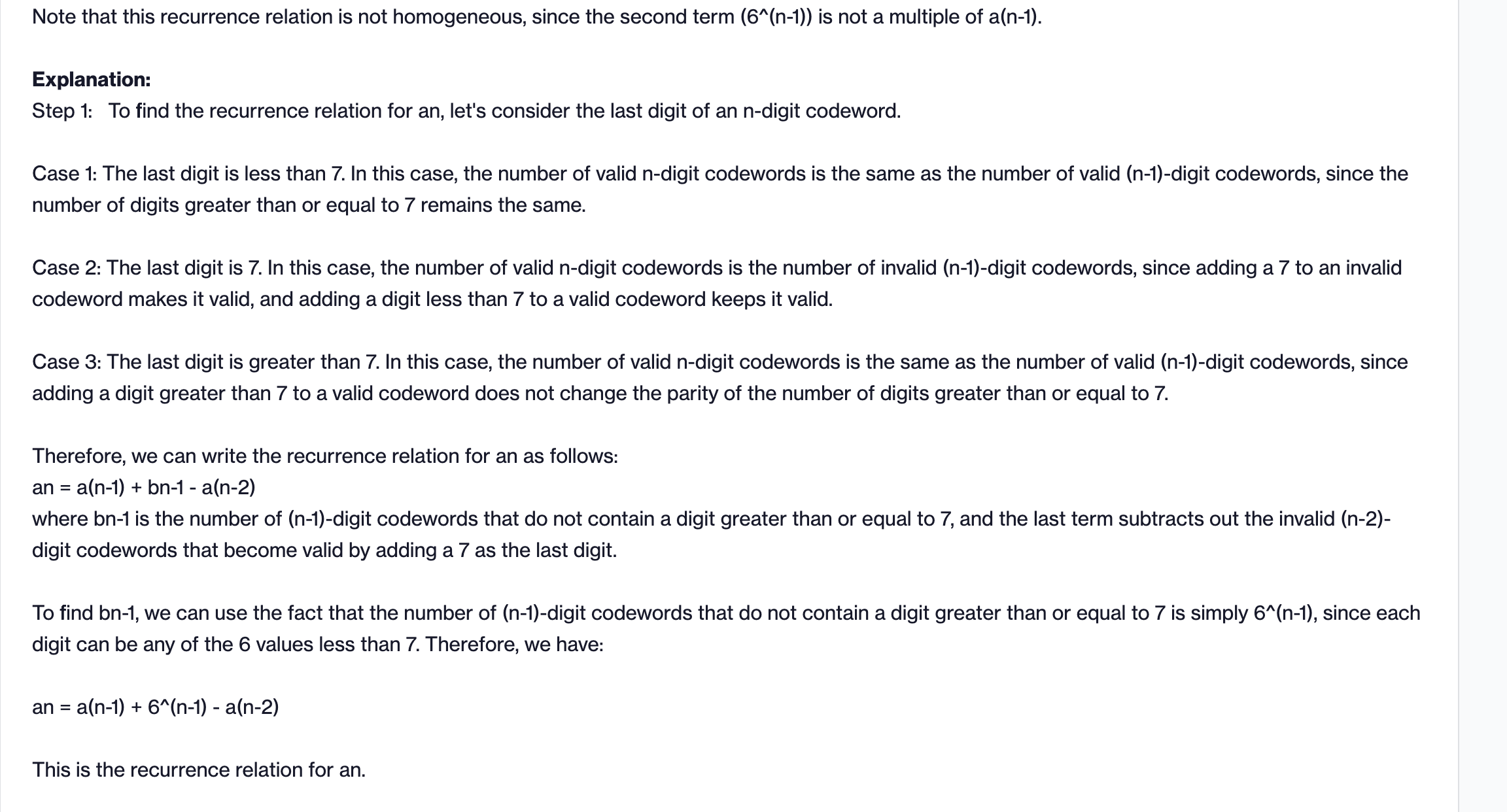
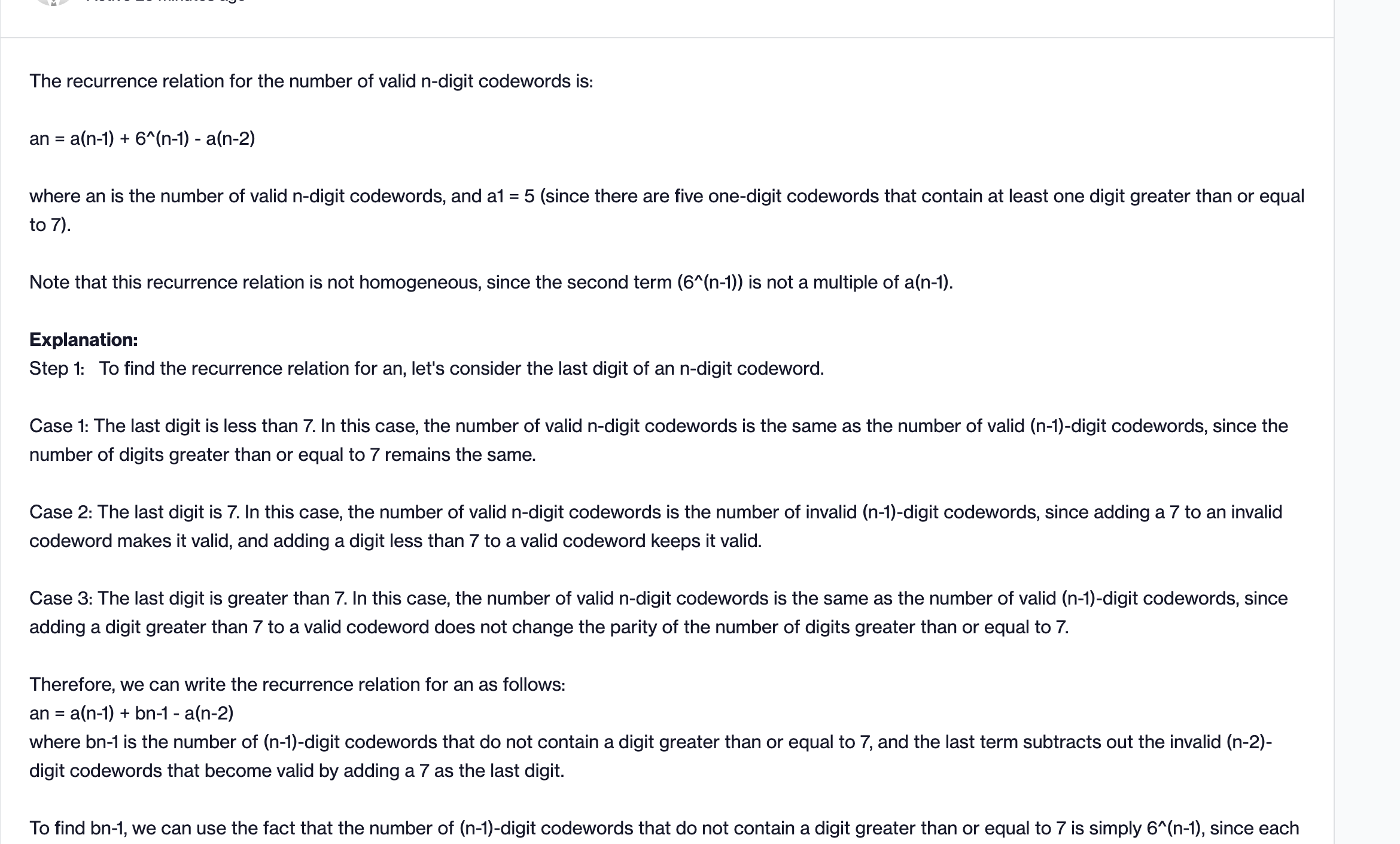
Problem 6) (2 points): A computer system considers a string of decimal digits a valid codeword if it contains an odd number of digits greater than or equal to 7. For instance, 03148847 is valid (because it contains three such digits, namely 8, 8 and 7), Whereas 756838267 is not valid (because it contains four such digits, namely 7, 8, 8, 7). Let an be the number of valid ndigit codewords. Find a recurrence relation for an, and explain how you found it. Do not solve it. (The recurrence relation you are looking for is not necessarily homogeneous.) Note that this recurrence relation is not homogeneous, since the second term (6^(n-1)) is not a multiple of a(n-1). Explanation: Step 1: To find the recurrence relation for an, let's consider the last digit of an n-digit codeword. Case 1: The last digit is less than 7. In this case, the number of valid n-digit codewords is the same as the number of valid (n-1)-digit codewords, since the number of digits greater than or equal to 7 remains the same. Case 2: The last digit is 7. In this case, the number of valid n-digit codewords is the number of invalid (n-1)-digit codewords, since adding a 7 to an invalid codeword makes it valid, and adding a digit less than 7 to a valid codeword keeps it valid. Case 3: The last digit is greater than 7. In this case, the number of valid n-digit codewords is the same as the number of valid (n-1)-digit codewords, since adding a digit greater than 7 to a valid codeword does not change the parity of the number of digits greater than or equal to 7. Therefore, we can write the recurrence relation for an as follows: an = a(n-1) + bn-1 - a(n-2) where bn-1 is the number of (n-1)-digit codewords that do not contain a digit greater than or equal to 7, and the last term subtracts out the invalid (n-2)- digit codewords that become valid by adding a 7 as the last digit. To find bn-1, we can use the fact that the number of (n-1)-digit codewords that do not contain a digit greater than or equal to 7 is simply 6^(n-1), since each digit can be any of the 6 values less than 7. Therefore, we have: an = a(n-1) + 6^(n-1) - a(n-2) This is the recurrence relation for an.The recurrence relation for the number of valid n-digit codewords is: an = a(n-1) + 6^(n-1) - a(n-2) where an is the number of valid n-digit codewords, and a1 = 5 (since there are five one-digit codewords that contain at least one digit greater than or equal to 7). Note that this recurrence relation is not homogeneous, since the second term (6^(n-1)) is not a multiple of a(n-1). Explanation: Step 1: To find the recurrence relation for an, let's consider the last digit of an n-digit codeword. Case 1: The last digit is less than 7. In this case, the number of valid n-digit codewords is the same as the number of valid (n-1)-digit codewords, since the number of digits greater than or equal to 7 remains the same. Case 2: The last digit is 7. In this case, the number of valid n-digit codewords is the number of invalid (n-1)-digit codewords, since adding a 7 to an invalid codeword makes it valid, and adding a digit less than 7 to a valid codeword keeps it valid. Case 3: The last digit is greater than 7. In this case, the number of valid n-digit codewords is the same as the number of valid (n-1)-digit codewords, since adding a digit greater than 7 to a valid codeword does not change the parity of the number of digits greater than or equal to 7. Therefore, we can write the recurrence relation for an as follows: an = a(n-1) + bn-1 - a(n-2) where bn-1 is the number of (n-1)-digit codewords that do not contain a digit greater than or equal to 7, and the last term subtracts out the invalid (n-2)- digit codewords that become valid by adding a 7 as the last digit. To find bn-1, we can use the fact that the number of (n-1)-digit codewords that do not contain a digit greater than or equal to 7 is simply 6^(n-1), since each
Step by Step Solution
There are 3 Steps involved in it
1 Expert Approved Answer
Step: 1 Unlock
Question Has Been Solved by an Expert!
Get step-by-step solutions from verified subject matter experts
Step: 2 Unlock
Step: 3 Unlock
Students Have Also Explored These Related Mathematics Questions!









 Study Help