



Question: discusion questions: 1 2 Closing Case demographic, Inputs to predict where nuisance crimes such as loiter Axon MIS Axon (www.axon.com) develops products for the law
discusion questions:
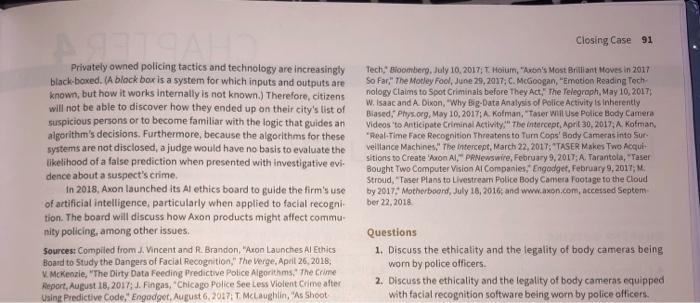
Closing Case demographic, Inputs to predict where nuisance crimes such as loiter Axon MIS Axon (www.axon.com) develops products for the law enforcement industry. Its flagship product is Toser, a line of electroshock weapons The company has diversified into technology products for law enforce ment, including body cameras and digital evidence solutions in 2017. Axon announced that it will provide any police department in the United States with free body cameras, along with one year of free data storage, training and support. The company's goals are to domi- nate the body camera market, to increase the amount of video captured by law enforcement officials, and to upload these data to Axon servers. With an estimated one-third of police departments using body cameras, police officers have been generating millions of hours of video footage, Aron stores terabytes of such video on its servers. Police agencies must continuously subscribe to this service for a monthly fee. Significantly, data from these video recordings are rarely analyzed for investigations. Axon wants to change that situation, Axon uses machine learning systems (see Technology Guide 4) to analyze its video footage, In February 2017, the company acquired a computer vision start-up called Dextro and a computer vision team from Fossil Group, Dextro's machine learning system learns to pick out objects such as stop signs, guns, and license plates and to recognize actions, such as the difference between a jogger and a suspect fleeing the police Axon plans to input all of its video footage into its machine learn ing system and then provide insights into crimes and citizen encoun ters with police. The firm claims that its software will enable police agencies to automatically conceal faces to protect privacy, to extract Important information, and to detect emotions and objects, all with out human Intervention However, privacy advocates have serious reservations about Axon's technology. By design, body cameras show the police point of view. Fur- thermore, the footage will likely be labeled by police officers rather than by civilians, meaning that machine learning systems could be taught to classify the behaviors of certain civilians as aggressive if these categori- zations help to support an officer's account of an encounter This bias is the reason why privacy experts fear that the human decisions that shape the way the data are collected and labeled might reinforce and automate the existing biases of the criminal judicial sys- tem. Legal experts and surveillance watchdogs caution that any com pany that automates recommendations about threat assessments and suspicions may transform policing tactics for the worse. Consider PredPol, the controversial predictive policing software first used in Los Angeles in 2009. Predpoluses geographic, rather than ing will occur. However, because such crimes are already overpolited in certain neighborhoods, the data fed to the machine learning algo rithms are already biased. When police respond to these data by send. ing additional officers to computer predicted loitering hot spots, the system justifies and reinforces its initial assumptions. Facial recognition software has the potential for making body camera videos even more intrusive. A 2016 survey funded by the us Department of Justice and conducted by Johns Hopkins University discovered that at least 9 of 38 manufacturers of body cameras had facial recognition capacities or had built in an option for such tech nology to be added later. Consider the Russian company Ntechlab (www.ntechlab.com/, which claims that its facial recognition soft- ware-called FindFace-is able to identify people in a crowd and determine whether they are angry, stressed, or nervous. The firm's software can monitor people for suspicious behavior by tracking their identity, age, gender, and current emotional state. Police departments now have a vast amount of body camera video footage. Analysis of these data provides insights into which inter- actions with the public have been positive, which have been negative, and how individuals' actions led to each type of interaction. Axon is betting that its software tools will be useful to determine what hap- pened and to anticipate what might happen in the future. This process is what worries privacy advocates. The question is not whether soft- ware will transform the legal and lethal limits of policing but, rather, how and for whose profits? integrating facial recognition software with body cameras increasingly concerns civil liberties advocates who worry about the impact of these new technologies on citizens' privacy. They warn that body cameras coupled with facial recognition software give police the ability to collect information at a distance. Therefore, officers would not need to justify a particular interaction or to find probable cause for a search, stop, or frisk. As a result, civil liberties groups are calling on police departments and legislators to implement clear policies to regulate camera footage retention, biometrics, and privacy. State and local-level legislation has lagged in regulating who can access body camera video footage, how long this footage is stored, and who gets to see it. However, the biggest impediment to ensuring that body camera video footage remains accountable might be the manufacturers themselves Nondisclosure agreements allow private companies like Axon to defend their proprietary computing systems from public scrutiny. Pri vacy advocates emphasize that these companies (1) are not subject to state public record laws and (2) require police departments to sign con- tracts that they will keep the relationship and the technology secret. Closing Case 91 Privately owned policing tactics and technology are increasingly black boxed. (A black box is a system for which inputs and outputs are known, but how it works Internally is not known.) Therefore, citizens will not be able to discover how they ended up on their city's list of suspicious persons or to become familiar with the logic that guides an algorithm's decisions. Furthermore, because the algorithms for these systems are not disclosed, a judge would have no basis to evaluate the Likelihood of a false prediction when presented with investigative evi dence about a suspect's crime. in 2018, Axon launched its Al ethics board to guide the firm's use of artificial intelligence, particularly when applied to facial recogni tion. The board will discuss how Axon products might affect commu nity policing, among other issues. Sources: Compiled from J. Vincent and R. Brandon, "Axon Launches Al Ethics Board to study the Dangers of Facial Recognition." The Verge, April 26, 2018, V. McKenzie, "The Dirty Data Feeding Predictive Police Algorithms, The Crime Report, August 18, 2017, J. Fingas, "Chicago Police See Less Violent Crime after Using Predictive Code. Engadget, August 6, 2017 McLaughlin, As Shoot Tech Bloomberg, July 10, 2017 Hoium, "Axon's Most Brilliant Moves in 2017 So Far;" The Motley Fool, June 29, 2017, C. McGoogan, "Emotion Reading Tech nology Claims to Spot Criminals before They Act The Telegraph, May 10, 2017: W. Isaac and A Dixon, "Why Big Data Analysis of Police Activity is inherently Biased. Phys.org, May 10, 2017; Kofman, "Tater Will Use Police Body Camera Videos to Anticipate Criminal Activity. The intercept, April 30, 2017. A. Kofman, "Real-Time Face Recognition Threatens to Turn Cops' Body Cameras into Sur veillance Machines. The intercept, March 22, 2017: "TASER Makes Two Acqui sitions to Create Aron AI, PRNewswire, February 9, 2017; A. Tarantola, Taser Bought Two Computer Vision Al Companies." Engadget, February 9, 2017, M. Stroud, "Taset Plans to Livestream Police Body Camera Footage to the Cloud by 2017. Motherboard, July 16, 2016, and www.axon.com, accessed Septem ber 22, 2018 Questions 1. Discuss the ethicality and the legality of body cameras being worn by police officers 2. Discuss the ethicality and the legality of body cameras equipped with facial recognition software being worn by police officers
1
2 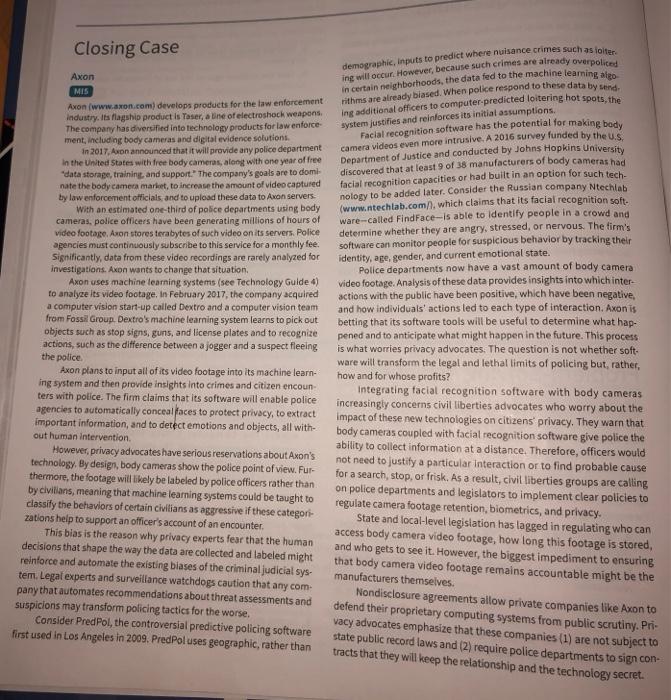
Step by Step Solution
There are 3 Steps involved in it
1 Expert Approved Answer
Step: 1 Unlock

Question Has Been Solved by an Expert!
Get step-by-step solutions from verified subject matter experts
Step: 2 Unlock
Step: 3 Unlock