Question: Discuss how this brand can solve the problems and improve by using Taylor's Scientific management. Give me the recommendation analysis. Dr Martens - Case study
Discuss how this brand can solve the problems and improve by using Taylor's Scientific management. Give me the recommendation analysis.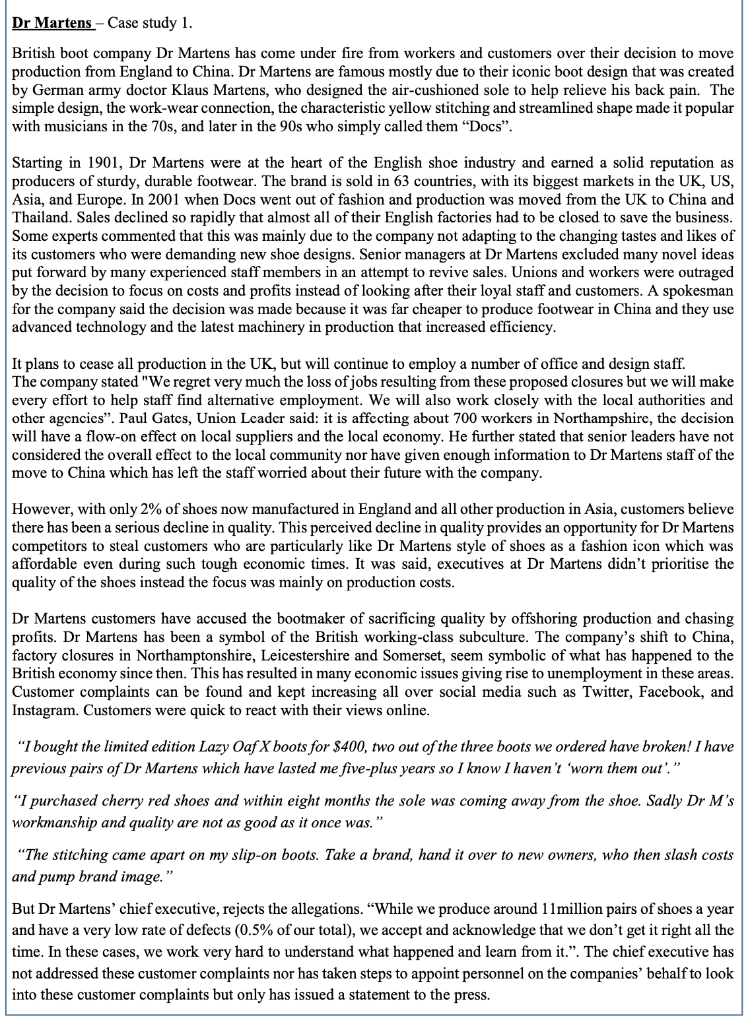
Dr Martens - Case study 1. British boot company Dr Martens has come under fire from workers and customers over their decision to move production from England to China. Dr Martens are famous mostly due to their iconic boot design that was created by German army doctor Klaus Martens, who designed the air-cushioned sole to help relieve his back pain. The simple design, the work-wear connection, the characteristic yellow stitching and streamlined shape made it popular with musicians in the 70s, and later in the 90s who simply called them "Docs". Starting in 1901, Dr Martens were at the heart of the English shoe industry and earned a solid reputation as producers of sturdy, durable footwear. The brand is sold in 63 countries, with its biggest markets in the UK, US, Asia, and Europe. In 2001 when Docs went out of fashion and production was moved from the UK to China and Thailand. Sales declined so rapidly that almost all of their English factories had to be closed to save the business. Some experts commented that this was mainly due to the company not adapting to the changing tastes and likes of its customers who were demanding new shoe designs. Senior managers at Dr Martens excluded many novel ideas put forward by many experienced staff members in an attempt to revive sales. Unions and workers were outraged by the decision to focus on costs and profits instead of looking after their loyal staff and customers. A spokesman for the company said the decision was made because it was far cheaper to produce footwear in China and they use advanced technology and the latest machinery in production that increased efficiency. It plans to cease all production in the UK, but will continue to employ a number of office and design staff. The company stated "We regret very much the loss of jobs resulting from these proposed closures but we will make every effort to help staff find alternative employment. We will also work closely with the local authorities and other agencies. Paul Gates, Union Leader said: it is affecting about 700 workers in Northampshire, the decision will have a flow-on effect on local suppliers and the local economy. He further stated that senior leaders have not considered the overall effect to the local community nor have given enough information to Dr Martens staff of the move to China which has left the staff worried about their future with the company. However, with only 2% of shoes now manufactured in England and all other production in Asia, customers believe there has been a serious decline in quality. This perceived decline in quality provides an opportunity for Dr Martens competitors to steal customers who are particularly like Dr Martens style of shoes as a fashion icon which was affordable even during such tough economic times. It was said, executives at Dr Martens didn't prioritise the quality of the shoes instead the focus was mainly on production costs. Dr Martens customers have accused the bootmaker of sacrificing quality by offshoring production and chasing profits. Dr Martens has been a symbol of the British working-class subculture. The company's shift to China, factory closures in Northamptonshire, Leicestershire and Somerset, seem symbolic of what has happened to the British economy since then. This has resulted in many economic issues giving rise to unemployment in these areas. Customer complaints can be found and kept increasing all over social media such as Twitter, Facebook, and Instagram. Customers were quick to react with their views online. "I bought the limited edition Lazy Oaf X boots for $400, two out of the three boots we ordered have broken! I have previous pairs of Dr Martens which have lasted me five-plus years so I know I haven't 'worn them out'." "I purchased cherry red shoes and within eight months the sole was coming away from the shoe. Sadly Dr M's workmanship and quality are not as good as it once was." "The stitching came apart on my slip-on boots. Take a brand, hand it over to new owners, who then slash costs and pump brand image." But Dr Martens' chief executive, rejects the allegations. While we produce around 11million pairs of shoes a year and have a very low rate of defects (0.5% of our total), we accept and acknowledge that we don't get it right all the time. In these cases, we work very hard to understand what happened and learn from it.". The chief executive has not addressed these customer complaints nor has taken steps to appoint personnel on the companies' behalf to look into these customer complaints but only has issued a statement to the press




