







Question: Discuss the example that is provided (P.165-166) in which an African American officer fairly new to a department did not speak up when it came
Discuss the example that is provided (P.165-166) in which an African American officer fairly new to a department did not speak up when it came to his partner's differential treatment of black citizens in a nightclub. What do you think held this officer from speaking up? What might the consequences of his silence be with respect to the ongoing relationship between black and white officers? 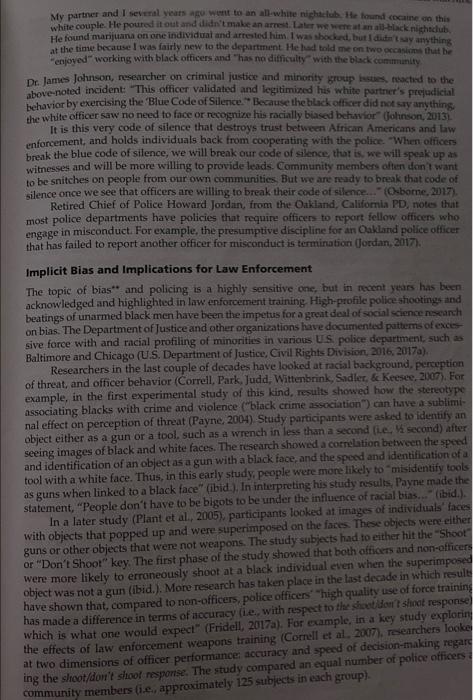
My partner and several years ago went to an all white nightclub He found cocaine on this white couple. He poured it out and didn't make an arrest Later we were an all-black nightclub He found marijuana on one individual and arrested him I was shocked, but I didn't say anything at the time because I was fairly new to the department Helad told me on two decanice that be enjoyed working with black officers and has no difficulty with the black community Dr. James Johnson, researcher on criminal justice and minority group buses, teacted to the above-noted incident: "This officer validated and legitimized his white partner's prejudicial behavior by exercising the Blue Code of Silence." Because the black officer did not say anything, the white officer saw no need to face or recognize his racially biased behavior" (Johnson, 20131 It is this very code of silence that destroys trust between African Americans and law enforcement, and holds individuals back from cooperating with the police. "When officers break the blue code of silence, we will break our code of silence that is we will speak up as witnesses and will be more willing to provide leads. Community members often don't want to be snitches on people from our own communities. But we are ready to break that code of silence once we see that officers are willing to break their code of silence..." (Osbome, 2017) Retired Chief of Police Howard Jordan, from the Oakland, California PD, notes that most police departments have policies that require officers to report fellow officers who engage in misconduct. For example, the presumptive discipline for an Oakland police officer that has failed to report another officer for misconduct is termination (Jordan 2017). Implicit Bias and Implications for Law Enforcement The topic of bias and policing is a highly sensitive one, but in recent years has been acknowledged and highlighted in law enforcement training High-profile police shootings and beatings of unarmed black men have been the impetus for a great deal of social science research on bias. The Department of Justice and other organizations have documented patterns of exces sive force with and racial profiling of minorities in various US police department such as Baltimore and Chicago (U.S. Department of Justice, Civil Rights Division, 2016, 2017), Researchers in the last couple of decades have looked at racial background, perception of threat, and officer behavior (Correll, Park, Judd, Wittenbrink, Sadler, & Keesee, 2007). For example, in the first experimental study of this kind, results showed how the stereotype associating blacks with crime and violence ("black crime association") can have a sublimi- nal effect on perception of threat (Payne, 2004). Study participants were asked to identify an object either as a gun or a tool, such as a wrench in less than a second lie. Second) after seeing images of black and white faces. The research showed a correlation between the speed and identification of an object as a gun with a black face, and the speed and identification of a tool with a white face. Thus, in this early study, people were more likely to misidentify tools as guns when linked to a black face" (ibid.), In interpreting his study results, Payne made the statement, "People don't have to be bigots to be under the influence of racial bias...(ibid.). In a later study (Plant et al, 2005), participants looked at images of individuals' faces with objects that popped up and were superimposed on the faces. These objects were either guns or other objects that were not weapons. The study subjects had to either hit the "Shoot or "Don't Shoot" key. The first phase of the study showed that both officers and non-officer were more likely to erroneously shoot at a black individual even when the superimposed object was not a gun (ibid.). More research has taken place in the last decade in which result have shown that compared to non-officers, police officers "high quality use of force training has made a difference in terms of accuracy ie, with respect to the shoot don't shoot response which is what one would expect" (Fridell, 2017a). For example, in a key study explorin the effects of law enforcement weapons training (Correll et al. 2007), researchers looke at two dimensions of officer performance accuracy and speed of decision-making regard ing the shoot don't shoot response. The study compared an equal number of police officers community members lie., approximately 125 subjects in each group)
Step by Step Solution
There are 3 Steps involved in it
1 Expert Approved Answer
Step: 1 Unlock

Question Has Been Solved by an Expert!
Get step-by-step solutions from verified subject matter experts
Step: 2 Unlock
Step: 3 Unlock
 Study Help