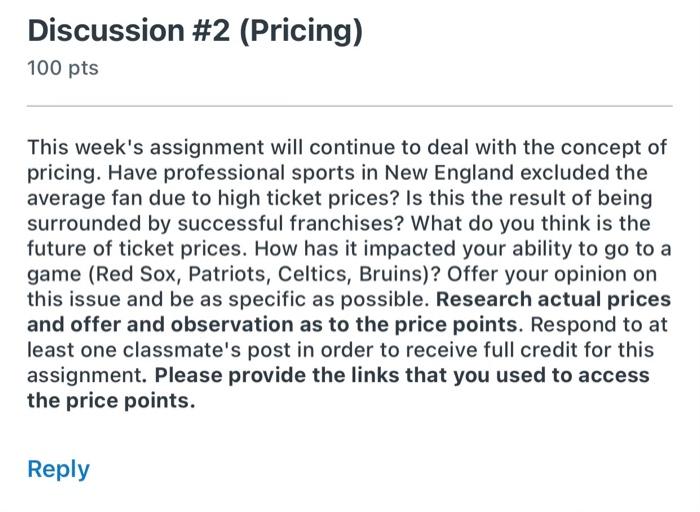
Question: Discussion #2 (Pricing) 100 pts This week's assignment will continue to deal with the concept of pricing. Have professional sports in New England excluded the
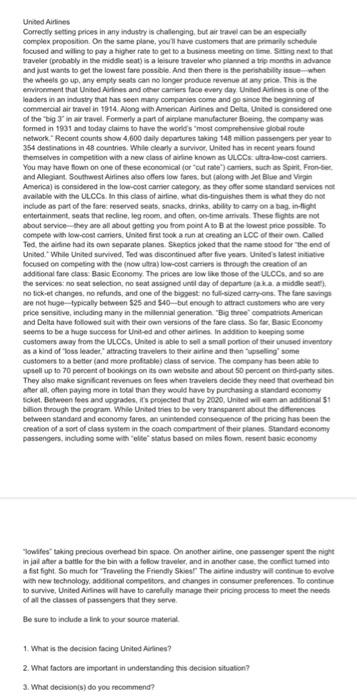
Discussion #2 (Pricing) 100 pts This week's assignment will continue to deal with the concept of pricing. Have professional sports in New England excluded the average fan due to high ticket prices? Is this the result of being surrounded by successful franchises? What do you think is the future of ticket prices. How has it impacted your ability to go to a game (Red Sox, Patriots, Celtics, Bruins)? Offer your opinion on this issue and be as specific as possible. Research actual prices and offer and observation as to the price points. Respond to at least one classmate's post in order to receive full credit for this assignment. Please provide the links that you used to access the price points. Reply United Airlines Correctly setting prices in any industry is challenging, but air travel can be an especially complex proposition. On the same plane, you'll have customers that are primary schedule focused and willing to pay a higher rate to get to a business meeting on time. Sitting next to that traveler (probably in the middle seat) is a lesure traveler who planned a trip months in advance and just wants to get the lowest fare possible. And then there is the perisability issue when the wheels go up, any empty seats can no longer produce revenue at any prion. This is the environment that United Airlines and other carriers face every day United Airlines is one of the leaders in an industry that has seen many companies come and go since the beginning of commercial air travel in 1914. Along with American Airlines and Delta United is considered one of the big 3in air travel. Formerly a part of airplane manufacturer Boeing the company was formed in 1931 and today claims to have the world's most comprehensive global route network Recent counts show 4,600 daily departures taking 148 million passengers per year to 354 destinations in 48 countries. While clearly a survivor, United has in recent years found themselves in competition with a new class of airline known as ULCCS ultra-low-cost camers. You may have down on one of these economical (or outrale") carriers, such as Spint. Fronter and Allegiant. Southwest Airlines also offers low ares, but along with Jet Blue and Virgin America) es considered in the low-cost carrier category, as they offer som standard services not available with the ULCCs. In this class of airline what distinguishes them is what they do not include as part of the fare reserved seats, snacks, drinks ability to carry on a bag in-tight entertainment. seats that recline, leg room and often on-time arials. These fights are not about service--they are all about getting you from point A to B at the lowest price possible. To compete with low-cost carriers. United first took a run at creating an LCC of their own. Called Ted, the airline had its own separate planes. Skeptics joked that the rame stood for the end of United. While United survived. Ted was discontinued after five years. United states initiative focused on competing with the now ultra low-cost carrers is through the creation of an additional fare class Basic Economy. The prices are low like those of the ULCC, and so are the services: no seat selection, no seat assigned until day of departure aka a middle eart no ticket changes, no refunds, and one of the biggest no full-sized carry-ons. The fare savings are not huge-typically between $25 and 540--but enough to attract customers who are very price sensitive, including many in the milenial generation "Big three compatriots American and Delta have followed suit with their own versions of the fare class. So far, Basic Economy seems to be a ruge success for United and other itines. In addition to keeping some customers away from the ULCCS United is able to sell a small portion of their used inventory as a kind of loss leader attracting travelers to the airline and then upselling some customers to a better and more profitable class of service. The company has been able to upsell up to 70 percent of bookings on its own website and about 50 percent on third-party sites They also make significant revenues on fees when travelers decide they need that overhead bin after all often paying more in total than they would have by purchasing a standard economy Sicket, Between fees and upgrades, it's projected that by 2020, United will cam an additional $1 billion through the program. While United tries to be very transparent about the differences between standard and economy fares, an unintended consequence of the pricing has been the creation of a sort of class system in the coach compartment of their planes Standard economy passengers, including some with lite status based on miles flown.resent basic economy Sowies" taking precious overhead bin space. On another airline, one passenger spent the night in ja aher a battle for the bin with a follow traveler, and in another case, the conflict tumed into a fist fight. So much for Traveling the Friendly Skies The airline industry will continue to evolve with new technology. additional competitors and changes in consumer preferences. To continue to survive, United Airlines will have to carefully manage their pricing process to meet the needs of all the classes of passengers that they serve Be sure to include a link to your source material 1. What is the decision facing United Airlines? 2. What factors are important in understanding this decision situation? 1. What decisions) do you recommend









 Study Help