







Question: Discussion Board Topic: Grading on the Curve - Some instructors believe that student grades should end up being 'normally distributed'. For example, A's are given
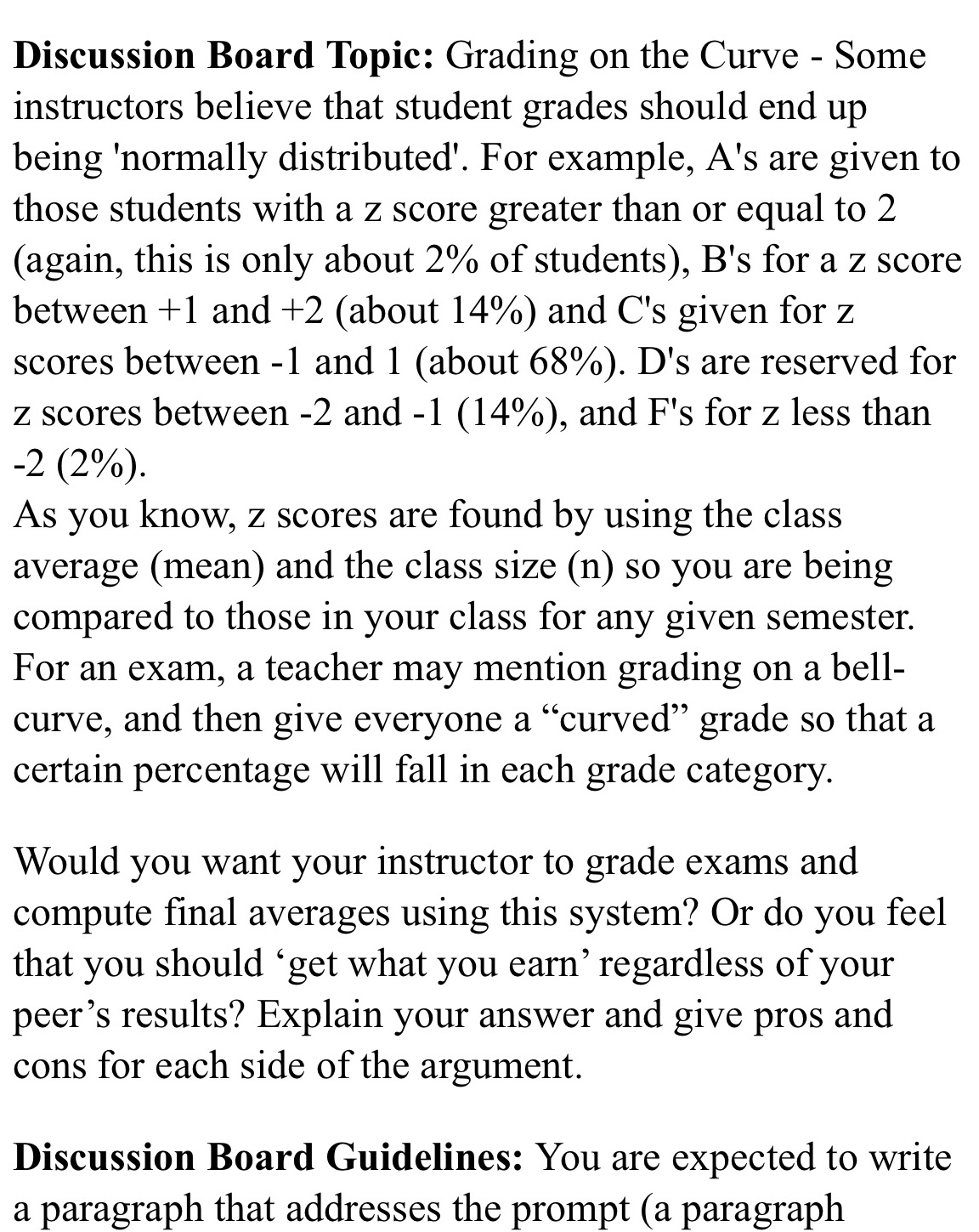
Discussion Board Topic: Grading on the Curve - Some instructors believe that student grades should end up being 'normally distributed'. For example, A's are given to those students with a z score greater than or equal to 2 (again, this is only about 2% of students), B's for a z score between +1 and +2 (about 14%) and Cs given for z scores between -1 and 1 (about 68%). D's are reserved for z scores between -2 and -l (14%), and F's for 2 less than -2 (2%). As you know, 2 scores are found by using the class average (mean) and the class size (n) so you are being compared to those in your class for any given semester. For an exam, a teacher may mention grading on a bell- curve, and then give everyone a \"curved\" grade so that a certain percentage will fall in each grade category. Would you want your instructor to grade exams and compute nal averages using this system? Or do you feel that you should 'get what you earn' regardless of your peer's results? Explain your answer and give pros and cons for each side of the argument. Discussion Board Guidelines: You are expected to write a paragraph that addresses the prompt (a paragraph
Step by Step Solution
There are 3 Steps involved in it

Get step-by-step solutions from verified subject matter experts
 Study Help