



Question: Discussion Question: Read the following article ( If the link doesn't work, please refer to the file under introduction above ) . In addition to
Discussion Question:
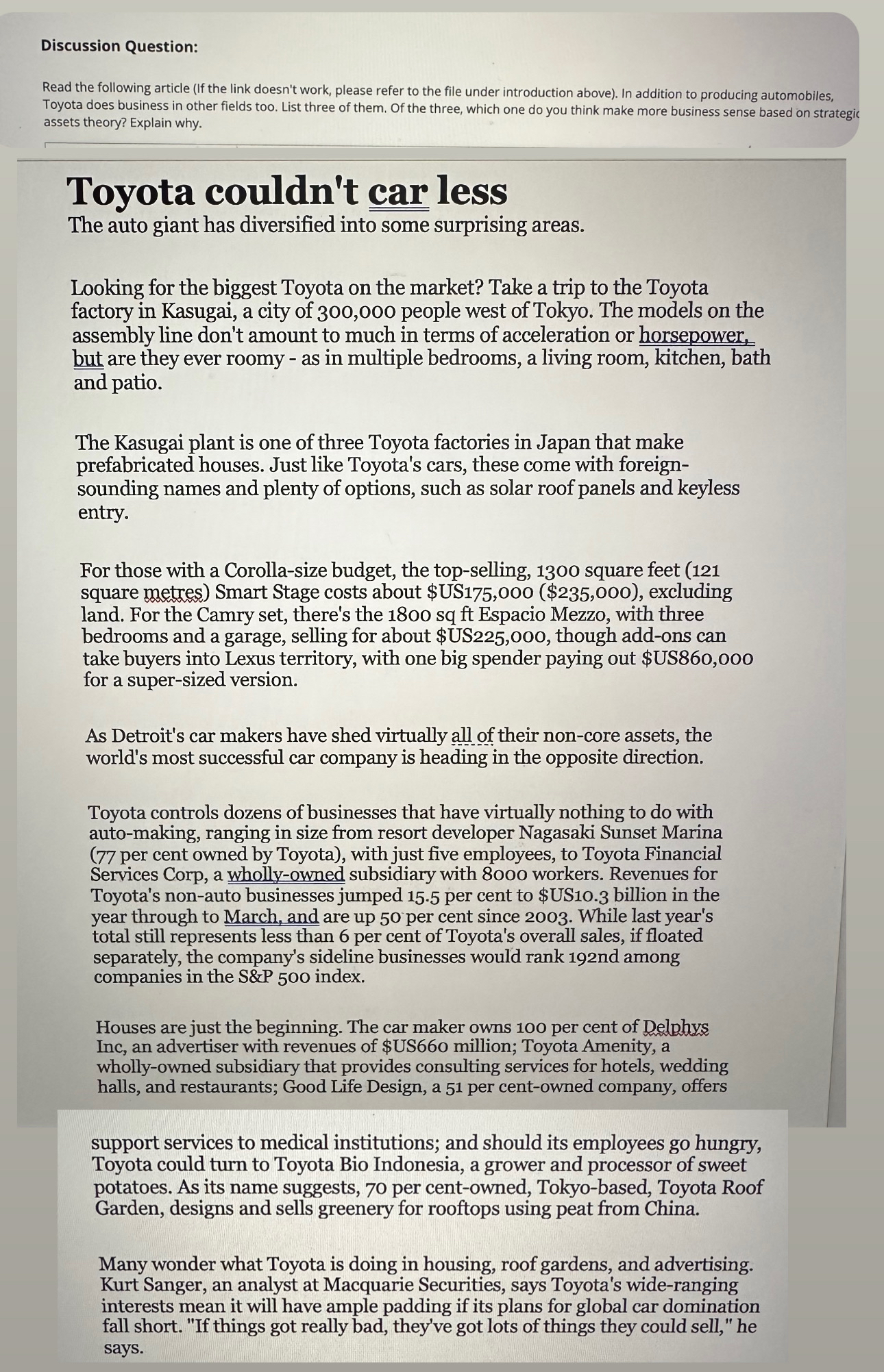
Read the following article If the link doesn't work, please refer to the file under introduction above In addition to producing automobiles, Toyota does business in other fields too. List three of them. Of the three, which one do you think make more business sense based on strategic assets theory? Explain why.
Toyota couldn't car less
The auto giant has diversified into some surprising areas.
Looking for the biggest Toyota on the market? Take a trip to the Toyota factory in Kasugai, a city of people west of Tokyo. The models on the assembly line don't amount to much in terms of acceleration or horsepower, but are they ever roomy as in multiple bedrooms, a living room, kitchen, bath and patio.
The Kasugai plant is one of three Toyota factories in Japan that make prefabricated houses. Just like Toyota's cars, these come with foreignsounding names and plenty of options, such as solar roof panels and keyless entry.
For those with a Corollasize budget, the topselling, square feet square metres Smart Stage costs about $US$ excluding land. For the Camry set, there's the sq ft Espacio Mezzo, with three bedrooms and a garage, selling for about $US though addons can take buyers into Lexus territory, with one big spender paying out $US for a supersized version.
As Detroit's car makers have shed virtually all of their noncore assets, the world's most successful car company is heading in the opposite direction.
Toyota controls dozens of businesses that have virtually nothing to do with automaking, ranging in size from resort developer Nagasaki Sunset Marina per cent owned by Toyota with just five employees, to Toyota Financial Services Corp, a whollyowned subsidiary with workers. Revenues for Toyota's nonauto businesses jumped per cent to $ US billion in the year through to March, and are up per cent since While last year's total still represents less than per cent of Toyota's overall sales, if floated separately, the company's sideline businesses would rank nd among companies in the S&P index.
Houses are just the beginning. The car maker owns per cent of Delphys Inc, an advertiser with revenues of $USo million; Toyota Amenity, a whollyowned subsidiary that provides consulting services for hotels, wedding halls, and restaurants; Good Life Design, a per centowned company, offers
support services to medical institutions; and should its employees go hungry, Toyota could turn to Toyota Bio Indonesia, a grower and processor of sweet potatoes. As its name suggests, per centowned, Tokyobased, Toyota Roof Garden, designs and sells greenery for rooftops using peat from China.
Many wonder what Toyota is doing in housing, roof gardens, and advertising. Kurt Sanger, an analyst at Macquarie Securities, says Toyota's wideranging interests mean it will have ample padding if its plans for global car domination fall short. If things got really bad, they've got lots of things they could sell," he says.
Step by Step Solution
There are 3 Steps involved in it
1 Expert Approved Answer
Step: 1 Unlock

Question Has Been Solved by an Expert!
Get step-by-step solutions from verified subject matter experts
Step: 2 Unlock
Step: 3 Unlock