







Question: Discussions List View Topic Discussion 5-2 v & Locked before Monday, February 8, 2021 12:00 AM CST. Subscribe Consider the discussion on circuit and packet
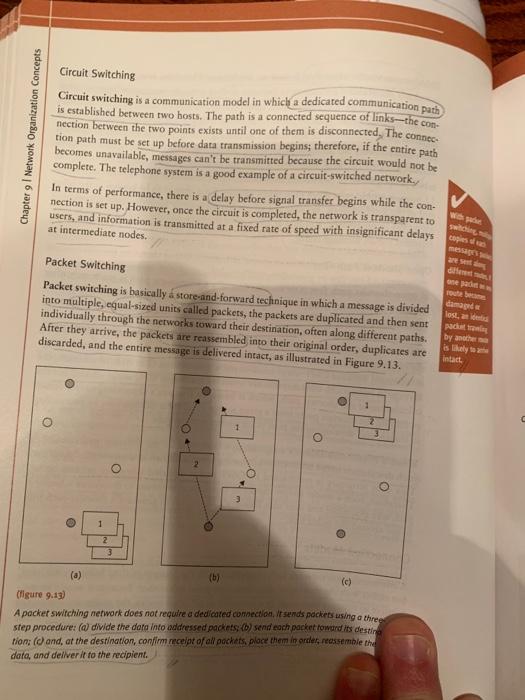
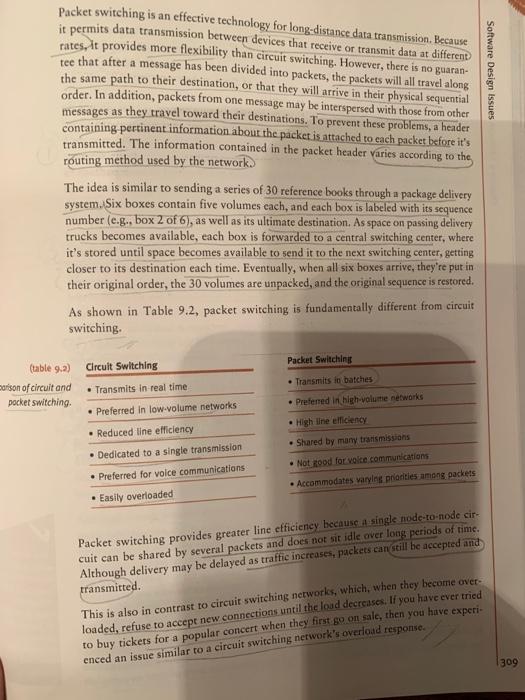
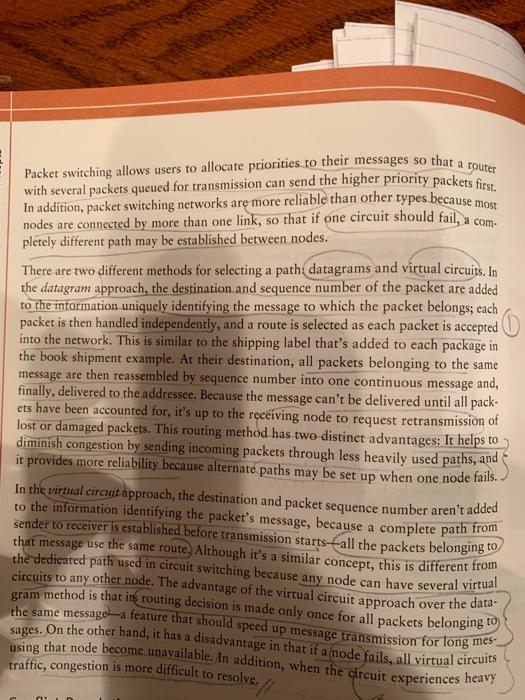
Discussions List View Topic Discussion 5-2 v & Locked before Monday, February 8, 2021 12:00 AM CST. Subscribe Consider the discussion on circuit and packet switching in Chapter 9. With regard to packet switching, would packet sizes have an impact on transmission time? Discuss whether or not this is true. Specifically, compare the concept of the number of bits that constitute the data portion of the packet, and the number of bits that constitute the address portion of the packet. Does your response apply in all cases, or are there certain scenarios that would be an exception? Your initial post is due by 11:59 pm CT Thursday, at least one response post due by 11:59 pm CT Sunday. Rubrics Discussion Start a New Thread Chapter 9 l Network Organization Concepts Circuit Switching Circuit switching is a communication model in which a dedicated communication path is established between two hosts. The path is a connected sequence of links--the cos nection between the two points exists until one of them is disconnected. The connec tion path must be set up before data transmission begins; therefore, if the entire path becomes unavailable, messages can't be transmitted because the circuit would not be complete. The telephone system is a good example of a circuit-switched network, In terms of performance, there is a delay before signal transfer begins while the con- nection is set up. However, once the circuit is completed, the network is transparent to users, and information is transmitted at a fixed rate of speed with insignificant delays copies of tres at intermediate nodes. Wise are Packet Switching Packet switching is basically a store-and-forward technique in which a message is divided into multiple, equal-sized units called packets, the packets are duplicated and then sent individually through the networks toward their destination, often along different paths. After they arrive, the packets are reassembled into their original order, duplicates are discarded, and the entire message is delivered intact, as illustrated in Figure 9.13. became damaged lest, pad by the intact 1 o 3 (a) (b) (figure 9.13) A pocket switching network does not require a dedicated comection. It sends pockets using a three step procedure: (a) divide the data into addressed packets: (b) send each packet toward its desting tion: () and, at the destination, confirm receipt of all pockets, place them in oreles, reassemble the dara, and deliver it to the recipient. Software Design Issues Packer switching is an effective technology for long-distance data transmission. Because it permits data transmission between devices that receive or transmit data at different rates, it provides more flexibility than circuit switching. However, there is no guaran- tee that after a message has been divided into packets, the packets will all travel along the same path to their destination, or that they will arrive in their physical sequential order. In addition, packets from one message may be interspersed with those from other messages as they travel toward their destinations. To prevent these problems, a header containing pertinent information about the packet is attached to each packet before it's transmitted. The information contained in the packet header varies according to the routing method used by the network. The idea is similar to sending a series of 30 reference books through a package delivery system. Six boxes contain five volumes each, and each box is labeled with its sequence number (e.g., box 2 of 6), as well as its ultimate destination. As space on passing delivery trucks becomes available, each box is forwarded to a central switching center, where it's stored until space becomes available to send it to the next switching center, getting closer to its destination each time. Eventually, when all six boxes arrive, they're put in their original order, the 30 volumes are unpacked, and the original sequence is restored. As shown in Table 9.2, packet switching is fundamentally different from circuit switching. Packet Switching (table 9.2) arison of circuit and pocket switching Transmits in batches Circuit Switching Transmits in real time Preferred in low-volume networks Reduced line efficiency Dedicated to a single transmission Preferred for volce communications Easily overloaded Prefered in high-volume networks Highline elliciency Shared by many transmissions Not good for voice communications Accommodates varying priorities among packets Packet switching provides greater line efficiency because a single node-to-node cir- cuit can be shared by several packets and does not sit idle over long periods of time Although delivery may be delayed as traffic increases, packets can still be accepted and transmitted. This is also in contrast to circuit switching networks, which, when they become over- loaded, refuse to accept new connections until the load decreases. If you have ever tried to buy tickets for a popular concert when they first go on sale, then you have experi- enced an issue similar to a circuit switching network's overload response. 1309 Packet switching allows users to allocate priorities to their messages so that a with several packets queued for transmission can send the higher priority packets first In addition, packet switching networks are more reliable than other types because mos nodes are connected by more than one link, so that if one circuit should fail, a com pletely different path may be established between nodes. sages. On the other hand, it has a disadvantage in that it anode fails, all virtual circuits router There are two different methods for selecting a path datagrams and virtual circuits. In the datagram approach, the destination and sequence number of the packet are added to the information uniquely identifying the message to which the packet belongs; each packet is then handled independently, and a route is selected as each packet is accepted into the network. This is similar to the shipping label that's added to each package in the book shipment example. At their destination, all packets belonging to the same message are then reassembled by sequence number into one continuous message and, finally, delivered to the addressee. Because the message can't be delivered until all pack- ets have been accounted for, it's up to the receiving node to request retransmission of lost or damaged packets. This routing method has two distinct advantages: It helps to diminish congestion by sending incoming packets through less heavily used paths, and it provides more reliability because alternate paths may be set up when one node fails. In the virtual circuit approach, the destination and packet sequence number aren't added to the information identifying the packet's message, because a complete path from sender to receiver is established before transmission starts--all the packets belonging to that message use the same route. Although it's a similar concept, this is different from the dedicated path used in circuit switching because any node can have several virtual circuits to any other nade. The advantage of the virtual circuit approach over the data- gram method is that its routing decision is made only once for all packets belonging to the same message a feature that should speed up message transmission for long mes using that node become unavailable. In addition, when the circuit experiences heavy traffic, congestion is more difficult to resolve
Step by Step Solution
There are 3 Steps involved in it

Get step-by-step solutions from verified subject matter experts
 Study Help