







Question: Distinguish between complementary goods and substitute goods. (d) (5 points) BWI wants to examine the impact of reinsurance on the tail mortality and lapse risks
Distinguish between complementary goods and substitute goods.
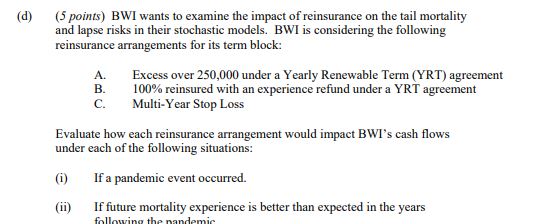
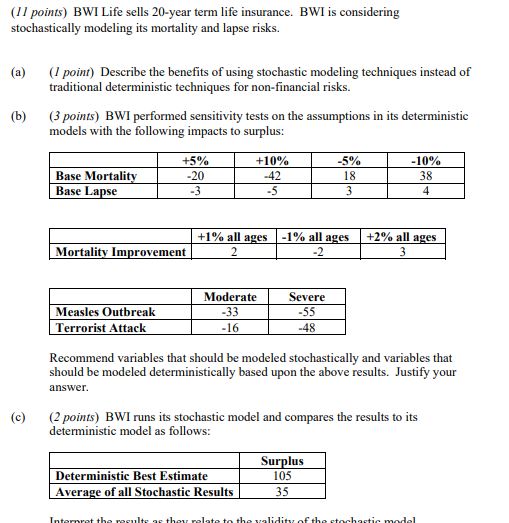
(d) (5 points) BWI wants to examine the impact of reinsurance on the tail mortality and lapse risks in their stochastic models. BWI is considering the following reinsurance arrangements for its term block: A. Excess over 250,000 under a Yearly Renewable Term (YRT) agreement B. 100% reinsured with an experience refund under a YRT agreement C. Multi-Year Stop Loss Evaluate how each reinsurance arrangement would impact BWI's cash flows under each of the following situations: (i) If a pandemic event occurred. (ii) If future mortality experience is better than expected in the years following the pandemic(II points) BWI Life sells 20-year term life insurance. BWI is considering stochastically modeling its mortality and lapse risks. (a) (/ point) Describe the benefits of using stochastic modeling techniques instead of traditional deterministic techniques for non-financial risks. (b) (3 points) BWI performed sensitivity tests on the assumptions in its deterministic models with the following impacts to surplus: +5% +10% -5% -10% Base Mortality 20 -42 18 38 Base Lapse -3 -5 3 4 +1% all ages -1% all ages +2% all ages Mortality Improvement 2 -2 3 Moderate Severe Measles Outbreak -33 55 Terrorist Attack -16 -48 Recommend variables that should be modeled stochastically and variables that should be modeled deterministically based upon the above results. Justify your answer. (c) (2 points) BWI runs its stochastic model and compares the results to its deterministic model as follows: Surplus Deterministic Best Estimate 105 Average of all Stochastic Results 35
Step by Step Solution
There are 3 Steps involved in it

Get step-by-step solutions from verified subject matter experts
 Study Help