







Question: do 13 show work SEC. 24.5 Random Variables. Probability Distributions 1029 findings, arranged in logical order and illustrated with numeric examples. 14. TEAM PROJECT. Permutations,
do 13 show work
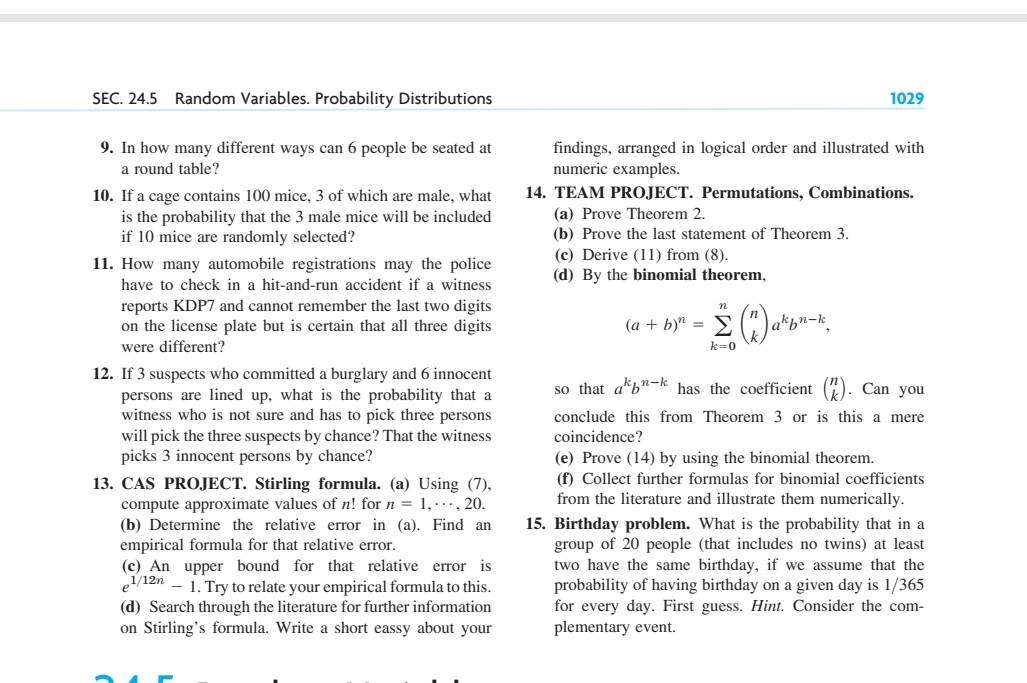
SEC. 24.5 Random Variables. Probability Distributions 1029 findings, arranged in logical order and illustrated with numeric examples. 14. TEAM PROJECT. Permutations, Combinations. (a) Prove Theorem 2. (b) Prove the last statement of Theorem 3. (c) Derive (11) from (8). (d) By the binomial theorem, 22 akpn-k (a + b)" = k=0 9. In how many different ways can 6 people be seated at a round table? 10. If a cage contains 100 mice, 3 of which are male, what is the probability that the 3 male mice will be included if 10 mice are randomly selected? 11. How many automobile registrations may the police have to check in a hit-and-run accident if a witness reports KDP7 and cannot remember the last two digits on the license plate but is certain that all three digits were different? 12. If 3 suspects who committed a burglary and 6 innocent persons are lined up, what is the probability that a witness who is not sure and has to pick three persons will pick the three suspects by chance? That the witness picks 3 innocent persons by chance? 13. CAS PROJECT. Stirling formula. (a) Using (7), compute approximate values of n! for n = 1,..., 20. (b) Determine the relative error in (a). Find an empirical formula for that relative error. (c) An upper bound for that relative error is - 1. Try to relate your empirical formula to this. (d) Search through the literature for further information on Stirling's formula. Write a short eassy about your so that akbn-k has the coefficient (K). Can you conclude this from Theorem 3 or is this a mere coincidence? (e) Prove (14) by using the binomial theorem. (f) Collect further formulas for binomial coefficients from the literature and illustrate them numerically. 15. Birthday problem. What is the probability that in a group of 20 people that includes no twins) at least two have the same birthday, if we assume that the probability of having birthday on a given day is 1/365 for every day. First guess. Hint. Consider the com- plementary event. 1/125 SEC. 24.5 Random Variables. Probability Distributions 1029 findings, arranged in logical order and illustrated with numeric examples. 14. TEAM PROJECT. Permutations, Combinations. (a) Prove Theorem 2. (b) Prove the last statement of Theorem 3. (c) Derive (11) from (8). (d) By the binomial theorem, 22 akpn-k (a + b)" = k=0 9. In how many different ways can 6 people be seated at a round table? 10. If a cage contains 100 mice, 3 of which are male, what is the probability that the 3 male mice will be included if 10 mice are randomly selected? 11. How many automobile registrations may the police have to check in a hit-and-run accident if a witness reports KDP7 and cannot remember the last two digits on the license plate but is certain that all three digits were different? 12. If 3 suspects who committed a burglary and 6 innocent persons are lined up, what is the probability that a witness who is not sure and has to pick three persons will pick the three suspects by chance? That the witness picks 3 innocent persons by chance? 13. CAS PROJECT. Stirling formula. (a) Using (7), compute approximate values of n! for n = 1,..., 20. (b) Determine the relative error in (a). Find an empirical formula for that relative error. (c) An upper bound for that relative error is - 1. Try to relate your empirical formula to this. (d) Search through the literature for further information on Stirling's formula. Write a short eassy about your so that akbn-k has the coefficient (K). Can you conclude this from Theorem 3 or is this a mere coincidence? (e) Prove (14) by using the binomial theorem. (f) Collect further formulas for binomial coefficients from the literature and illustrate them numerically. 15. Birthday problem. What is the probability that in a group of 20 people that includes no twins) at least two have the same birthday, if we assume that the probability of having birthday on a given day is 1/365 for every day. First guess. Hint. Consider the com- plementary event. 1/125
Step by Step Solution
There are 3 Steps involved in it

Get step-by-step solutions from verified subject matter experts
 Study Help