







Question: do 2 questions Case Study 5.1: Wiltshire Distribution Transformers Sid Beckett, the Managing Director of Wiltshire Distribution Transformers (WDT), had concentrated on a new generation
do 2 questions
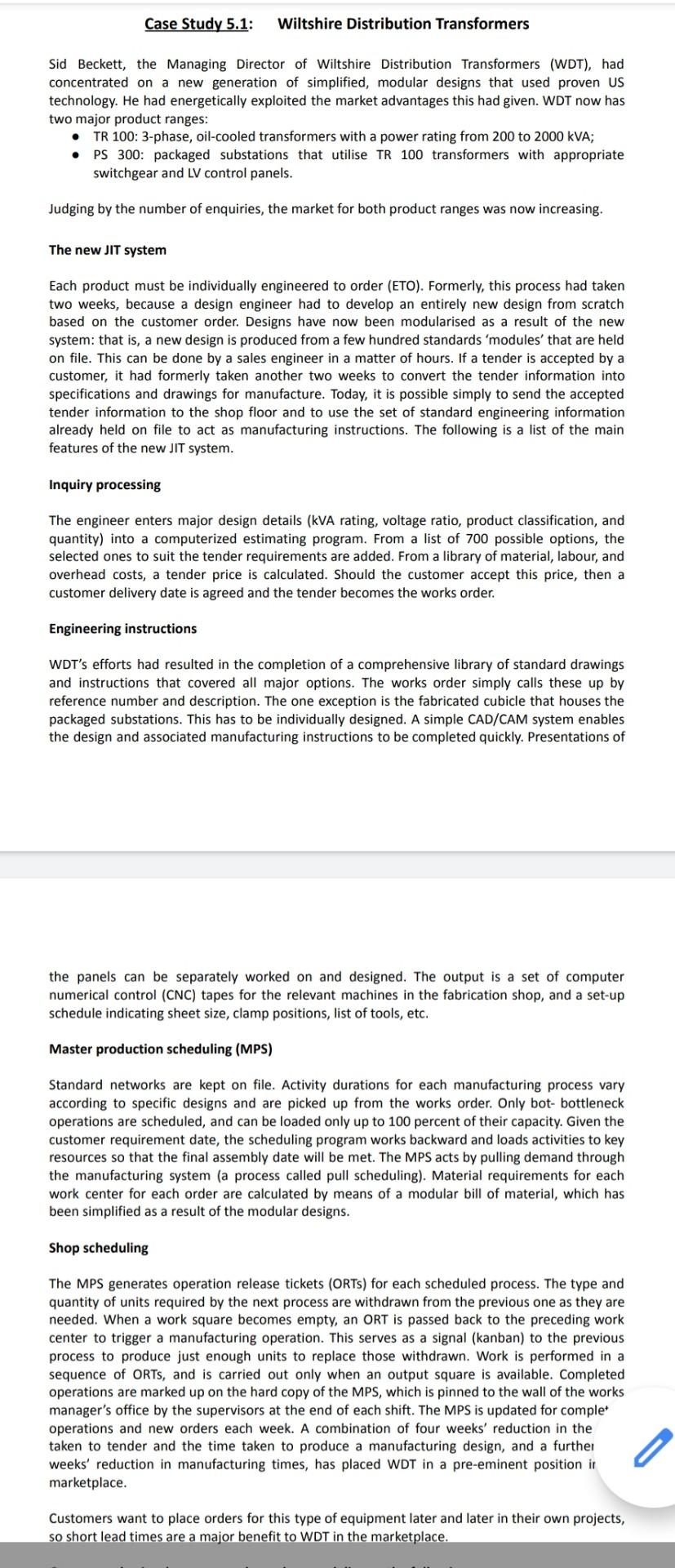
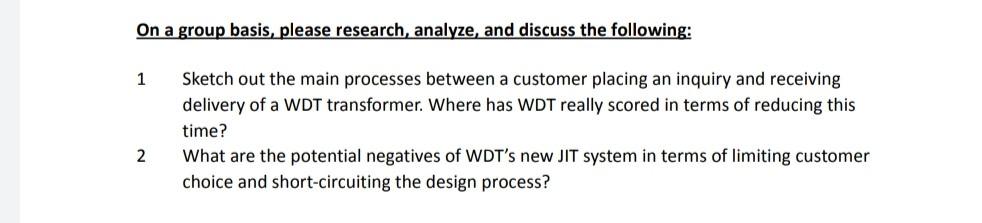
Case Study 5.1: Wiltshire Distribution Transformers Sid Beckett, the Managing Director of Wiltshire Distribution Transformers (WDT), had concentrated on a new generation of simplified, modular designs that used proven US technology. He had energetically exploited the market advantages this had given. WDT now has two major product ranges: TR 100: 3-phase, oil-cooled transformers with a power rating from 200 to 2000 KVA; PS 300: packaged substations that utilise TR 100 transformers with appropriate switchgear and LV control panels. Judging by the number of enquiries, the market for both product ranges was now increasing. The new JIT system Each product must be individually engineered to order (ETO). Formerly, this process had taken two weeks, because a design engineer had to develop an entirely new design from scratch based on the customer order. Designs have now been modularised as a result of the new system: that is, a new design is produced from a few hundred standards 'modules' that are held on file. This can be done by a sales engineer in a matter of hours. If a tender is accepted by a customer, it had formerly taken another two weeks to convert the tender information into specifications and drawings for manufacture. Today, it is possible simply to send the accepted tender information to the shop floor and to use the set of standard engineering information already held on file to act as manufacturing instructions. The following is a list of the main features of the new JIT system. Inquiry processing The engineer enters major design details (kVA rating, voltage ratio, product classification, and quantity) into a computerized estimating program. From a list of 700 possible options, the selected ones to suit the tender requirements are added. From a library of material, labour, and overhead costs, a tender price is calculated. Should the customer accept this price, then a customer delivery date is agreed and the tender becomes the works order. Engineering instructions WDT's efforts had resulted in the completion of a comprehensive library of standard drawings and instructions that covered all major options. The works order simply calls these up by reference number and description. The one exception is the fabricated cubicle that houses the packaged substations. This has to be individually designed. A simple CAD/CAM system enables the design and associated manufacturing instructions to be completed quickly. Presentations of the panels can be separately worked on and designed. The output is a set of computer numerical control (CNC) tapes for the relevant machines in the fabrication shop, and a set-up schedule indicating sheet size, clamp positions, list of tools, etc. Master production scheduling (MPS) Standard networks are kept on file. Activity durations for each manufacturing process vary according to specific designs and are picked up from the works order. Only bot- bottleneck operations are scheduled, and can be loaded only up to 100 percent of their capacity. Given the customer requirement date, the scheduling program works backward and loads activities to key resources so that the final assembly date will be met. The MPS acts by pulling demand through the manufacturing system (a process called pull scheduling). Material requirements for each work center for each order are calculated by means of a modular bill of material, which has been simplified as a result of the modular designs. Shop scheduling The MPS generates operation release tickets (ORTS) for each scheduled process. The type and quantity of units required by the next process are withdrawn from the previous one as they are needed. When a work square becomes empty, an ORT is passed back to the preceding work center to trigger a manufacturing operation. This serves as a signal (kanban) to the previous process to produce just enough units to replace those withdrawn. Work is performed in a sequence of ORTS, and is carried out only when an output square is available. Completed operations are marked up on the hard copy of the MPS, which is pinned to the wall of the works manager's office by the supervisors at the end of each shift. The MPS is updated for comple* operations and new orders each week. A combination of four weeks' reduction in the taken to tender and the time taken to produce a manufacturing design, and a further weeks' reduction in manufacturing times, has placed WDT in a pre-eminent position in marketplace. Customers want to place orders for this type of equipment later and later in their own projects, so short lead times are a major benefit to WDT in the marketplace. On a group basis, please research, analyze, and discuss the following: 1 2 Sketch out the main processes between a customer placing an inquiry and receiving delivery of a WDT transformer. Where has WDT really scored in terms of reducing this time? What are the potential negatives of WDT's new JIT system in terms of limiting customer choice and short-circuiting the design processStep by Step Solution
There are 3 Steps involved in it
1 Expert Approved Answer
Step: 1 Unlock

Question Has Been Solved by an Expert!
Get step-by-step solutions from verified subject matter experts
Step: 2 Unlock
Step: 3 Unlock
 Study Help