



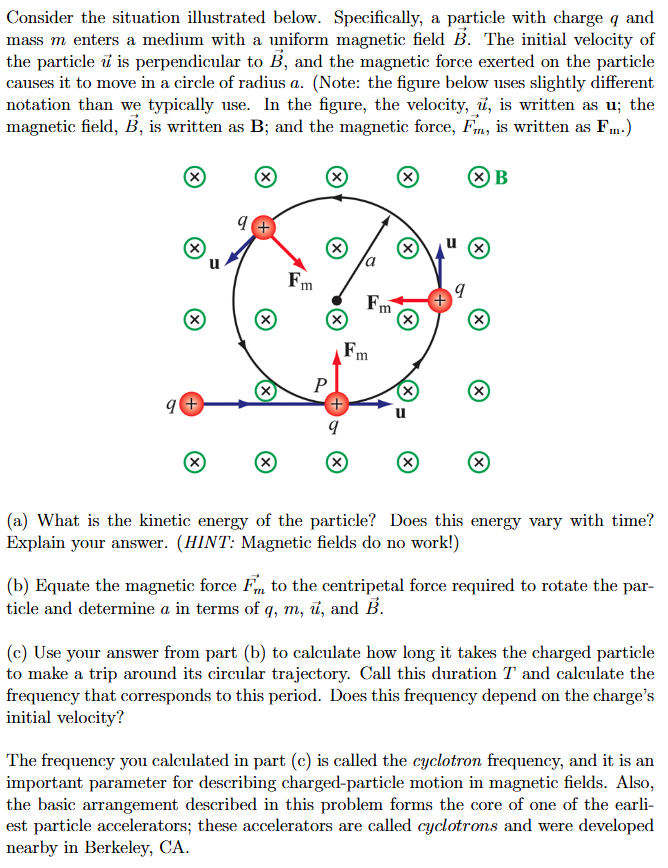
Question: Do all parts Consider the situation illustrated below. Specifically, a particle with charge ( q ) and mass ( m )
Do all parts
Consider the situation illustrated below. Specifically, a particle with charge q and mass m enters a medium with a uniform magnetic field vecB The initial velocity of the particle vecu is perpendicular to vecB and the magnetic force exerted on the particle causes it to move in a circle of radius a Note: the figure below uses slightly different notation than we typically use. In the figure, the velocity, vecu is written as mathbfu; the magnetic field, vecB is written as mathbfB; and the magnetic force, vecFm is written as mathbfFmathrmm
a What is the kinetic energy of the particle? Does this energy vary with time? Explain your answer. HINT: Magnetic fields do no work!
b Equate the magnetic force overrightarrowFm to the centripetal force required to rotate the particle and determine a in terms of q mvecu and vecB
c Use your answer from part b to calculate how long it takes the charged particle to make a trip around its circular trajectory. Call this duration T and calculate the frequency that corresponds to this period. Does this frequency depend on the charge's initial velocity?
The frequency you calculated in part c is called the cyclotron frequency, and it is an important parameter for describing chargedparticle motion in magnetic fields. Also, the basic arrangement described in this problem forms the core of one of the earliest particle accelerators; these accelerators are called cyclotrons and were developed nearby in Berkeley, CA
Step by Step Solution
There are 3 Steps involved in it
1 Expert Approved Answer
Step: 1 Unlock

Question Has Been Solved by an Expert!
Get step-by-step solutions from verified subject matter experts
Step: 2 Unlock
Step: 3 Unlock