







Question: Do all parts please In class, we saw a compression algorithm called WindowEncode that was used to encode fixed density binary strings of length n
Do all parts please 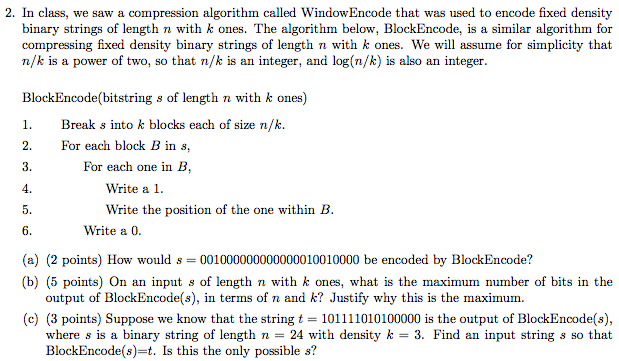
In class, we saw a compression algorithm called WindowEncode that was used to encode fixed density binary strings of length n with k ones. The algorithm below, BlockEncode, is a similar algorithm for compressing fixed density binary strings of length n with k ones. We will assume for simplicity that n/k is a power of two, so that n/k is an integer, and log(n/k) is also an integer. Block Encode (bitstring s of length n with k ones) Break s into k blocks each of size n/k. For each block B in s, For each one in B, Write a 1 Write the position of the one within B. Write a 0. How would s = 001000000000000010010000 be encoded by BlockEncode? On an input s of length n with k ones, what is the maximum number of bits in the output of BlockEncode(s), in terms of n and k? Justify why this is the maximum. Suppose we know that the string t = 101111010100000 is the output of BlockEncode(s), where s is a binary string of length n = 24 with density k = 3. Find an input string s so that Block Encode(s) = t. Is this the only possible s
Step by Step Solution
There are 3 Steps involved in it

Get step-by-step solutions from verified subject matter experts
 Study Help