Question: do do question 1 Internet Sales Tax: A 50-State Guide to State Laws On June 21, 2018, the United States Supreme Court fundamentally changed the
do
do question 1 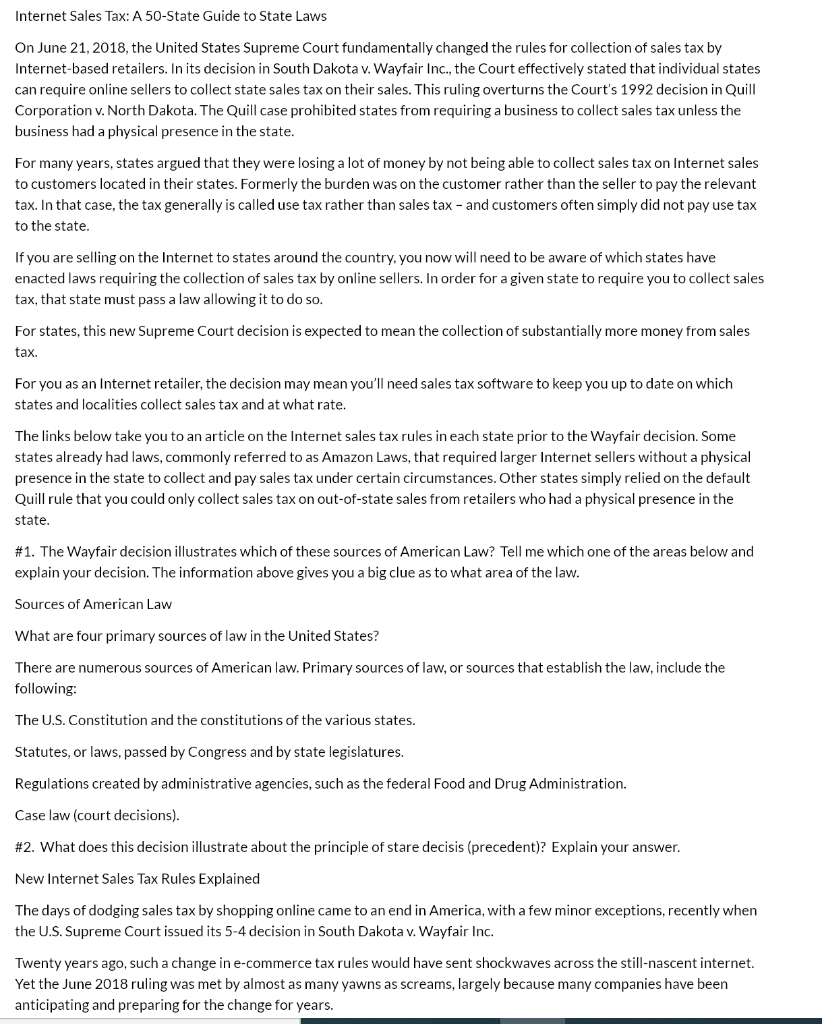
Internet Sales Tax: A 50-State Guide to State Laws On June 21, 2018, the United States Supreme Court fundamentally changed the rules for collection of sales tax by Internet-based retailers. In its decision in South Dakota v. Wayfair Inc., the Court effectively stated that individual states can require online sellers to collect state sales tax on their sales. This ruling overturns the Court's 1992 decision in Quill Corporation v. North Dakota. The Quill case prohibited states from requiring a business to collect sales tax unless the business had a physical presence in the state. For many years, states argued that they were losing a lot of money by not being able to collect sales tax on Internet sales to customers located in their states. Formerly the burden was on the customer rather than the seller to pay the relevant tax. In that case, the tax generally is called use tax rather than sales tax - and customers often simply did not pay use tax to the state. If you are selling on the Internet to states around the country, you now will need to be aware of which states have enacted laws requiring the collection of sales tax by online sellers. In order for a given state to require you to collect sales tax, that state must pass a law allowing it to do so. For states, this new Supreme Court decision is expected to mean the collection of substantially more money from sales tax. For you as an Internet retailer, the decision may mean you'll need sales tax software to keep you up to date on which states and localities collect sales tax and at what rate. The links below take you to an article on the Internet sales tax rules in each state prior to the Wayfair decision. Some states already had laws, commonly referred to as Amazon Laws, that required larger Internet sellers without a physical presence in the state to collect and pay sales tax under certain circumstances. Other states simply relied on the default Quill rule that you could only collect sales tax on out-of-state sales from retailers who had a physical presence in the state. #1. The Wayfair decision illustrates which of these sources of American Law? Tell me which one of the areas below and explain your decision. The information above gives you a big clue as to what area of the law. Sources of American Law What are four primary sources of law in the United States? There are numerous sources of American law. Primary sources of law, or sources that establish the law, include the following: The U.S. Constitution and the constitutions of the various states. Statutes, or laws, passed by Congress and by state legislatures. Regulations created by administrative agencies, such as the federal Food and Drug Administration. Case law (court decisions). #2. What does this decision illustrate about the principle of stare decisis (precedent)? Explain your answer. New Internet Sales Tax Rules Explained The days of dodging sales tax by shopping online came to an end in America, with a few minor exceptions, recently when the U.S. Supreme Court issued its 5-4 decision in South Dakota v. Wayfair Inc. Twenty years ago, such a change in e-commerce tax rules would have sent shockwaves across the still-nascent internet. Yet the June 2018 ruling was met by almost as many yawns as screams, largely because many companies have been anticipating and preparing for the change for years









 Study Help