







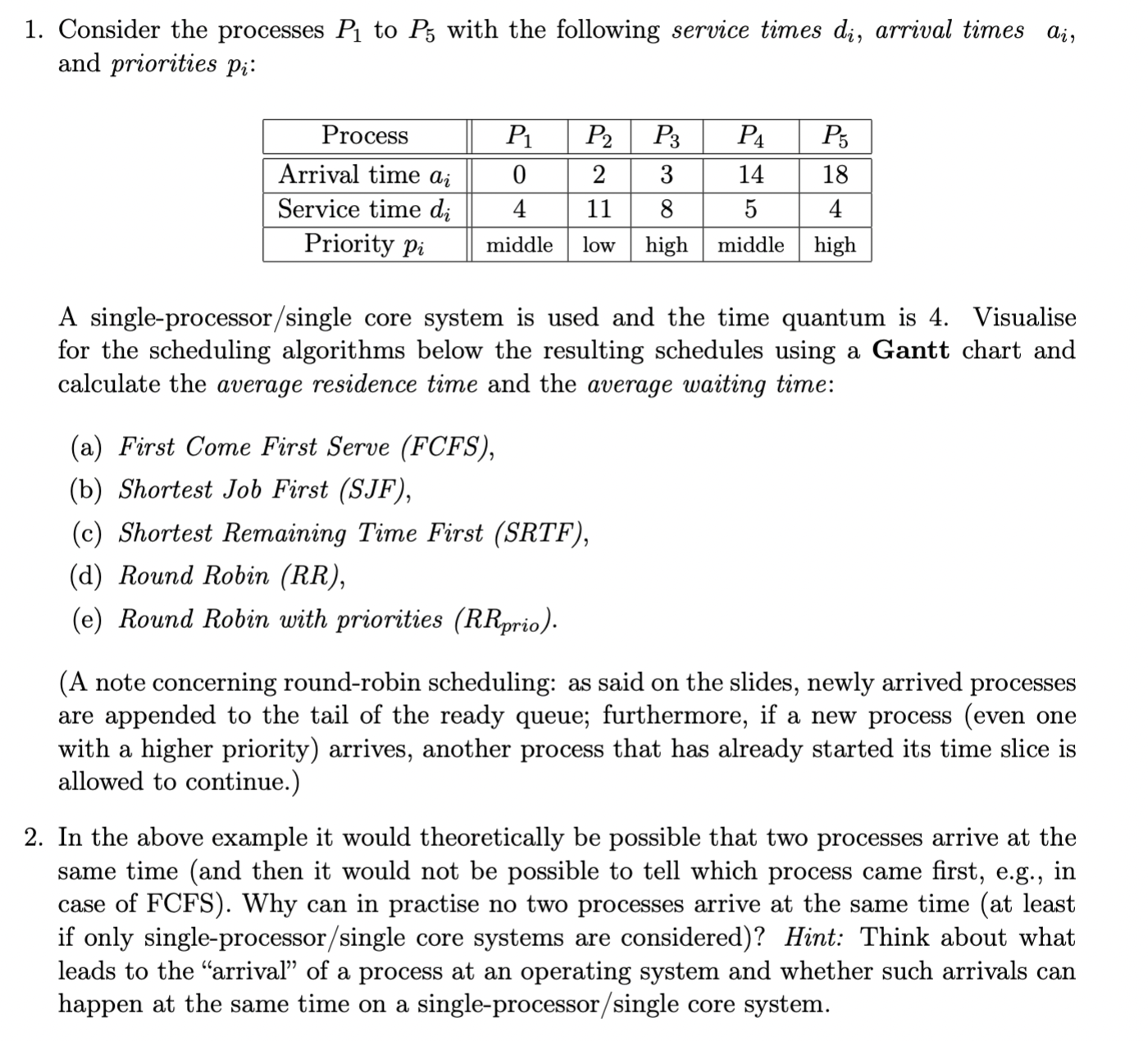
Question: Do exercise 2 not exercise 1 : Consider the processes P 1 to P 5 with the following service times d i , arrival times
Do exercise not exercise : Consider the processes to with the following service times arrival times
and priorities :
A singleprocessorsingle core system is used and the time quantum is Visualise
for the scheduling algorithms below the resulting schedules using a Gantt chart and
calculate the average residence time and the average waiting time:
a First Come First Serve FCFS
b Shortest Job First SJF
c Shortest Remaining Time First SRTF
d Round Robin RR
e Round Robin with priorities
A note concerning roundrobin scheduling: as said on the slides, newly arrived processes
are appended to the tail of the ready queue; furthermore, if a new process even one
with a higher priority arrives, another process that has already started its time slice is
allowed to continue.
In the above example it would theoretically be possible that two processes arrive at the
same time and then it would not be possible to tell which process came first, eg in
case of FCFS Why can in practise no two processes arrive at the same time at least
if only singleprocessorsingle core systems are considered Hint: Think about what
leads to the "arrival" of a process at an operating system and whether such arrivals can
happen at the same time on a singleprocessorsingle core systemlease
Step by Step Solution
There are 3 Steps involved in it
1 Expert Approved Answer
Step: 1 Unlock

Question Has Been Solved by an Expert!
Get step-by-step solutions from verified subject matter experts
Step: 2 Unlock
Step: 3 Unlock
 Study Help