







Question: Do it according to the example started. do this one. Thank you! Use conditional proof and the eighteen rules of inference to derive the conclusions

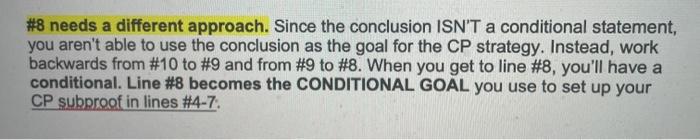 Do it according to the example started.
 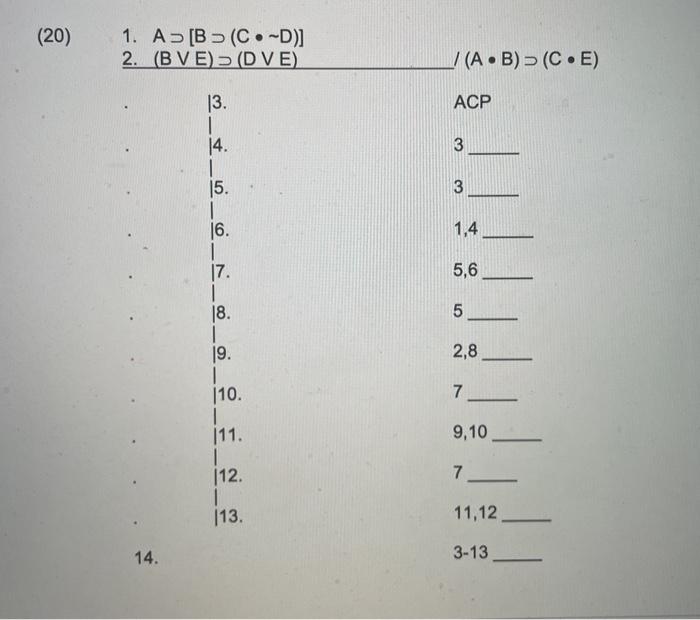 do this one. Thank you!
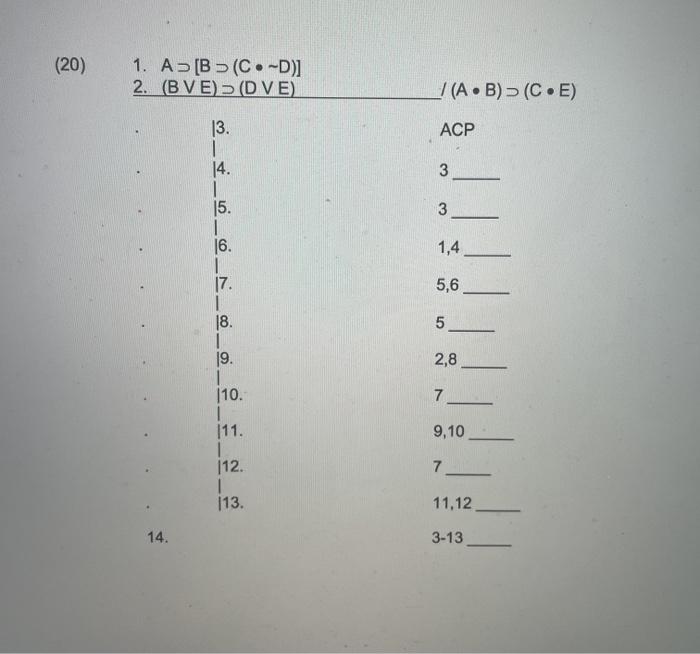 Use conditional proof and the eighteen rules of inference to derive the conclusions of the following symbolized arguments. Having done so, attempt to derive the conclutions without using conditional proof.
 sont dom Thema 20 tror of the time the one 30 Cound your demon) #8 needs a different approach. Since the conclusion ISN'T a conditional statement, you aren't able to use the conclusion as the goal for the CP strategy. Instead, work backwards from #10 to #9 and from #9 to #8. When you get to line #8, you'll have a conditional. Line #8 becomes the CONDITIONAL GOAL you use to set up your CP subproof in lines #4-7. (20) 1. A[B (C.-D)] 2. (BVE) (DVE) I(AB) ( CE) 13. ACP 14. 3 15. 3 16. 1,4 17. 5,6 18. LO 19. 2,8 110. 7 111. 9,10 112. 7 113. 11,12 14. 3-13 (20) 1. A[B > (C.-D)] 2. (BVE) - (DVE) /( AB) = ( CE) ACP 13. 1 14. 3 3 15. 1 16. 1,4 5,6 17. I 18. 1 5 19. 2,8 110. 7 111. 9,10 112. 7 113. 11,12 14. 3-13 sont dom Thema 20 tror of the time the one 30 Cound your demon) #8 needs a different approach. Since the conclusion ISN'T a conditional statement, you aren't able to use the conclusion as the goal for the CP strategy. Instead, work backwards from #10 to #9 and from #9 to #8. When you get to line #8, you'll have a conditional. Line #8 becomes the CONDITIONAL GOAL you use to set up your CP subproof in lines #4-7. (20) 1. A[B (C.-D)] 2. (BVE) (DVE) I(AB) ( CE) 13. ACP 14. 3 15. 3 16. 1,4 17. 5,6 18. LO 19. 2,8 110. 7 111. 9,10 112. 7 113. 11,12 14. 3-13 (20) 1. A[B > (C.-D)] 2. (BVE) - (DVE) /( AB) = ( CE) ACP 13. 1 14. 3 3 15. 1 16. 1,4 5,6 17. I 18. 1 5 19. 2,8 110. 7 111. 9,10 112. 7 113. 11,12 14. 3-13
Step by Step Solution
There are 3 Steps involved in it

Get step-by-step solutions from verified subject matter experts
 Study Help