







Question: #Do it accurately in C Program for both tasks (part A & part b) #Make sure the coding could run in C compiler # I
#Do it accurately in C Program for both tasks (part A & part b)
#Make sure the coding could run in C compiler
# I will upvote for the correct coding given
# please do it accurately according to the question given.
USE " 191022310" AS THE SEED GENERATOR - DO IT IN C PROGRAM WITH NO ERRORS BASED ON THE QUESTION GIVEN
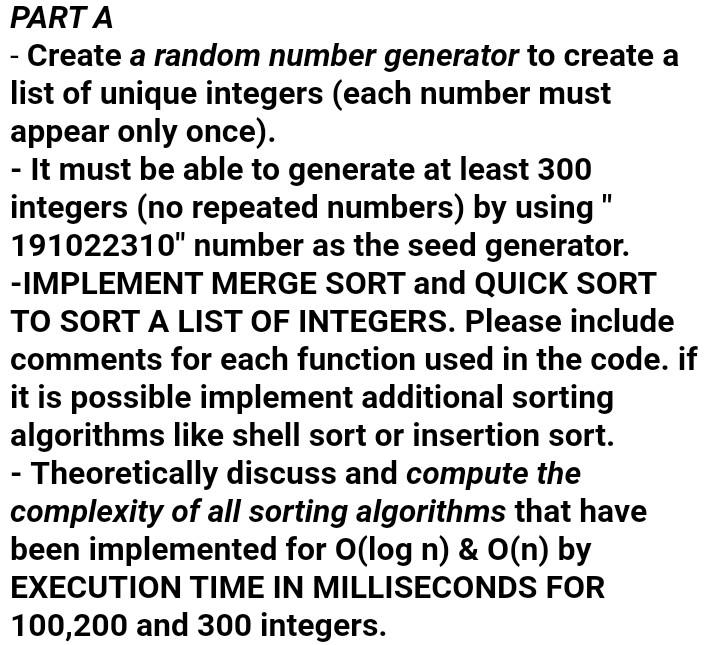
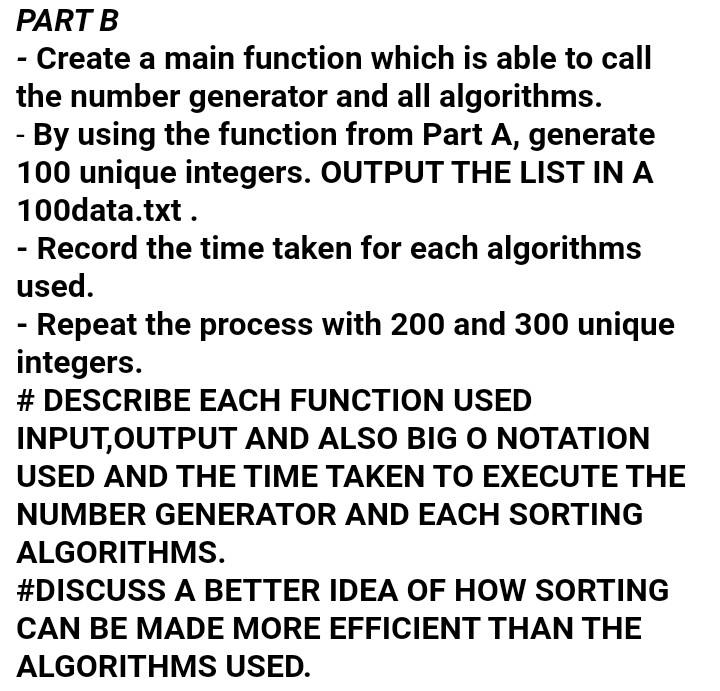
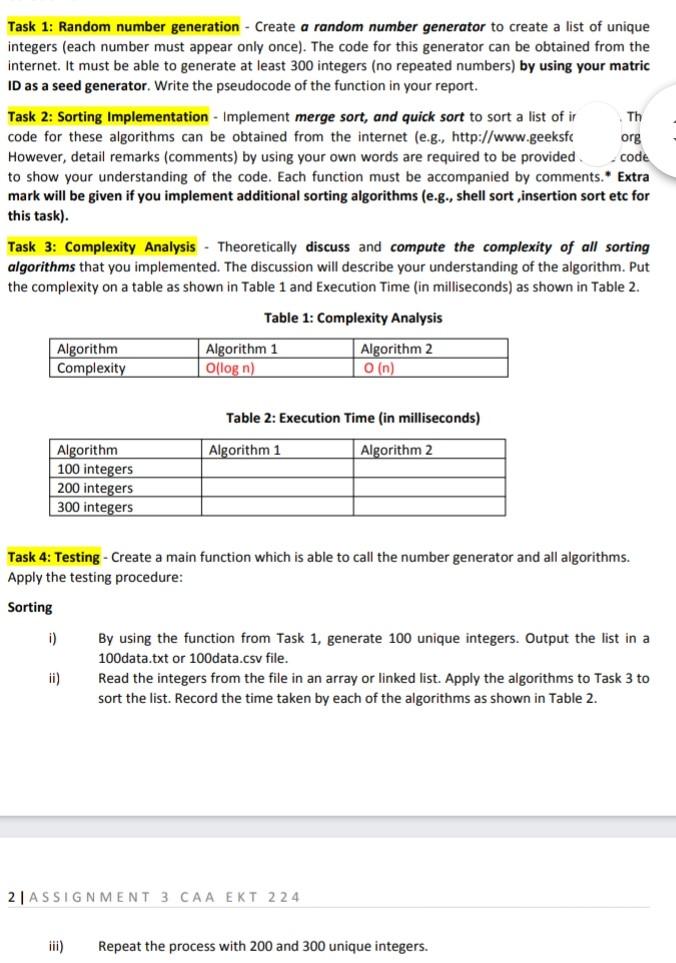
PARTA Create a random number generator to create a list of unique integers (each number must appear only once). It must be able to generate at least 300 integers (no repeated numbers) by using 191022310" number as the seed generator. -IMPLEMENT MERGE SORT and QUICK SORT TO SORT A LIST OF INTEGERS. Please include comments for each function used in the code. if it is possible implement additional sorting algorithms like shell sort or insertion sort. - Theoretically discuss and compute the complexity of all sorting algorithms that have been implemented for O(log n) & O(n) by EXECUTION TIME IN MILLISECONDS FOR 100,200 and 300 integers. - PART B Create a main function which is able to call the number generator and all algorithms. - By using the function from Part A, generate 100 unique integers. OUTPUT THE LIST IN A 100data.txt. Record the time taken for each algorithms used. Repeat the process with 200 and 300 unique integers. # DESCRIBE EACH FUNCTION USED INPUT,OUTPUT AND ALSO BIG O NOTATION USED AND THE TIME TAKEN TO EXECUTE THE NUMBER GENERATOR AND EACH SORTING ALGORITHMS. #DISCUSS A BETTER IDEA OF HOW SORTING CAN BE MADE MORE EFFICIENT THAN THE ALGORITHMS USED. Task 1: Random number generation - Create a random number generator to create a list of unique integers (each number must appear only once). The code for this generator can be obtained from the internet. It must be able to generate at least 300 integers (no repeated numbers) by using your matric ID as a seed generator. Write the pseudocode of the function in your report. Task 2: Sorting Implementation - Implement merge sort, and quick sort to sort a list of ir Th code for these algorithms can be obtained from the internet (e.g., http://www.geeksfe org However, detail remarks (comments) by using your own words are required to be provided code to show your understanding of the code. Each function must be accompanied by comments. Extra mark will be given if you implement additional sorting algorithms (e.g., shell sort ,insertion sort etc for this task). Task 3: Complexity Analysis. Theoretically discuss and compute the complexity of all sorting algorithms that you implemented. The discussion will describe your understanding of the algorithm. Put the complexity on a table as shown in Table 1 and Execution Time (in milliseconds) as shown in Table 2. Table 1: Complexity Analysis Algorithm Complexity Algorithm 1 Ollog n) Algorithm 2 On) Table 2: Execution Time (in milliseconds) Algorithm 1 Algorithm 2 Algorithm 100 integers 200 integers 300 integers Task 4: Testing - Create a main function which is able to call the number generator and all algorithms. Apply the testing procedure: Sorting i) By using the function from Task 1, generate 100 unique integers. Output the list in a 100data.txt or 100data.csv file. Read the integers from the file in an array or linked list. Apply the algorithms to Task 3 to sort the list. Record the time taken by each of the algorithms as shown in Table 2. ii) 2 ASSIGNMENT 3 CAA EKT 224 Repeat the process with 200 and 300 unique integers
Step by Step Solution
There are 3 Steps involved in it

Get step-by-step solutions from verified subject matter experts
 Study Help