







Question: Do not copy and paste from google. Write on your own language. Sample introduction part of a report on the topic Impact of K-pop and
Do not copy and paste from google. Write on your own language.
Sample introduction part of a report on the topic "Impact of K-pop and K-drama culture in our society" is given below: 1.0 Chapter 1: Introduction 1.1 Background 1.1.1 Online Series on OTT Platform People's main source of entertainment in the 1990s was watching movies in theaters and on VHS tapes. However, with the introduction of CD and DVD discs, floppy discs, pen drives, and the internet, technology has changed dramatically. The rate of technological change was so rapid that it was difficult for people to keep up. Watching or telling stories is a basic instinctual human drive, and with these rapid technological changes, our generation has adopted a global habit, one of which is to watch stories on small screens such as television or smartphones. 1.1.2 Over-the-top Media A media service offered directly to viewers via the Internet is known as an over-the-top (OTT) media service. The traditional controllers and distributors of such content, such as cable, broadcast, and satellite television platforms, are bypassed by OTT. It's also been used to refer to no-carrier cellphones, in which all communications are charged as data to avoid monopolistic competition, and apps for phones that transmit data in this manner, including both call replacement and software updates. Subscription-based video-on-demand (SVoD) services that provide access to film and television content are most commonly associated with the term (including existing series acquired from other producers, as well as original content produced specifically for the service). The Canadian Radio-Television and Telecommunications Commission (CRTC), Canada's telecom regulator, stated in 2011 that "the defining feature of what have been termed 'over-the-top' services is Internet access to programming independent of a facility or network dedicated to its delivery (via, for example, cable or satellite)". 10 1.1.3 Online series on OTT at present in Bangladesh (pandemic) The COVID-19 pandemic is altering our media and entertainment consumption habits (M&E). Our social lives have moved online as people have become more confined to their homes, and entertainment consumption has increased, particularly in the at-home segments of television, online gaming, and over-the-top services (OTT). On the other hand, as physical distancing norms and lockdowns are enforced, movie theaters, theme parks, museums, and other external consumption models suffer.The pandemic moved the development of the system which has been in its undeveloped stage in Bangladesh. Inside a limited ability to focus time, various stages have arisen making a consistently developing powerful situation of OTT in the nearby market. Bioscope by Grameenphone, Robi TV+ by Robi, and Banglaflix by Banglalink are some of the most popular streaming platforms. Local independent platforms such as Bongo BD and Cinematic exist in addition to platforms run by the major telecom operators. These platforms, like Netflix or Hoichoi, host mostly local and some dubbed international movies and shows from third parties, as well as a large library of exclusive content. The similarities, however, end there. Netflix began offering services in Bangladesh in 2016. It hasn't looked back since then. Currently, there are around 200,000 active subscribers in the country. Netflix earns around $21.6 million from Bangladeshi subscribers, according to data from the Bangladesh Telecommunication Regulatory Commission (BTRC). Spotify, Hulu, Amazon Prime, and Disney Hotstar are some of the other over-the-top (OTT) services available. In Bangladesh, there were two lakh Netflix subscribers in 2019. In the last year, the number has undoubtedly increased. Netflix has profited handsomely from these subscribers without ever investing a penny in the local market. According to the Bangladesh Telecommunications Research Center, there were 103 million internet users in Bangladesh in March 2020, with 95 percent of them using mobile internet. 11 1.2 Objectives The research was based on the following primary objective: To investigate how spending time on OTT media platform during the ongoing pandemic affects the peoples' watching habits and lifestyles. The research also had the following secondary objectives: To observe the difference between watching series on OTT media platform before and after the pandemic. To better understand why people like watching on OTT platforms. 1.3 Research Methodology 1.3.1 Survey To gather data and information, we used a Google Forms survey. Because it was the most efficient way to contact people in a short amount of time, the google form survey was used. It was also practical for the respondents. A couple of questionnaires were included in the survey. The majority of the questions were question-oriented, meaning respondents had to fill out a form with yeso, multiple choice, and checkbox options. There were both open-ended and closedended questions in the survey. The questions focused on how people of all ages felt about watching online series on an OTT platform during the pandemic. There were a total of 15 questions to find out what they thought about this topic. Both male and female participants responded to the google form survey. The survey had 129 responses about the reaction of watching online series on OTT platform in pandemic. 1.3.2 Interview We conducted some interviews via mobile phone in order to collect data and information. We spoke with ten people over the phone, six of whom were female and four of whom were male, to learn their thoughts on the impact of watching online series on OTT platforms during a 12 pandemic. We posed open-ended questions to them. Among these ten people, five females responded positively, claiming that watching online series on the OTT platform during the pandemic helped them relieve tension and anxiety. They will continue to watch online series on OTT platforms because there are so many options, and they can choose their program based on their preferences, which will keep them entertained during their free time.Another 5 people, on the other hand, stated that they are aware of online series on OTT platforms but have no desire to watch them. One female user also stated that she dislikes watching online series on the OTT platform because it is time-consuming and expensive. Those who disagreed with watching online series on OTT platform in pandemic responded that watching series is not useful in relieving them from anxiety as their minds are set with tension of their families health. 1.4 Limitations The survey failed to highlight the people who do not watch series on OTT media platforms. Shortage of time. The report unintentionally consisted mostly of young adults. This report is formed on the basis of the information provided by the respondents.
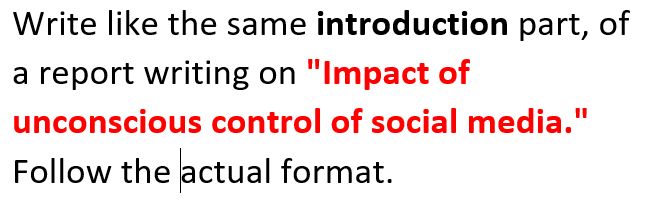
Write like the same introduction part, of a report writing on "Impact of unconscious control of social media." Follow the actual formatStep by Step Solution
There are 3 Steps involved in it

Get step-by-step solutions from verified subject matter experts
 Study Help