







Question: do not copy and paste. there are 3 subquestions. read all Real Choices at Nestl Digital advertising has revolutionized the promotion component of the marketing
do not copy and paste. there are 3 subquestions. read all 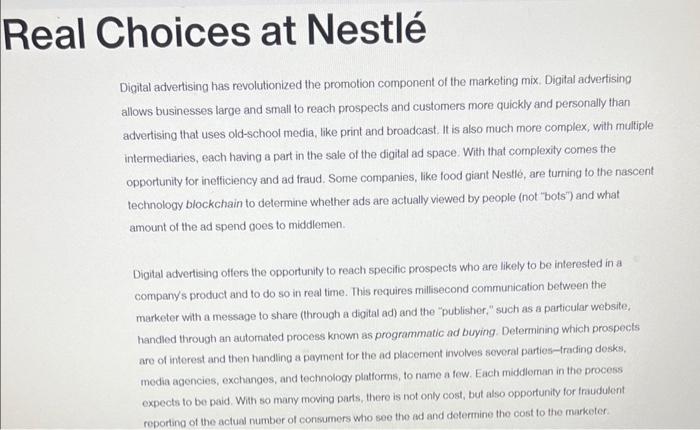
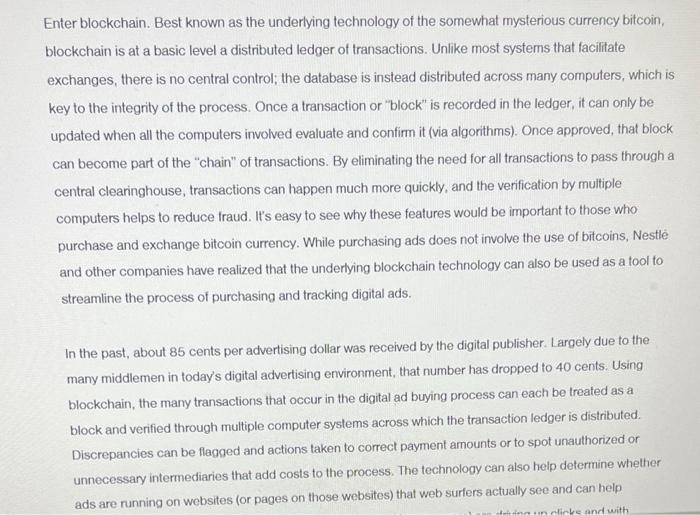
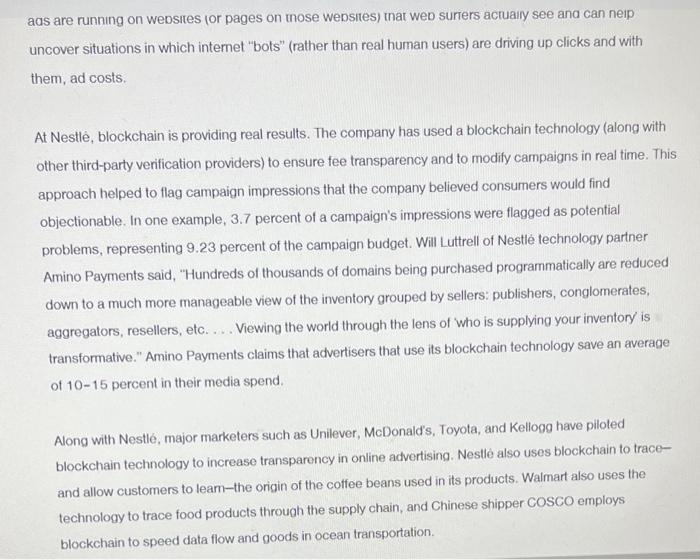
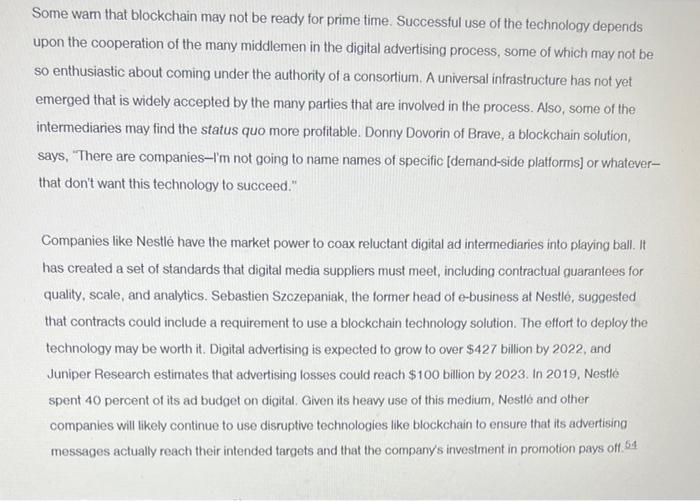
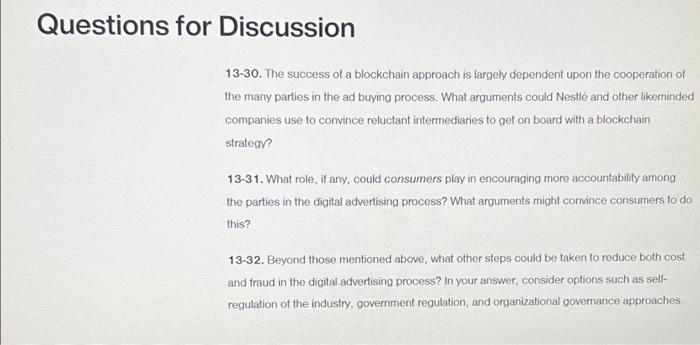
Real Choices at Nestl Digital advertising has revolutionized the promotion component of the marketing mix. Digital advertising allows businesses large and small to reach prospects and customers more quickly and personally than advertising that uses old-school media, like print and broadcast. It is also much more complex, with multiple intermediaries, each having a part in the sale of the digital ad space. With that complexity comes the opportunity for inefficiency and ad fraud. Some companies, like food giant Nestl, are turning to the nascent technology blockchain to determine whether ads are actually viewed by people (not "bots") and what amount of the ad spend goes to middlemen. Digital advertising offers the opportunity to reach specific prospects who are likely to be interested in a company's product and to do so in real time. This requires millisecond communication between the marketer with a message to share (through a digital ad) and the "publisher," such as a particular website, handled through an automated process known as programmatic ad buying. Determining which prospects are of interest and then handling a payment for the ad placement involves several parties-trading desks, media agencies, exchanges, and technology platforms, to name a few. Each middleman in the process expects to be paid. With so many moving parts, there is not only cost, but also opportunity for fraudulent reporting of the actual number of consumers who see the ad and determine the cost to the marketer. Enter blockchain. Best known as the underlying technology of the somewhat mysterious currency bitcoin, blockchain is at a basic level a distributed ledger of transactions. Unlike most systems that facilitate exchanges, there is no central control; the database is instead distributed across many computers, which is key to the integrity of the process. Once a transaction or "block" is recorded in the ledger, it can only be updated when all the computers involved evaluate and confirm it (via algorithms). Once approved, that block can become part of the "chain" of transactions. By eliminating the need for all transactions to pass through a central clearinghouse, transactions can happen much more quickly, and the verification by multiple computers helps to reduce fraud. It's easy to see why these features would be important to those who purchase and exchange bitcoin currency. While purchasing ads does not involve the use of bitcoins, Nestl and other companies have realized that the underlying blockchain technology can also be used as a tool to streamline the process of purchasing and tracking digital ads. In the past, about 85 cents per advertising dollar was received by the digital publisher. Largely due to the many middlemen in today's digital advertising environment, that number has dropped to 40 cents. Using blockchain, the many transactions that occur in the digital ad buying process can each be treated as a block and verified through multiple computer systems across which the transaction ledger is distributed. Discrepancies can be flagged and actions taken to correct payment amounts or to spot unauthorized or unnecessary intermediaries that add costs to the process. The technology can also help determine whether ads are running on websites (or pages on those websites) that web surfers actually see and can help friving un clicks and with aas are running on websites (or pages on those websites) that web surfers actually see and can neip uncover situations in which internet "bots" (rather than real human users) are driving up clicks and with them, ad costs. At Nestl, blockchain is providing real results. The company has used a blockchain technology (along with other third-party verification providers) to ensure fee transparency and to modify campaigns in real time. This approach helped to flag campaign impressions that the company believed consumers would find objectionable. In one example, 3.7 percent of a campaign's impressions were flagged as potential problems, representing 9.23 percent of the campaign budget. Will Luttrell of Nestl technology partner Amino Payments said, "Hundreds of thousands of domains being purchased programmatically are reduced down to a much more manageable view of the inventory grouped by sellers: publishers, conglomerates, aggregators, resellers, etc.... Viewing the world through the lens of who is supplying your inventory is transformative." Amino Payments claims that advertisers that use its blockchain technology save an average of 10-15 percent in their media spend. Along with Nestl, major marketers such as Unilever, McDonald's, Toyota, and Kellogg have piloted blockchain technology to increase transparency in online advertising. Nestl also uses blockchain to trace- and allow customers to leam-the origin of the coffee beans used in its products. Walmart also uses the technology to trace food products through the supply chain, and Chinese shipper COSCO employs blockchain to speed data flow and goods in ocean transportation. Some wam that blockchain may not be ready for prime time. Successful use of the technology depends upon the cooperation of the many middlemen in the digital advertising process, some of which may not be so enthusiastic about coming under the authority of a consortium. A universal infrastructure has not yet emerged that is widely accepted by the many parties that are involved in the process. Also, some of the intermediaries may find the status quo more profitable. Donny Dovorin of Brave, a blockchain solution, says, "There are companies-I'm not going to name names of specific [demand-side platforms] or whatever- that don't want this technology to succeed." Companies like Nestl have the market power to coax reluctant digital ad intermediaries into playing ball. It has created a set of standards that digital media suppliers must meet, including contractual guarantees for quality, scale, and analytics. Sebastien Szczepaniak, the former head of e-business at Nestl, suggested that contracts could include a requirement to use a blockchain technology solution. The effort to deploy the technology may be worth it. Digital advertising is expected to grow to over $427 billion by 2022, and Juniper Research estimates that advertising losses could reach $100 billion by 2023. In 2019, Nestl spent 40 percent of its ad budget on digital. Given its heavy use of this medium, Nestl and other companies will likely continue to use disruptive technologies like blockchain to ensure that its advertising messages actually reach their intended targets and that the company's investment in promotion pays off. 54 Questions for Discussion 13-30. The success of a blockchain approach is largely dependent upon the cooperation of the many parties in the ad buying process. What arguments could Nestle and other likeminded companies use to convince reluctant intermediaries to get on board with a blockchain strategy? 13-31. What role, if any, could consumers play in encouraging more accountability among the parties in the digital advertising process? What arguments might convince consumers to do this? 13-32. Beyond those mentioned above, what other steps could be taken to reduce both cost and fraud in the digital advertising process? In your answer, consider options such as self- regulation of the industry, government regulation, and organizational governance approaches Step by Step Solution
There are 3 Steps involved in it
1 Expert Approved Answer
Step: 1 Unlock

Question Has Been Solved by an Expert!
Get step-by-step solutions from verified subject matter experts
Step: 2 Unlock
Step: 3 Unlock
 Study Help