







Question: DO NOT COPY FROM GOOGLE OR OTHER CHEGG EXPERTS BECAUSE ITS WRONG. USE NOTES ONLY. I REALLY NEED HELP TO DO THIS. Type your answers.
DO NOT COPY FROM GOOGLE OR OTHER CHEGG EXPERTS BECAUSE ITS WRONG. USE NOTES ONLY. I REALLY NEED HELP TO DO THIS. Type your answers.
NOTES:
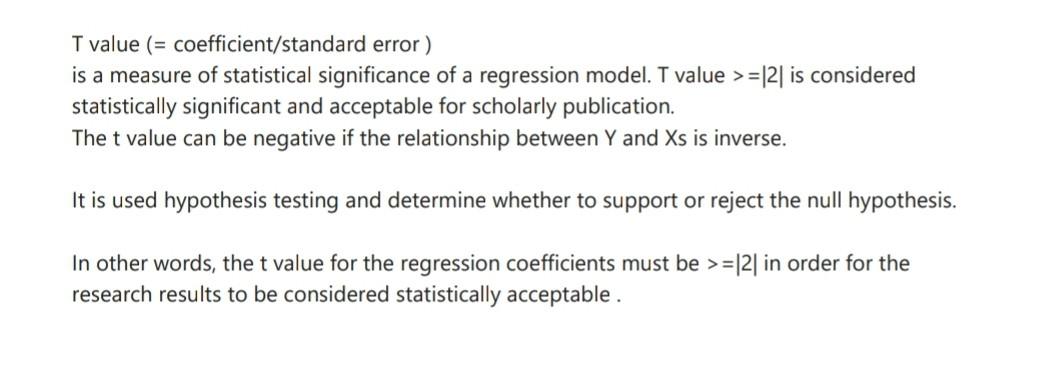
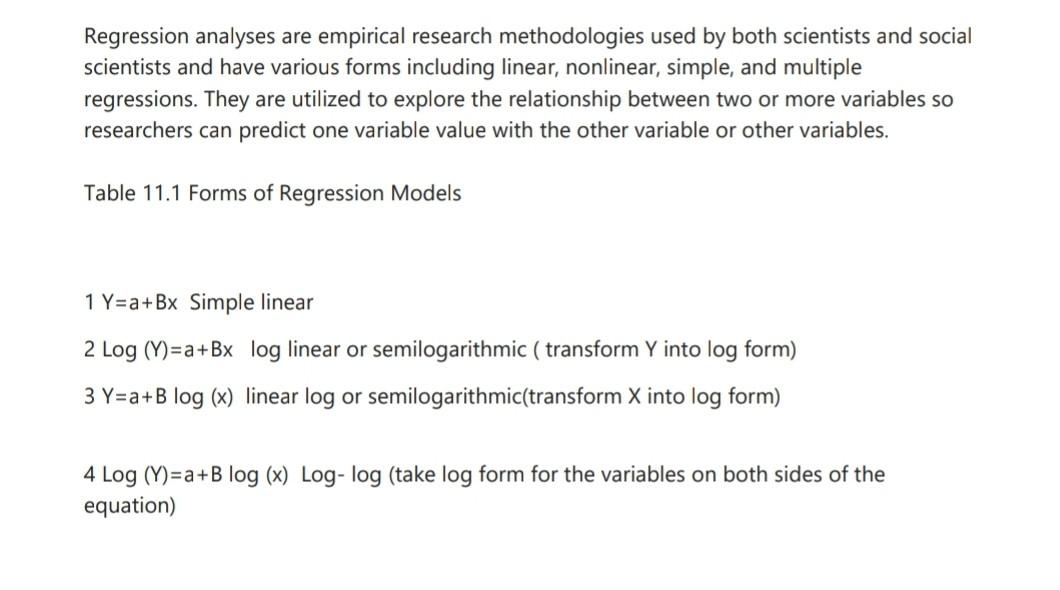
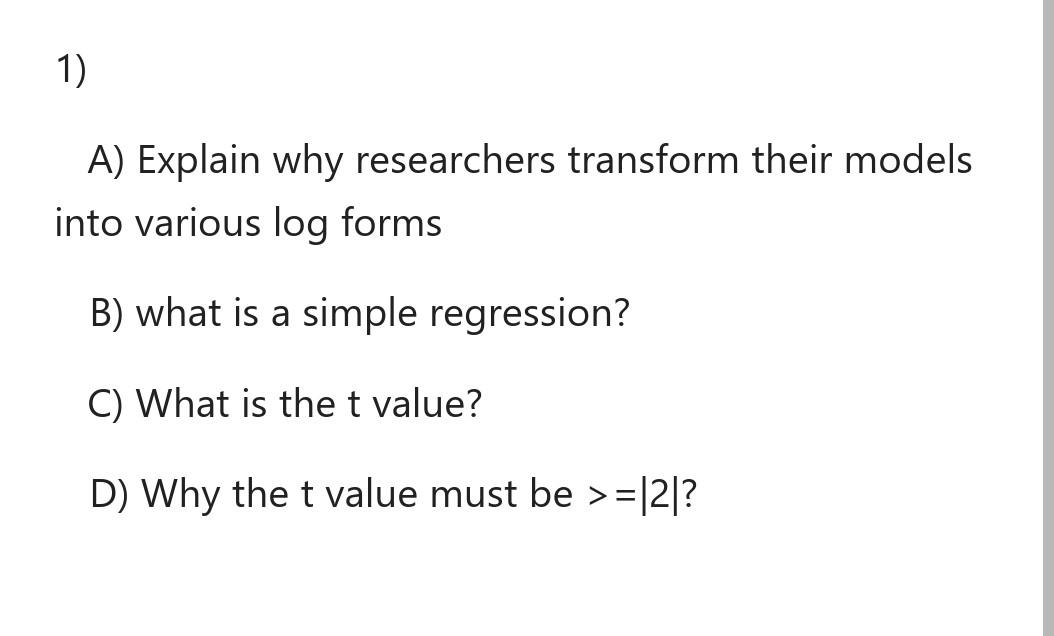
1) A) Explain why researchers transform their models into various log forms B) what is a simple regression? C) What is the t value? D) Why the t value must be >=12]? T value (= coefficient/standard error) is a measure of statistical significance of a regression model. T value >=121 is considered statistically significant and acceptable for scholarly publication. The t value can be negative if the relationship between Y and Xs is inverse. It is used hypothesis testing and determine whether to support or reject the null hypothesis. In other words, the t value for the regression coefficients must be >=12| in order for the research results to be considered statistically acceptable. Regression analyses are empirical research methodologies used by both scientists and social scientists and have various forms including linear, nonlinear, simple, and multiple regressions. They are utilized to explore the relationship between two or more variables so researchers can predict one variable value with the other variable or other variables. Table 11.1 Forms of Regression Models 1 Y=a+Bx Simple linear 2 Log (Y)=a+Bx log linear or semilogarithmic ( transform Y into log form) 3 Y=a+B log (x) linear log or semilogarithmic(transform X into log form) 4 Log (Y)=a+B log (x) Log-log (take log form for the variables on both sides of the equation)
Step by Step Solution
There are 3 Steps involved in it
1 Expert Approved Answer
Step: 1 Unlock

Question Has Been Solved by an Expert!
Get step-by-step solutions from verified subject matter experts
Step: 2 Unlock
Step: 3 Unlock
 Study Help