







Question: DO NOT DO THE MATLAB PORTION. JUST NEED HELP ON THE WORK. HW #6, ECE 356 - Systems and Control, spring 2021, Due: April 2,
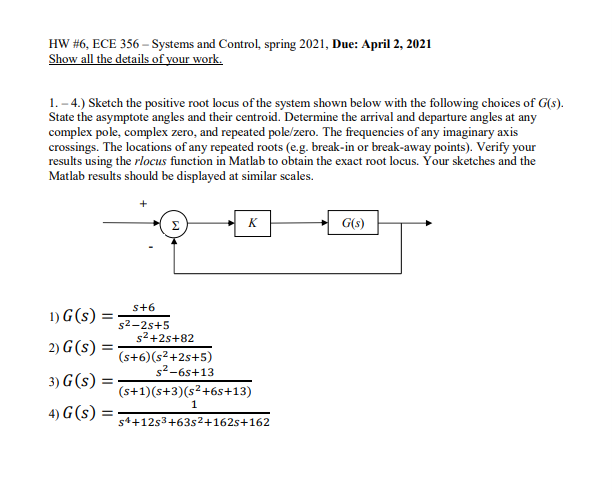
DO NOT DO THE MATLAB PORTION. JUST NEED HELP ON THE WORK.
HW #6, ECE 356 - Systems and Control, spring 2021, Due: April 2, 2021 Show all the details of your work. 1. - 4.) Sketch the positive root locus of the system shown below with the following choices of G(s). State the asymptote angles and their centroid. Determine the arrival and departure angles at any complex pole, complex zero, and repeated pole/zero. The frequencies of any imaginary axis crossings. The locations of any repeated roots (e.g. break-in or break-away points). Verify your results using the rlocus function in Matlab to obtain the exact root locus. Your sketches and the Matlab results should be displayed at similar scales. K G(s) S+6 1) G(S) = S2-2s+5 2+28+82 2) G(S) = (s+6) (2 +25+5) s2-65+13 3) G(S) = (5+1)(5+3)(2 +6s+13) 4) G(S) $4+12s3+63s2+162s+162 1 HW #6, ECE 356 - Systems and Control, spring 2021, Due: April 2, 2021 Show all the details of your work. 1. - 4.) Sketch the positive root locus of the system shown below with the following choices of G(s). State the asymptote angles and their centroid. Determine the arrival and departure angles at any complex pole, complex zero, and repeated pole/zero. The frequencies of any imaginary axis crossings. The locations of any repeated roots (e.g. break-in or break-away points). Verify your results using the rlocus function in Matlab to obtain the exact root locus. Your sketches and the Matlab results should be displayed at similar scales. K G(s) S+6 1) G(S) = S2-2s+5 2+28+82 2) G(S) = (s+6) (2 +25+5) s2-65+13 3) G(S) = (5+1)(5+3)(2 +6s+13) 4) G(S) $4+12s3+63s2+162s+162 1
Step by Step Solution
There are 3 Steps involved in it

Get step-by-step solutions from verified subject matter experts
 Study Help