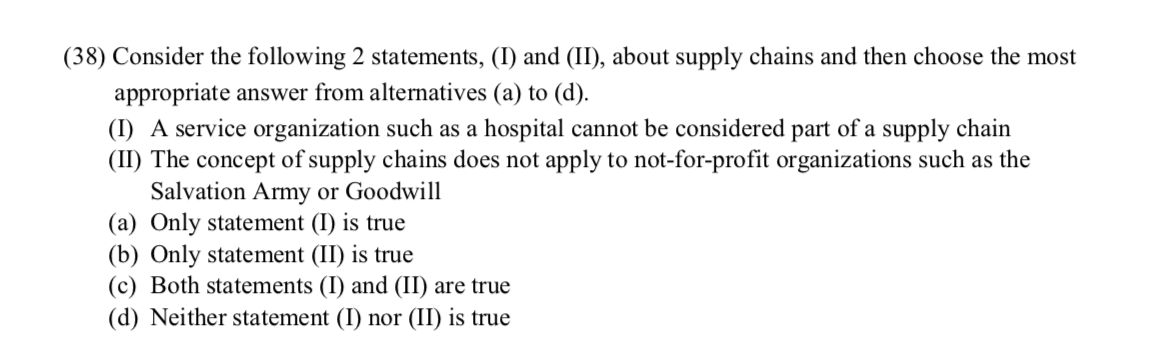
Question: Do not need to show work. (38) Consider the following 2 statements, (I) and (II), about supply chains and then choose the most appropriate answer

Do not need to show work.
Do not need to show work. (38) Consider theDo not need to show work. (38) Consider theDo not need to show work. (38) Consider theDo not need to show work. (38) Consider the

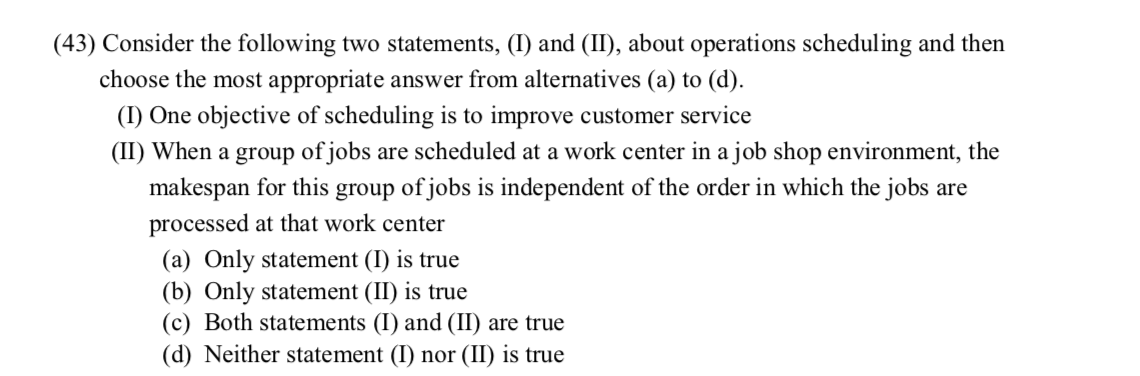
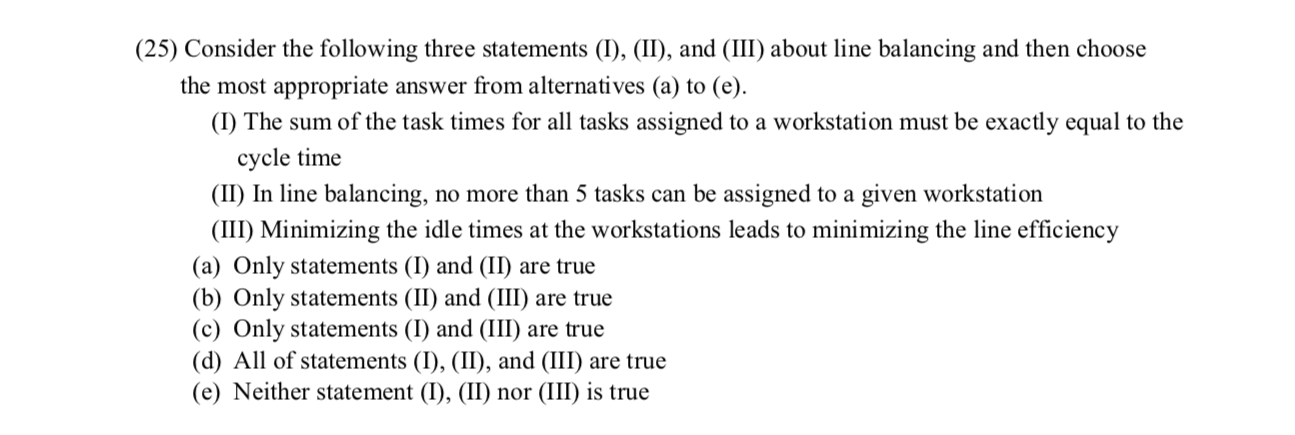
(38) Consider the following 2 statements, (I) and (II), about supply chains and then choose the most appropriate answer from alternatives (a) to (d). (1) A service organization such as a hospital cannot be considered part of a supply chain (II) The concept of supply chains does not apply to not-for-profit organizations such as the Salvation Army or Goodwill (a) Only statement (I) is true (b) Only statement (II) is true (c) Both statements (I) and (II) are true (d) Neither statement (I) nor (II) is true (43) Consider the following two statements, (I) and (II), about operations scheduling and then choose the most appropriate answer from alternatives (a) to (d). (I) One objective of scheduling is to improve customer service (II) When a group of jobs are scheduled at a work center in a job shop environment, the makespan for this group of jobs is independent of the order in which the jobs are processed at that work center (a) Only statement (I) is true (b) Only statement (II) is true (c) Both statements (1) and (II) are true (d) Neither statement (1) nor (II) is true (25) Consider the following three statements (I), (II), and (III) about line balancing and then choose the most appropriate answer from alternatives (a) to (e). (1) The sum of the task times for all tasks assigned to a workstation must be exactly equal to the cycle time (II) In line balancing, no more than 5 tasks can be assigned to a given workstation (III) Minimizing the idle times at the workstations leads to minimizing the line efficiency (a) Only statements (I) and (II) are true (b) Only statements (II) and (III) are true (c) Only statements (I) and (III) are true (d) All of statements (I), (II), and (III) are true (e) Neither statement (I), (II) nor (III) is true

Step by Step Solution

There are 3 Steps involved in it

1 Expert Approved Answer
Step: 1 Unlock blur-text-image

Question Has Been Solved by an Expert!

Get step-by-step solutions from verified subject matter experts

Step: 2 Unlock
Step: 3 Unlock

Students Have Also Explored These Related General Management Questions!