







Question: Do not solve B, ONLY A,C,D,E ( 25 points) Suppose the small town of Mahone Bay, Nova Scotia has only 2 stores where you can
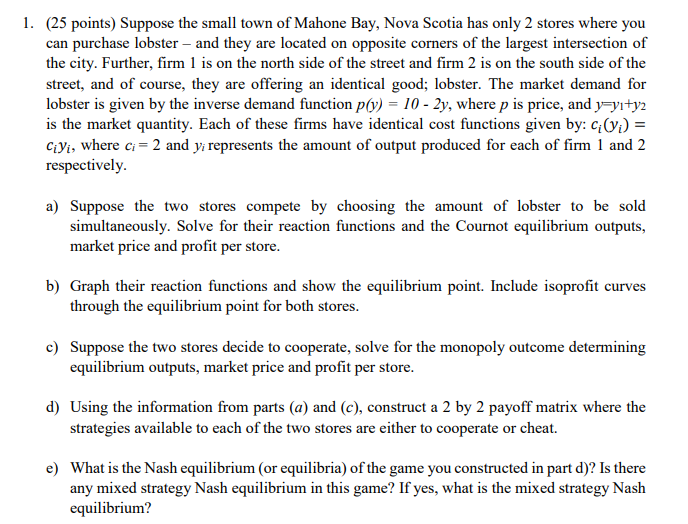
Do not solve B, ONLY A,C,D,E
( 25 points) Suppose the small town of Mahone Bay, Nova Scotia has only 2 stores where you can purchase lobster - and they are located on opposite corners of the largest intersection of the city. Further, firm 1 is on the north side of the street and firm 2 is on the south side of the street, and of course, they are offering an identical good; lobster. The market demand for lobster is given by the inverse demand function p(y)=102y, where p is price, and y2=y1+y2 is the market quantity. Each of these firms have identical cost functions given by: ci(yi)= ciyi, where ci=2 and yi represents the amount of output produced for each of firm 1 and 2 respectively. a) Suppose the two stores compete by choosing the amount of lobster to be sold simultaneously. Solve for their reaction functions and the Cournot equilibrium outputs, market price and profit per store. b) Graph their reaction functions and show the equilibrium point. Include isoprofit curves through the equilibrium point for both stores. c) Suppose the two stores decide to cooperate, solve for the monopoly outcome determining equilibrium outputs, market price and profit per store. d) Using the information from parts (a) and (c), construct a 2 by 2 payoff matrix where the strategies available to each of the two stores are either to cooperate or cheat. e) What is the Nash equilibrium (or equilibria) of the game you constructed in part d)? Is there any mixed strategy Nash equilibrium in this game? If yes, what is the mixed strategy Nash equilibrium? ( 25 points) Suppose the small town of Mahone Bay, Nova Scotia has only 2 stores where you can purchase lobster - and they are located on opposite corners of the largest intersection of the city. Further, firm 1 is on the north side of the street and firm 2 is on the south side of the street, and of course, they are offering an identical good; lobster. The market demand for lobster is given by the inverse demand function p(y)=102y, where p is price, and y2=y1+y2 is the market quantity. Each of these firms have identical cost functions given by: ci(yi)= ciyi, where ci=2 and yi represents the amount of output produced for each of firm 1 and 2 respectively. a) Suppose the two stores compete by choosing the amount of lobster to be sold simultaneously. Solve for their reaction functions and the Cournot equilibrium outputs, market price and profit per store. b) Graph their reaction functions and show the equilibrium point. Include isoprofit curves through the equilibrium point for both stores. c) Suppose the two stores decide to cooperate, solve for the monopoly outcome determining equilibrium outputs, market price and profit per store. d) Using the information from parts (a) and (c), construct a 2 by 2 payoff matrix where the strategies available to each of the two stores are either to cooperate or cheat. e) What is the Nash equilibrium (or equilibria) of the game you constructed in part d)? Is there any mixed strategy Nash equilibrium in this game? If yes, what is the mixed strategy Nash equilibrium
Step by Step Solution
There are 3 Steps involved in it

Get step-by-step solutions from verified subject matter experts
 Study Help