







Question: Do not use bubble sorting to solve this Java problem please read the instructions provided thoroughly. In a Java application: - Instantiate two ArrayLists of
Do not use bubble sorting to solve this Java problem please read the instructions provided thoroughly.
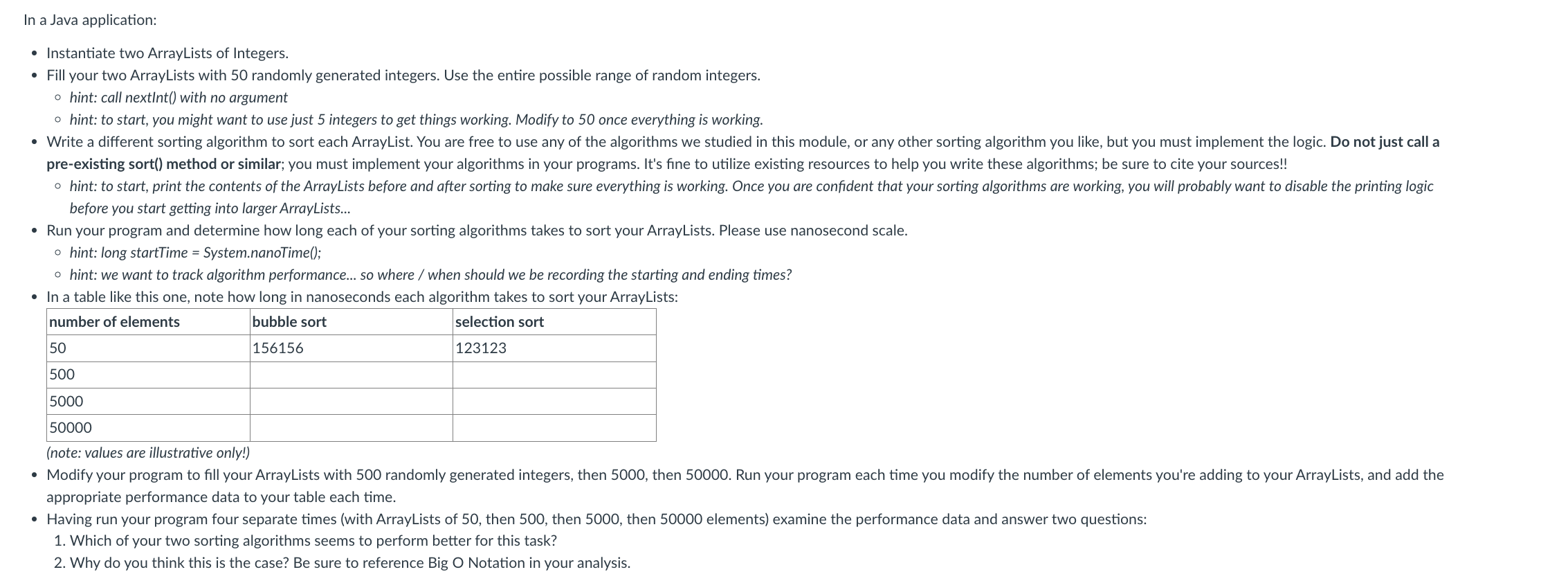
In a Java application: - Instantiate two ArrayLists of Integers. - Fill your two ArrayLists with 50 randomly generated integers. Use the entire possible range of random integers. - hint: call nextInt() with no argument - hint: to start, you might want to use just 5 integers to get things working. Modify to 50 once everything is working. before you start getting into larger ArrayLists... - Run your program and determine how long each of your sorting algorithms takes to sort your ArrayLists. Please use nanosecond scale. - hint: long startTime = System.nanoTime(); - hint: we want to track algorithm performance... so where / when should we be recording the starting and ending times? - In a table like this one, note how long in nanoseconds each algorithm takes to sort your ArrayLists: ju (note: values are illustrative only!) appropriate performance data to your table each time. - Having run your program four separate times (with ArrayLists of 50 , then 500 , then 5000 , then 50000 elements) examine the performance data and answer two questions: 1. Which of your two sorting algorithms seems to perform better for this task? 2. Why do you think this is the case? Be sure to reference Big O Notation in your analysis
Step by Step Solution
There are 3 Steps involved in it

Get step-by-step solutions from verified subject matter experts
 Study Help