







Question: do problem #3 only: 2. Let be an alphabet. For any languages A, B. C-S', define the minority of A, B, and C as the
do problem #3 only:
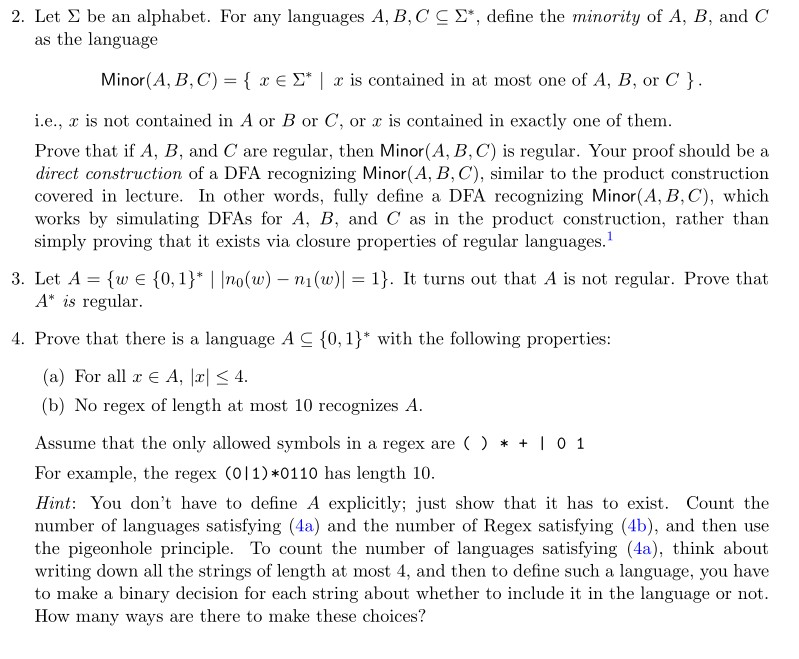
2. Let be an alphabet. For any languages A, B. C-S', define the minority of A, B, and C as the language Minor(A, B, C) = { x E * | x is contained in at most one of A, B, or C } i.e., r is not contained in A or B or C, or x is contained in exactly one of them Prove that if A, B, and C are regular, then Minor(A, B, C) is regular. Your proof should be a direct construction of a DFA recognizing Minor(A, B, C), similar to the product construction covered in lecture. In other words, fully define a DFA recognizing Minor(A, B,C), which works by simulating DFAs for A, B, and C as in the product construction, rather than simply proving that it exists via closure properties of regular languages 3. Let A = {w E {0, 1)" | |n0(W) _ nl (w)| = 1]. It turns out that A is not regular. Prove that A* is regular. 4. Prove that there is a language A C 10, 1)* with the following properties: (a) For all r E A,
Step by Step Solution
There are 3 Steps involved in it

Get step-by-step solutions from verified subject matter experts
 Study Help