



Question: Do problem 4.1.27 only part 1 (for N=5 and N=10 only) on p. 94 Problem 4.1.27. Runge's example. Consider the function f(z)- 1 + 1.
Do problem 4.1.27 only part 1 (for N=5 and N=10 only) on p. 94
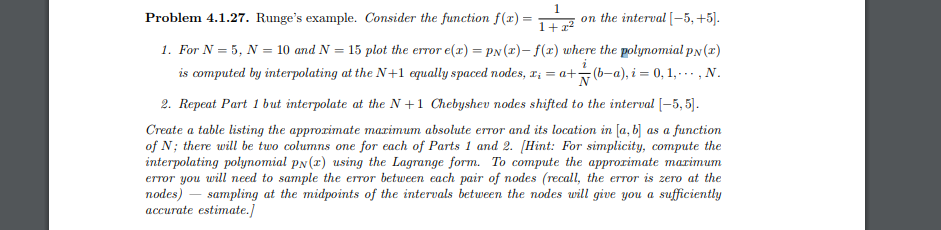
Problem 4.1.27. Runge's example. Consider the function f(z)- 1 + 1. For N = 5, N = 10 and N = 15 plot the emore(z) = pN (z)-f (x) where the polynomial pN) is computed by interolating at the N +1 equally spaced nodes, zi = a+-(b-a), i = 0, 1,-. . , N. 2. Repeat Part 1 but interpolate at the N +1 Chebyshev nodes shifted to the interval -5,5 Create a table listing the approzimate mazimum absolute error and its location in [a, b] as a function of N; there will be two columns one for each of Parts 1 and 2. [Hint: For simplicity, compute the interpolating polynomial pv(x) using the Lagrange form. To compute the approrimate marimum error you will need to sample the error between each pair of nodes (recall, the error is zero at the nodes) -sampling at the midpoints of the intervals between the nodes will give you a sufficiently accurate estimate. Problem 4.1.27. Runge's example. Consider the function f(z)- 1 + 1. For N = 5, N = 10 and N = 15 plot the emore(z) = pN (z)-f (x) where the polynomial pN) is computed by interolating at the N +1 equally spaced nodes, zi = a+-(b-a), i = 0, 1,-. . , N. 2. Repeat Part 1 but interpolate at the N +1 Chebyshev nodes shifted to the interval -5,5 Create a table listing the approzimate mazimum absolute error and its location in [a, b] as a function of N; there will be two columns one for each of Parts 1 and 2. [Hint: For simplicity, compute the interpolating polynomial pv(x) using the Lagrange form. To compute the approrimate marimum error you will need to sample the error between each pair of nodes (recall, the error is zero at the nodes) -sampling at the midpoints of the intervals between the nodes will give you a sufficiently accurate estimate
Step by Step Solution
There are 3 Steps involved in it

Get step-by-step solutions from verified subject matter experts