







Question: Do Question # 3 in its entirety. Question 1 - Financial Planning You are considering going to graduate school to get your Ph.D. You anticipate
Do Question # 3 in its entirety.
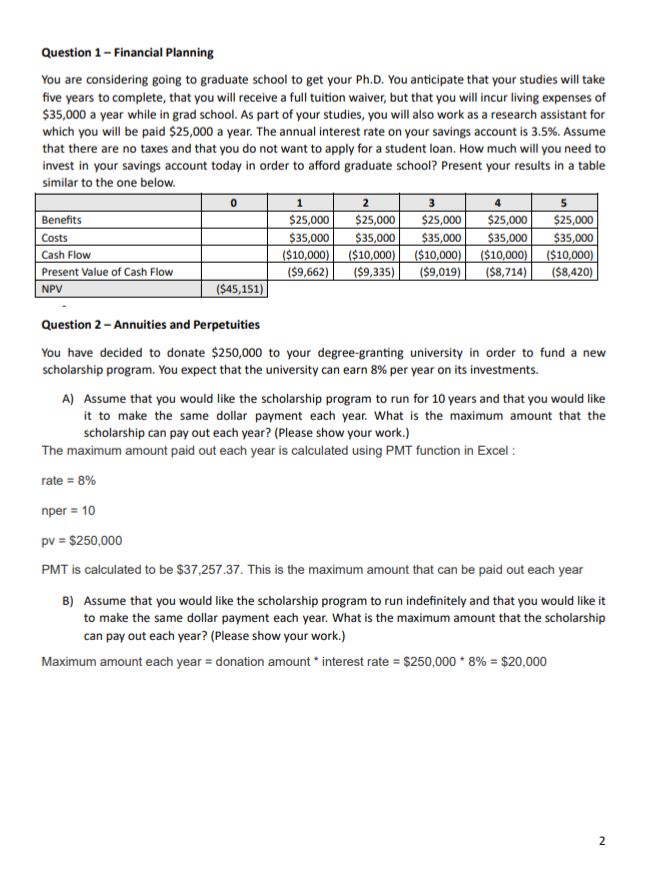
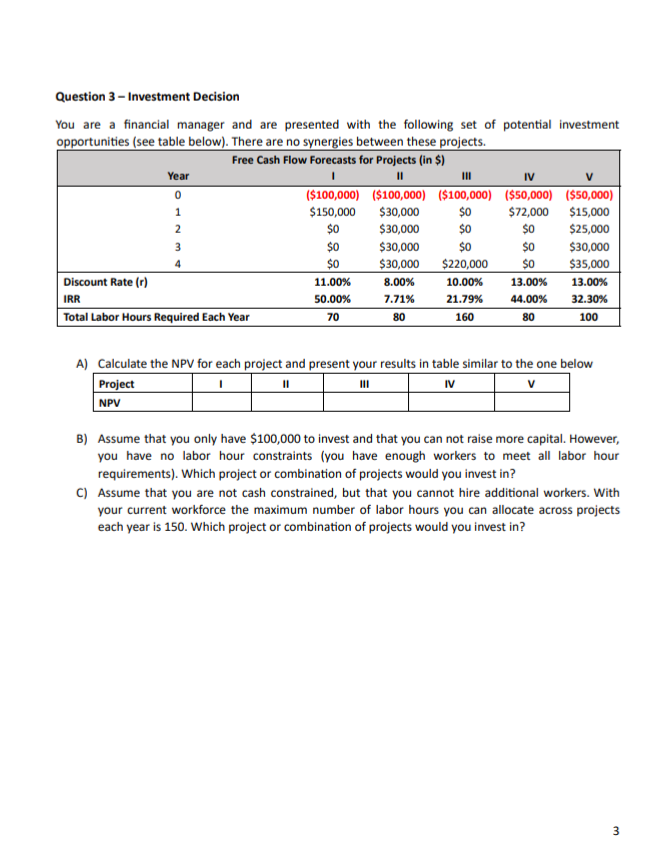
Question 1 - Financial Planning You are considering going to graduate school to get your Ph.D. You anticipate that your studies will take five years to complete, that you will receive a full tuition waiver, but that you will incur living expenses of $35,000 a year while in grad school. As part of your studies, you will also work as a research assistant for which you will be paid $25,000 a year. The annual interest rate on your savings account is 3.5%. Assume that there are no taxes and that you do not want to apply for a student loan. How much will you need to invest in your savings account today in order to afford graduate school? Present your results in a table similar to the one below. 0 1 2 3 4 5 Benefits $25,000 $25,000 $25,000 $25,000 $25,000 Costs $35,000 $35,000 $35,000 $35,000 $35,000 Cash Flow ($10,000) ($10,000) ($10,000) ($10,000) ($10,000) Present Value of Cash Flow ($9,662) ($9,335) ($9,019) ($8,714) ($8,420) NPV ($45,151) Question 2 - Annuities and Perpetuities You have decided to donate $250,000 to your degree-granting university in order to fund a new scholarship program. You expect that the university can earn 8% per year on its investments. A) Assume that you would like the scholarship program to run for 10 years and that you would like it to make the same dollar payment each year. What is the maximum amount that the scholarship can pay out each year? (Please show your work.) The maximum amount paid out each year is calculated using PMT function in Excel rate = 8% nper = 10 pv = $250,000 PMT is calculated to be $37,257.37. This is the maximum amount that can be paid out each year B) Assume that you would like the scholarship program to run indefinitely and that you would like it to make the same dollar payment each year. What is the maximum amount that the scholarship can pay out each year? (Please show your work.) Maximum amount each year = donation amount * interest rate = $250,000 8% = $20,000 Question 3 - Investment Decision You are a financial manager and are presented with the following set of potential investment opportunities (see table below). There are no synergies between these projects. Free Cash Flow Forecasts for Projects (in $) Year IV ($100,000) ($100,000) ($100,000) ($50,000) ($50,000) $150,000 $30,000 $0 $72,000 $15,000 $30,000 $0 $0 $25,000 $30,000 $0 $0 $30,000 $30,000 $220,000 $0 $35,000 Discount Rate (r) 11.00% 8.00% 10.00% 13.00% 13.00% IRR 50.00% 7.71% 21.79% 44.00% 32.30% Total Labor Hours Required Each Year 70 80 160 80 100 SO $0 A) Calculate the NPV for each project and present your results in table similar to the one below Project NPV B) Assume that you only have $100,000 to invest and that you can not raise more capital. However, you have no labor hour constraints (you have enough workers to meet all labor hour requirements). Which project or combination of projects would you invest in? C) Assume that you are not cash constrained, but that you cannot hire additional workers. With your current workforce the maximum number of labor hours you can allocate across projects each year is 150. Which project or combination of projects would you invest in
Step by Step Solution
There are 3 Steps involved in it

Get step-by-step solutions from verified subject matter experts
 Study Help