







Question: do second one The numbers 1, 2, ..., 2n are divided into two groups of n numbers. Prove that the pairwise sums of numbers in
do second one
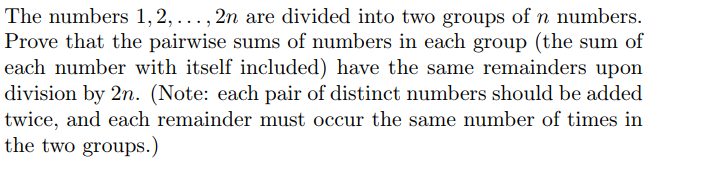
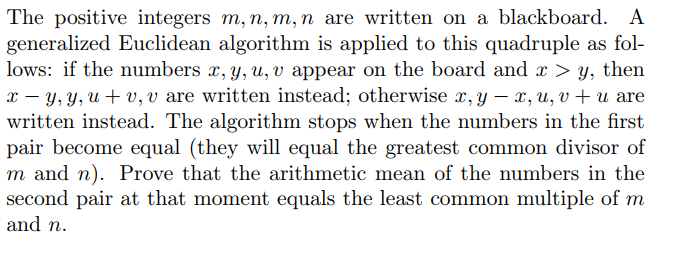
The numbers 1, 2, ..., 2n are divided into two groups of n numbers. Prove that the pairwise sums of numbers in each group (the sum of each number with itself included) have the same remainders upon division by 2n. (Note: each pair of distinct numbers should be added twice, and each remainder must occur the same number of times in the two groups.) The positive integers m, n, m, n are written on a blackboard. A generalized Euclidean algorithm is applied to this quadruple as fol- lows: if the numbers x, y, u, v appear on the board and x > y, then 3 y, y, u + v, v are written instead; otherwise x,y - 3,u,v + u are written instead. The algorithm stops when the numbers in the first pair become equal (they will equal the greatest common divisor of m and n). Prove that the arithmetic mean of the numbers in the second pair at that moment equals the least common multiple of m and n. The numbers 1, 2, ..., 2n are divided into two groups of n numbers. Prove that the pairwise sums of numbers in each group (the sum of each number with itself included) have the same remainders upon division by 2n. (Note: each pair of distinct numbers should be added twice, and each remainder must occur the same number of times in the two groups.) The positive integers m, n, m, n are written on a blackboard. A generalized Euclidean algorithm is applied to this quadruple as fol- lows: if the numbers x, y, u, v appear on the board and x > y, then 3 y, y, u + v, v are written instead; otherwise x,y - 3,u,v + u are written instead. The algorithm stops when the numbers in the first pair become equal (they will equal the greatest common divisor of m and n). Prove that the arithmetic mean of the numbers in the second pair at that moment equals the least common multiple of m and nStep by Step Solution
There are 3 Steps involved in it
1 Expert Approved Answer
Step: 1 Unlock

Question Has Been Solved by an Expert!
Get step-by-step solutions from verified subject matter experts
Step: 2 Unlock
Step: 3 Unlock
 Study Help