







Question: DO SECOND PART ONLY PLEASE!!!!!!!!!!!!!!!!!!!!!!!!!!!!!!!!!!! DO SECOND PART ONLY PLEASE!!!!!!!!!!!!!!!!!!!!!!!!!!!!!!!!!!! DO SECOND PART ONLY PLEASE!!!!!!!!!!!!!!!!!!!!!!!!!!!!!!!!!!! DO SECOND PART ONLY PLEASE!!!!!!!!!!!!!!!!!!!!!!!!!!!!!!!!!!! 6. A group of monkeys
DO SECOND PART ONLY PLEASE!!!!!!!!!!!!!!!!!!!!!!!!!!!!!!!!!!!
DO SECOND PART ONLY PLEASE!!!!!!!!!!!!!!!!!!!!!!!!!!!!!!!!!!!
DO SECOND PART ONLY PLEASE!!!!!!!!!!!!!!!!!!!!!!!!!!!!!!!!!!!
DO SECOND PART ONLY PLEASE!!!!!!!!!!!!!!!!!!!!!!!!!!!!!!!!!!!
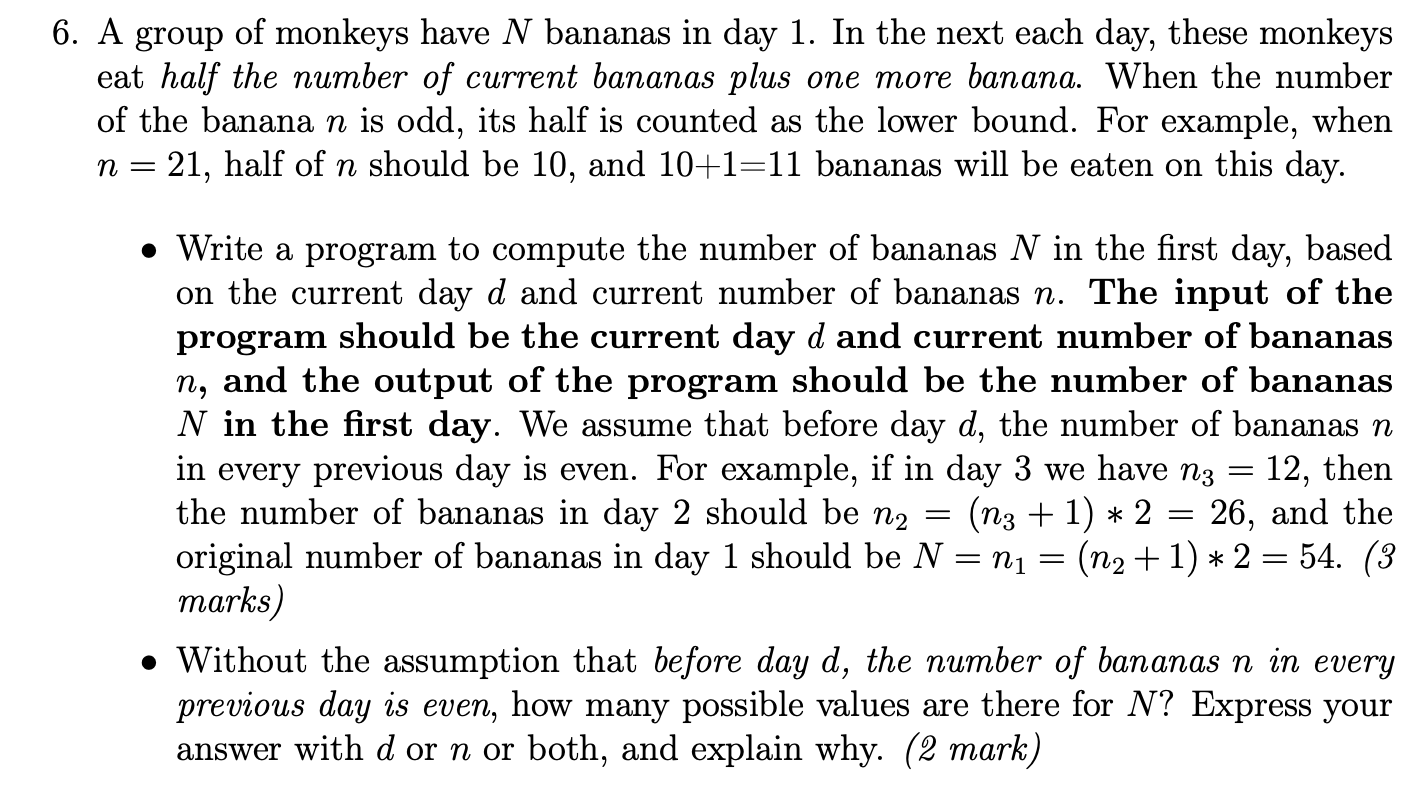
6. A group of monkeys have N bananas in day 1. In the next each day, these monkeys eat half the number of current bananas plus one more banana. When the number of the banana n is odd, its half is counted as the lower bound. For example, when 21, half of n should be 10, and 10+1=11 bananas will be eaten on this day. n = Write a program to compute the number of bananas N in the first day, based on the current day d and current number of bananas n. The input of the program should be the current day d and current number of bananas n, and the output of the program should be the number of bananas N in the first day. We assume that before day d, the number of bananas n in every previous day is even. For example, if in day 3 we have nz 12, then the number of bananas in day 2 should be na (n3 + 1) * 2 26, and the original number of bananas in day 1 should be N = n1 = (n2 + 1) * 2 = 54. (3 marks) = Without the assumption that before day d, the number of bananas n in every previous day is even, how many possible values are there for N? Express your answer with d or n or both, and explain why. (2 mark)
Step by Step Solution
There are 3 Steps involved in it

Get step-by-step solutions from verified subject matter experts
 Study Help