







Question: Do the following questions through given table: Draw and present a dependency diagram for the table above, including transitive dependencies. In your oral presentation, you
Do the following questions through given table:
- Draw and present a dependency diagram for the table above, including transitive dependencies. In your oral presentation, you need to explain each dependency.
- If the table above is not in the first normal form, normalize it so that it is in the first normal form without creating any more tables. You may create an additional attribute or attributes. Orally present your solution and the reason why it was not in the first normal form, and what changes were made to make it in the first normal form. If the table above is in the first normal form, explain why it is in first normal form.
- If the resulting table from the previous task is not in the second normal form, normalize it so that it is in the second normal form without creating any more tables. You may create an additional attribute or attributes. Orally present your solution and the reason why it was not in the second normal form, as well as the changes that were made to turn it to the second normal form. If the resulting table from the previous task is already in the second normal form, explain why it is in the second normal form.
- If the resulting table from the previous task is not in the third normal form, normalize it so that it is in the third normal form. You may create additional tables. Orally present your solution and the reason why it was not in the third normal form, as well as the changes that were made to turn it to the third normal form. If the resulting table from the previous task is already in the third normal form, explain why it is in the third normal form.
- Based on the resulting table from the previous task, draw and present an ERD to the audience. Please use Lucid Chart or an equivalent professional diagramming software application to draw the ERD.
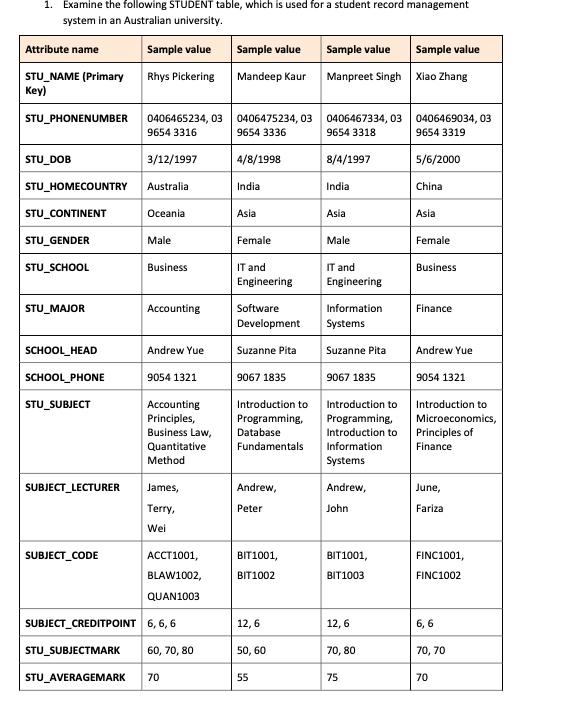
1. Examine the following STUDENT table, which is used for a student record management system in an Australian university. Sample value Rhys Pickering Attribute name STU_NAME (Primary Key) STU_PHONENUMBER STU_DOB STU_HOMECOUNTRY STU_CONTINENT STU_GENDER STU_SCHOOL STU_MAJOR SCHOOL_HEAD SCHOOL_PHONE STU_SUBJECT SUBJECT_CODE Australia Oceania 0406465234, 03 0406475234, 03 0406467334, 03 0406469034, 03 9654 3316 9654 3319 9654 3336 9654 3318 3/12/1997 Male Business Accounting Andrew Yue 9054 1321 Accounting Principles, Business Law, Quantitative Method SUBJECT_LECTURER James, Terry, Wei ACCT1001, BLAW1002, QUAN1003 Sample value Mandeep Kaur SUBJECT_CREDITPOINT 6, 6, 6 STU_SUBJECTMARK 60, 70, 80 STU_AVERAGEMARK 70 4/8/1998 India Asia Female IT and Engineering Software Development Suzanne Pita 9067 1835 Introduction to Programming, Database Fundamentals Andrew, Peter BIT1001, BIT1002 12,6 50, 60 Sample value Manpreet Singh 55 8/4/1997 India Asia Male IT and Engineering Information Systems Suzanne Pita 9067 1835 Introduction to Programming, Introduction to Information Systems Andrew, John BIT1001, BIT1003 12,6 70, 80 Sample value Xiao Zhang 75 5/6/2000 China Asia Female Business Finance Andrew Yue 9054 1321 Introduction to Microeconomics, Principles of Finance June, Fariza FINC1001, FINC1002 6,6 70, 70 70
Step by Step Solution
3.36 Rating (149 Votes )
There are 3 Steps involved in it
We can see that there are transitive dependencies in this table which means that it is not in first normal form The transitive dependencies are STUNAM... View full answer

Get step-by-step solutions from verified subject matter experts
 Study Help