







Question: Do the relevant calculations so you can indicate which you prefer: a bank account that pays 5.3% per year (EAR) for three years or a.
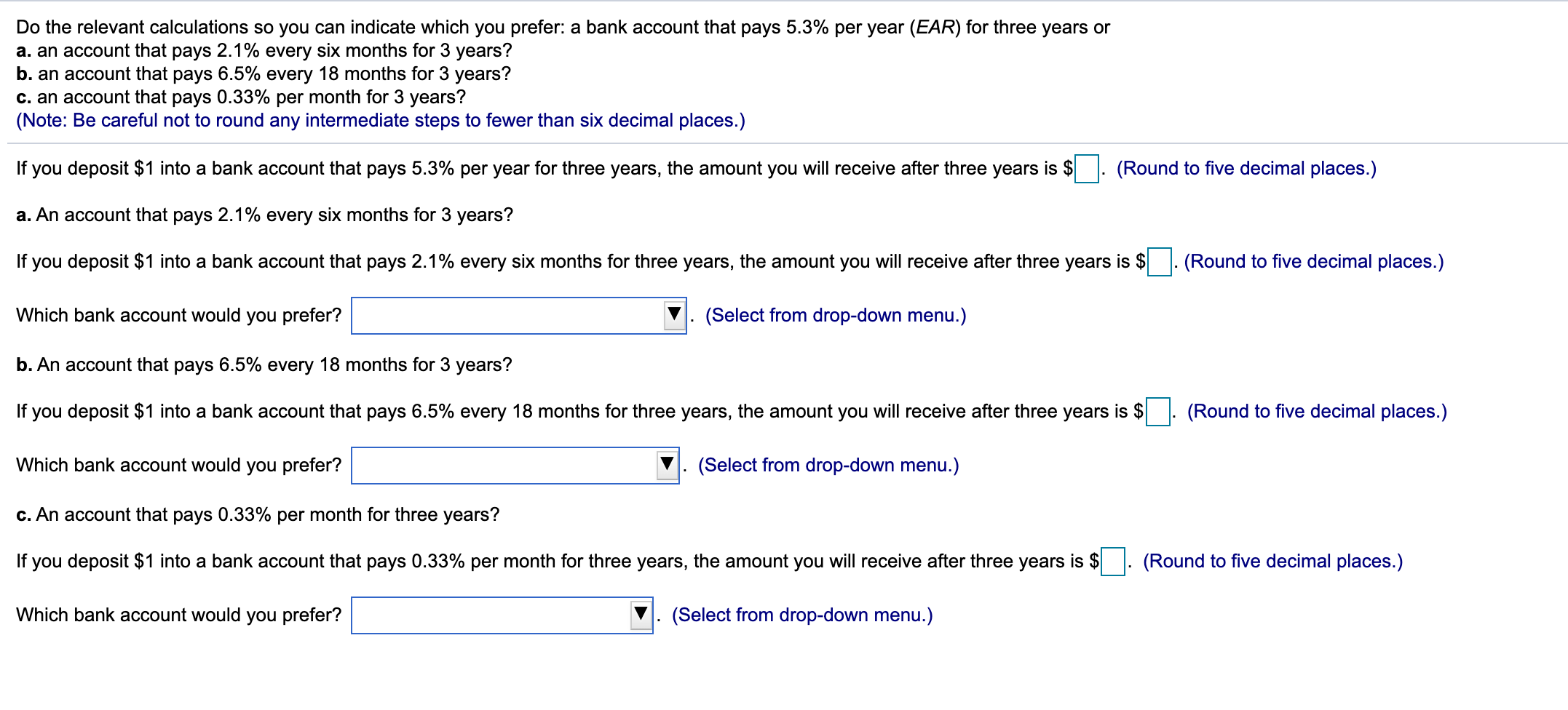

Do the relevant calculations so you can indicate which you prefer: a bank account that pays 5.3% per year (EAR) for three years or a. an account that pays 2.1% every six months for 3 years? b. an account that pays 6.5% every 18 months for 3 years? c. an account that pays 0.33% per month for 3 years? (Note: Be careful not to round any intermediate steps to fewer than six decimal places.) If you deposit $1 into a bank account that pays 5.3% per year for three years, the amount you will receive after three years is $ (Round to five decimal places.) a. An account that pays 2.1% every six months for 3 years? If you deposit $1 into a bank account that pays 2.1% every six months for three years, the amount you will receive after three years is $ (Round to five decimal places.) Which bank account would you prefer? (Select from drop-down menu.) b. An account that pays 6.5% every 18 months for 3 years? If you deposit $1 into a bank account that pays 6.5% every 18 months for three years, the amount you will receive after three years is $ (Round to five decimal places.) Which bank account would you prefer? (Select from drop-down menu.) c. An account that pays 0.33% per month for three years? If you deposit $1 into a bank account that pays 0.33% per month for three years, the amount you will receive after three years is $ (Round to five decimal places.) Which bank account would you prefer? (Select from drop-down menu.) Suppose the interest rate is 9.3% APR with monthly compounding. What is the present value of an annuity that pays $80 every 3 months for 6 years? (Note: Be careful not to round any intermediate steps to fewer than six decimal places.) The present value of the annuity is $. (Round to the nearest cent.)
Step by Step Solution
There are 3 Steps involved in it

Get step-by-step solutions from verified subject matter experts
 Study Help