



Question: Do these MCQs asap 13. Consider the following network that is composed of LAN A and LAN B: LAN A Bridge Station 1 Station 2
Do these MCQs asap
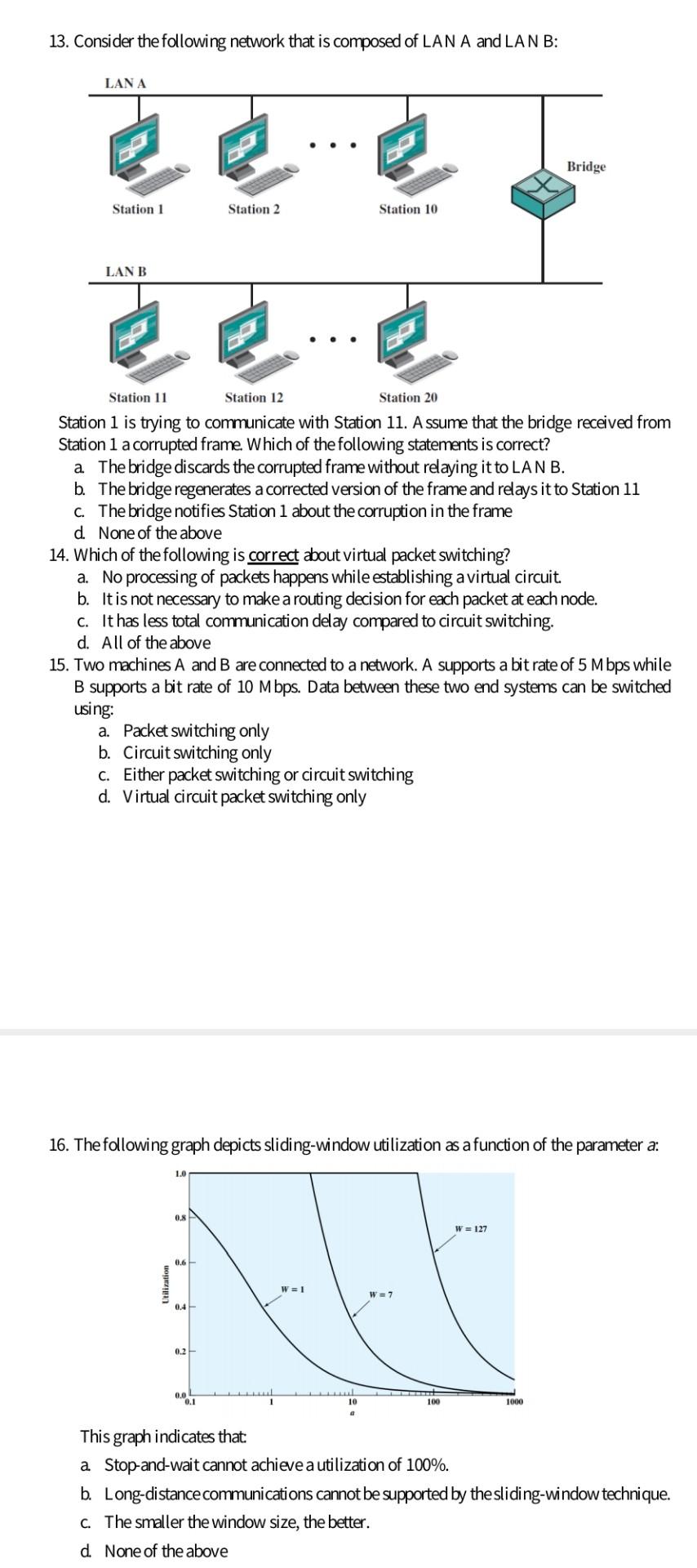
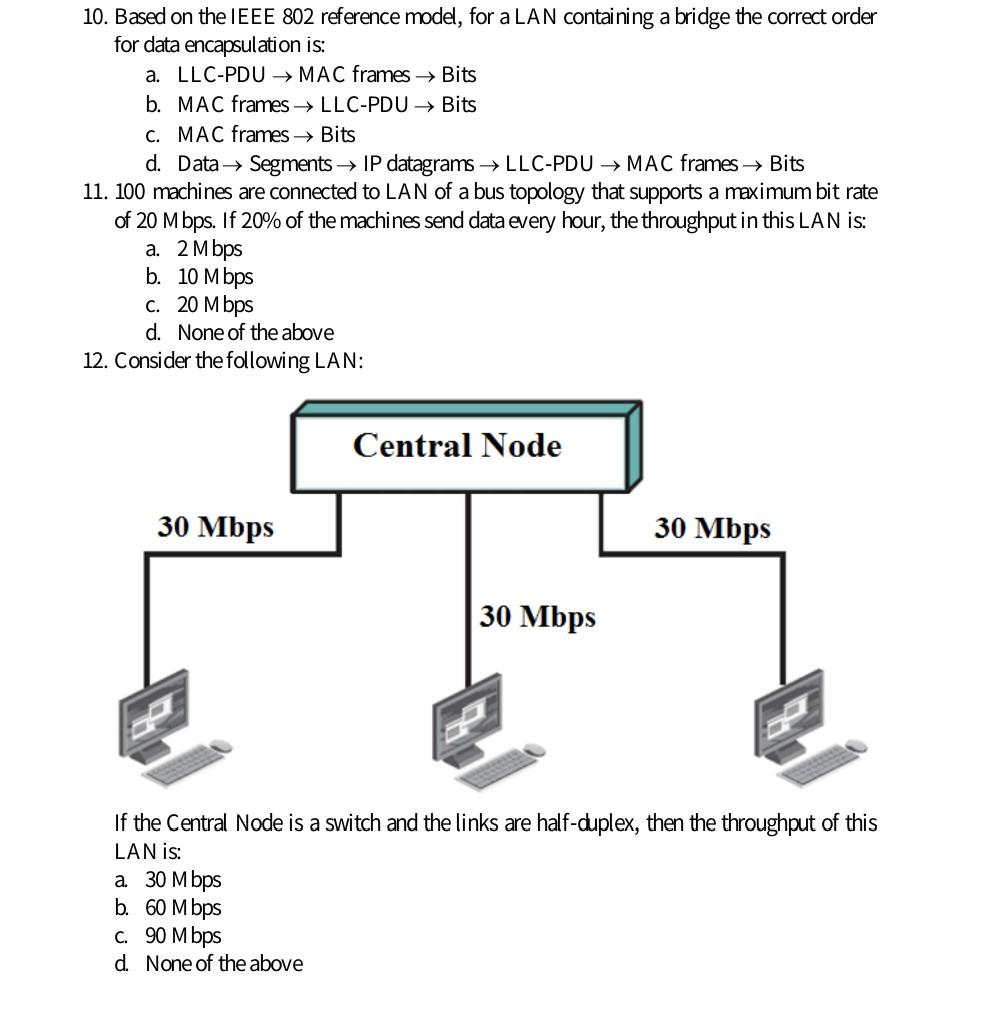
13. Consider the following network that is composed of LAN A and LAN B: LAN A Bridge Station 1 Station 2 Station 10 LAN B Station 12 Station 20 Station 11 Station 1 is trying to communicate with Station 11. A ssume that the bridge received from Station 1 a corrupted frame. Which of the following statements is correct? a. The bridge discards the corrupted frame without relaying it to LAN B. b. The bridge regenerates a corrected version of the frame and relays it to Station 11 C. The bridge notifies Station 1 about the corruption in the frame d. None of the above 14. Which of the following is correct about virtual packet switching? a. No processing of packets happens while establishing a virtual circuit b. It is not necessary to make a routing decision for each packet at each node. c. It has less total communication delay compared to circuit switching. d. All of the above 15. Two machines A and B are connected to a network. A supports a bit rate of 5 Mbps while B supports a bit rate of 10 Mbps. Data between these two end systems can be switched using: a. Packet switching only b. Circuit switching only C. Either packet switching or circuit switching d. Virtual circuit packet switching only 16. The following graph depicts sliding-window utilization as a function of the parameter a: 1. 0.8 W = 127 0.6 W=1 W=7 0.4 0.2 0.0 0.1 10 100 1000 This graph indicates that: a Stop-and-wait cannot achieve a utilization of 100%. b. Long-distance communications cannot be supported by the sliding-window technique. C. The smaller the window size, the better. d. None of the above 10. Based on the IEEE 802 reference model, for a LAN containing a bridge the correct order for data encapsulation is: a. LLC-PDU MAC frames Bits b. MAC frames LLC-PDU Bits C. MAC frames Bits d. Data Segments IP datagrams LLC-PDU MAC frames Bits 11. 100 machines are connected to LAN of a bus topology that supports a maximum bit rate of 20 Mbps. If 20% of the machines send data every hour, the throughput in this LAN is: a. 2 Mbps b. 10 Mbps C. 20 Mbps d. None of the above 12. Consider the following LAN: Central Node 30 Mbps 30 Mbps 30 Mbps If the Central Node is a switch and the links are half-duplex, then the throughput of this LAN is: a. 30 Mbps b. 60 Mbps C. 90 Mbps d. None of the above
Step by Step Solution
There are 3 Steps involved in it

Get step-by-step solutions from verified subject matter experts