







Question: Documentary Analysis Assignment Sheet Points: 20 Assignment Description: One of the crucial commitments within International Studies is to utilize alternative texts. Documentaries are particularly valuable
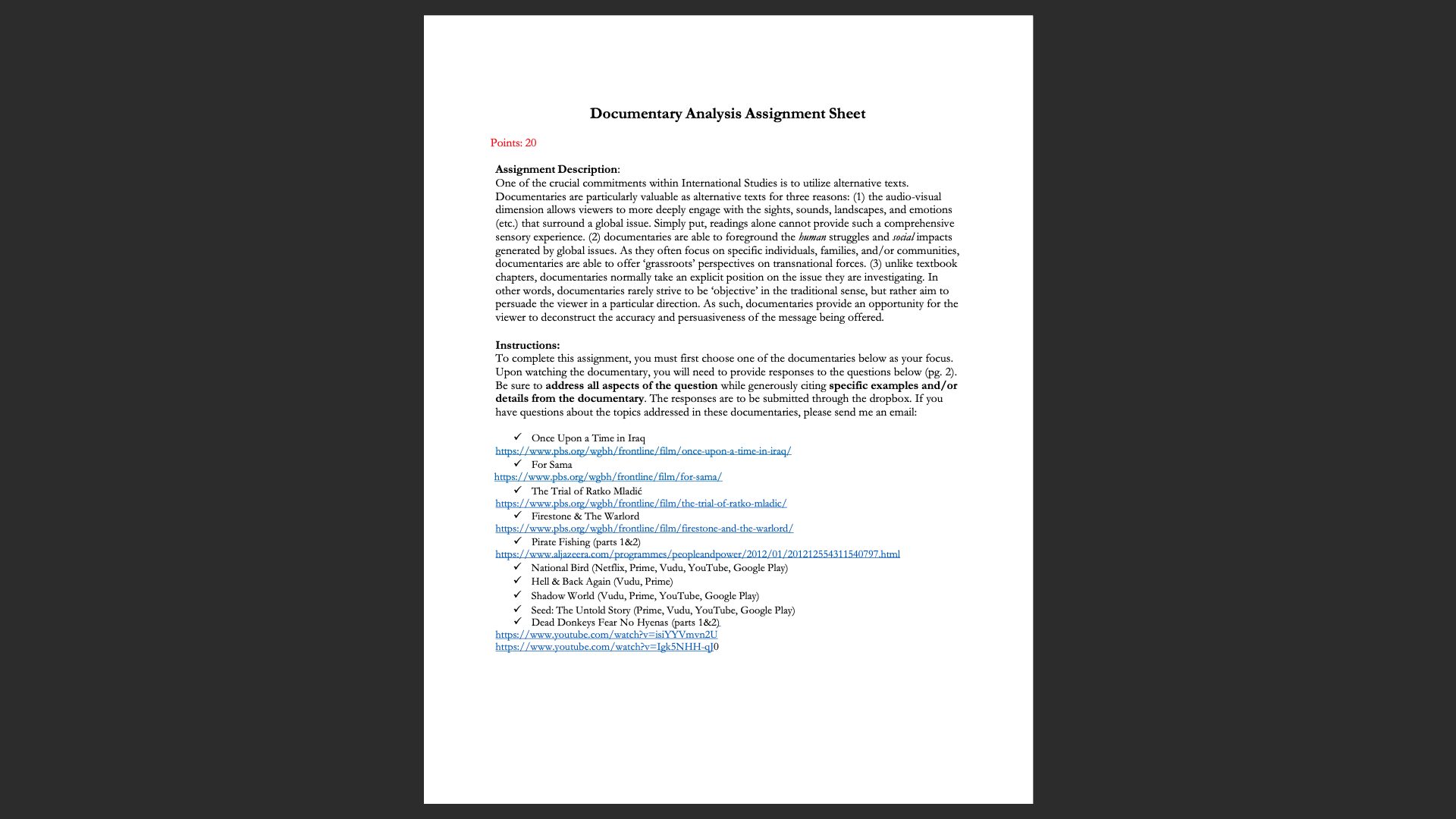
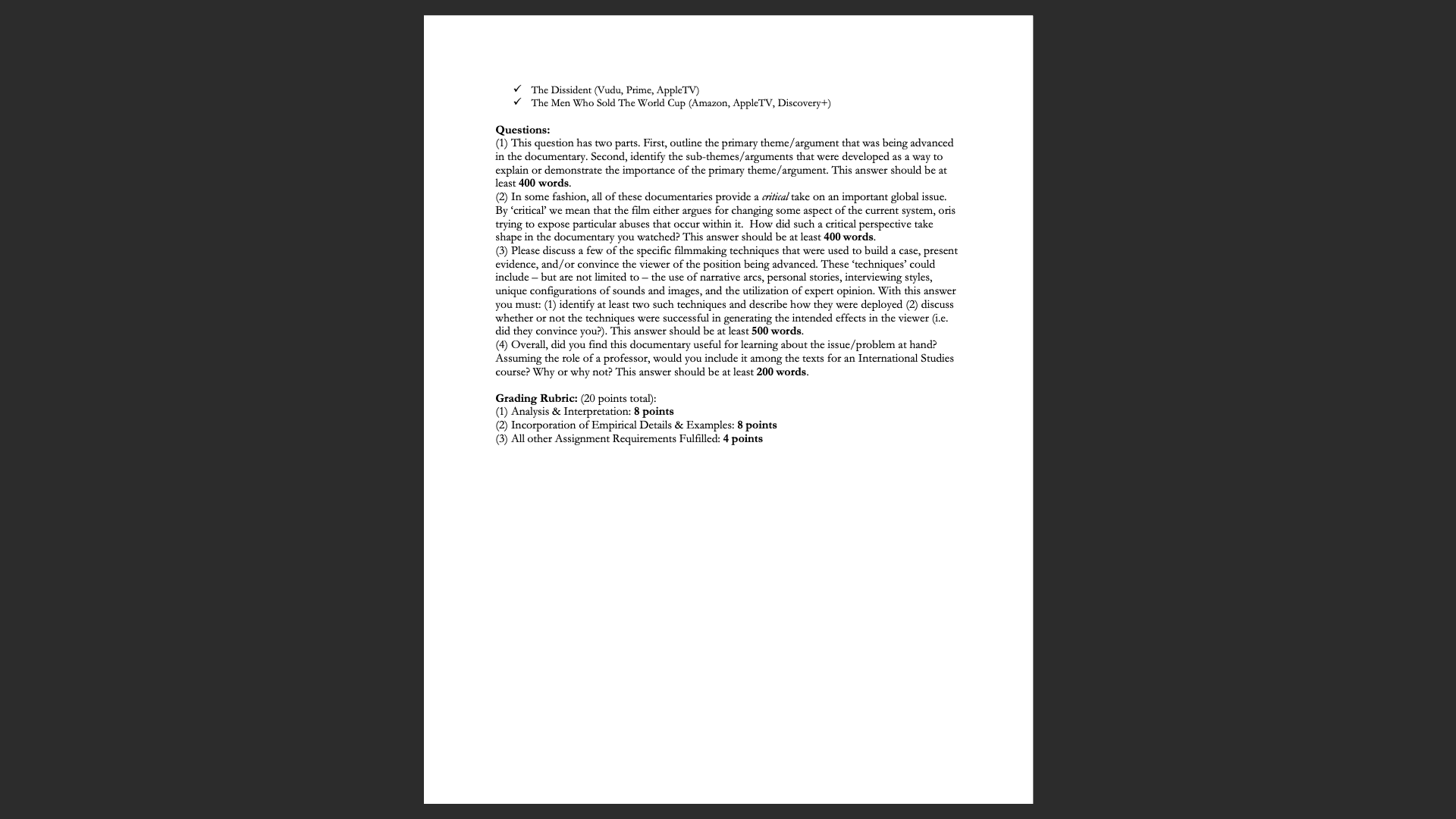
Documentary Analysis Assignment Sheet Points: 20 Assignment Description: One of the crucial commitments within International Studies is to utilize alternative texts. Documentaries are particularly valuable as alternative texts for three reasons: (1) the audio-visual dimension allows viewers to more deeply engage with the sights, sounds, landscapes, and emotions (etc.) that surround a global issue. Simply put, readings alone cannot provide such a comprehensive sensory experience. (2) documentaries are able to foreground the human struggles and social impacts generated by global issues. As they often focus on specific individuals, families, and/ or communities, documentaries are able to offer 'grassroots' perspectives on transnational forces. (3) unlike textbook chapters, documentaries normally take an explicit position on the issue they are investigating. In other words, documentaries rarely strive to be 'objective' in the traditional sense, but rather aim to persuade the viewer in a particular direction. As such, documentaries provide an opportunity for the viewer to deconstruct the accuracy and persuasiveness of the message being offered. Instructions: To complete this assignment, you must first choose one of the documentaries below as your focus. Upon watching the documentary, you will need to provide responses to the questions below (pg. 2). Be sure to address all aspects of the question while generously citing specific examples and/ or details from the documentary. The responses are to be submitted through the dropbox. If you have questions about the topics addressed in these documentaries, please send me an email: Once Upon a Time in Iraq https://www.pbs.org/wgbh/frontline/film/once-upon-a-time-in-iraq/ For Sama https://www.pbs.org/wgbh/frontline/film/for-sama/ The Trial of Ratko Mladic https://www.pbs.org/wgbh/frontline/film/the-trial-of-ratko-mladic/ Firestone & The Warlord https://www.pbs.org/webh/frontline/film/firestone-and-the-warlord/ Pirate Fishing (parts 1&2) https://www.aljazeera.com/programmes/peopleandpower/2012/01/201212554311540797.html National Bird (Netflix, Prime, Vudu, YouTube, Google Play) Hell & Back Again (Vudu, Prime) V Shadow World (Vudu, Prime, You Tube, Google Play) V Seed: The Untold Story (Prime, Vudu, YouTube, Google Play) Dead Donkeys Fear No Hyenas (parts 1&:2) https://www.youtube.com/watch?v=isiYYVmvn2U https://www.youtube.com/watch?v=Igk5NHH-q10The Dissident (Vudu, Prime, AppleTV) The Men Who Sold The World Cup (Amazon, AppleTV, Discovery+) Questions: (1) This question has two parts. First, outline the primary theme/ argument that was being advanced in the documentary. Second, identify the sub-themes/arguments that were developed as a way to explain or demonstrate the importance of the primary theme/argument. This answer should be at least 400 words. (2) In some fashion, all of these documentaries provide a critical take on an important global issue. By 'critical' we mean that the film either argues for changing some aspect of the current system, oris trying to expose particular abuses that occur within it. How did such a critical perspective take shape in the documentary you watched? This answer should be at least 400 words. (3) Please discuss a few of the specific filmmaking techniques that were used to build a case, present evidence, and/ or convince the viewer of the position being advanced. These 'techniques' could include - but are not limited to - the use of narrative arcs, personal stories, interviewing styles, unique configurations of sounds and images, and the utilization of expert opinion. With this answer you must: (1) identify at least two such techniques and describe how they were deployed (2) discuss whether or not the techniques were successful in generating the intended effects in the viewer (i.e. did they convince you?). This answer should be at least 500 words. (4) Overall, did you find this documentary useful for learning about the issue/problem at hand? Assuming the role of a professor, would you include it among the texts for an International Studies course? Why or why not? This answer should be at least 200 words. Grading Rubric: (20 points total): (1) Analysis & Interpretation: 8 points (2) Incorporation of Empirical Details & Examples: 8 points (3) All other Assignment Requirements Fulfilled: 4 points
Step by Step Solution
There are 3 Steps involved in it

Get step-by-step solutions from verified subject matter experts
 Study Help