







Question: Does anyone know how to create an adaptive trapezoidal rule function in python according to some specifications? The procedure is to use n = 2^k
Does anyone know how to create an adaptive trapezoidal rule function in python according to some specifications? The procedure is to use n = 2^k equi-length panels at the k-step iteration, starting with k = 0, and stopping when the difference between the approximate integral values of two adjacent iterations is below the given tolerance.
If anyone could help with this that would be much appreciated Thanks!.
Code
def Trapezoid_adap(f, a, b, tol=1e-5): ''' Usage: integral_value, npanels = Trapezoid_adap(f,a,b,tol=1e-5). Apply the adaptive trapezoidal rule to compute integral of f on [a,b] using 2^k panels at each iteration, starting with k=0. Break the loop when the difference between two adjacent integral values are below tolerance. Return the integral value and the number of panels used. '''
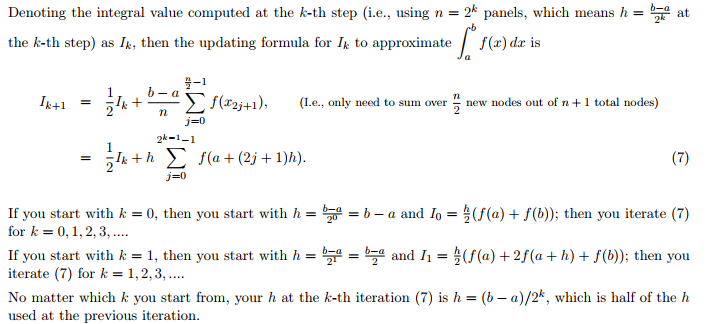
Denoting the integral value computed at the k-th step (i.e., using n = 2k panels, which means h = the k-th step) as Ii, then the updating formula for Ik to approximatef(x) dr is at f(r2j+1),(L.e., only need to sum over j-0 new nodesout of n 1 total nodes) = k+1 j=0 If you start with k = 0, then you start with h = = b-a and 1,- (f(a) +f(b)); then you iterate (7) for k 0, 1, 2, 3, If you start with k = 1, then you start with h = and 11-(f(a) + 2/(a + h) + f(b)); then you iterate (7) for k = 1, 2, 3, No matter which k you start from, your h at the k-th iteration (7) is h-()-a)/2k, which is half of the h used at the previous iteration Denoting the integral value computed at the k-th step (i.e., using n = 2k panels, which means h = the k-th step) as Ii, then the updating formula for Ik to approximatef(x) dr is at f(r2j+1),(L.e., only need to sum over j-0 new nodesout of n 1 total nodes) = k+1 j=0 If you start with k = 0, then you start with h = = b-a and 1,- (f(a) +f(b)); then you iterate (7) for k 0, 1, 2, 3, If you start with k = 1, then you start with h = and 11-(f(a) + 2/(a + h) + f(b)); then you iterate (7) for k = 1, 2, 3, No matter which k you start from, your h at the k-th iteration (7) is h-()-a)/2k, which is half of the h used at the previous iteration
Step by Step Solution
There are 3 Steps involved in it

Get step-by-step solutions from verified subject matter experts
 Study Help