



Question: Does Orix appear to be a good place to work for someone interested in the mining industry? Why or why not? Assess Orixs approach to
Does Orix appear to be a good place to work for someone interested in the mining industry? Why or why not?
Assess Orixs approach to employee motivation and engagement. How does it work? What are the pros and cons of a system like this?
Why does scaling up present a dilemma for the founder? What are the potential problems that could arise with continuing the current system as the company grows and the industry heats up?
How would you assess Ramnath as a leader? Please explain.
Develop an action plan for Ramnath. What should the employee management systems look like three years from now, assuming high growth with the upturn? What should Ramnath start putting in place now to prepare the organization for these systems? What actions need to be taken to achieve high levels of employee engagement moving forward?
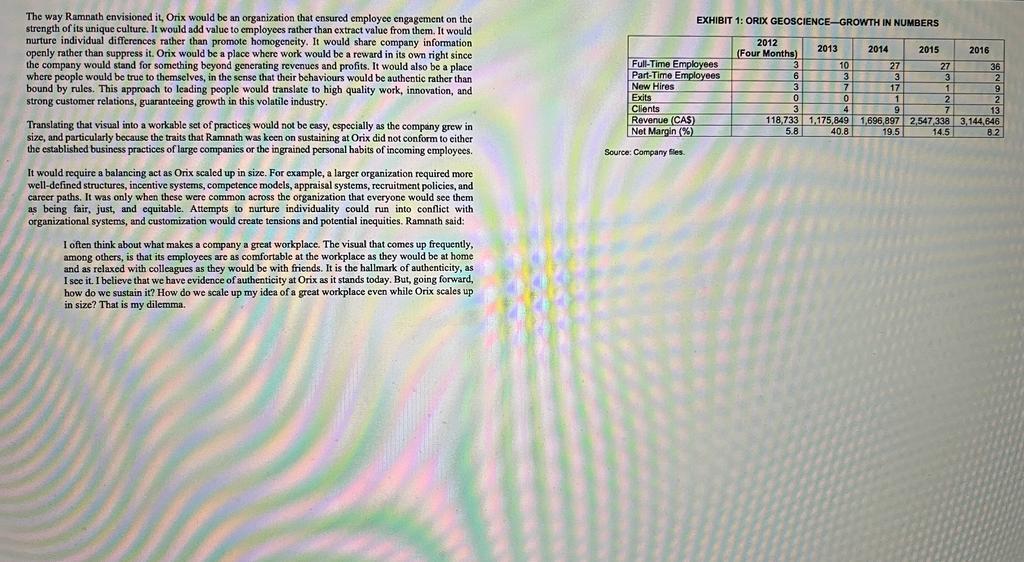
ORIX GEOSCIENCE: SCALING UP EMPLOYEE ENGAGEMENT Ramasastry Chandrasekhar wrote this case under the supervision of Martha L. Maznevski solely to provide material for class discussion. The authors do not intend to illustrate either effective or ineffective handling of a managerial situation. The authors may have disguised certain names and other identififing information to protect confidentiality. This publication may not be transmitted, photocopied, digitized, or otherwise reproduced in any form or by any means without the permission of the copyright holder. Reproduction of this material is not covered under authorization by any reproduction rights organization. To order copies or request permission to reproduce materials, contact ivey Publishing, Ivey Business School, Western University, London, Ontario, Canada, N6G ON1; (t) 519.661.3208; (e) cases@ivey.ca; www.iveycases.com. Copyright 2018, Ivey Business School Foundation Version: 2018-11-09 In December 2016, Shastri Ramnath, co-founder and president of Orix Geoscience Inc. (Orix), a Torontobased geological consulting firm, was reflecting on her decision a year earlier regarding employee engagement and pay strategies. At the time, she had decided to focus on non-financial incentives and organizational culture enhancement, rather than salary increases or financial incentives. At the time, it seemed to have been the right call. But now the industry was set to grow, and the company had to be prepared to scale up even faster. In late 2015 , Orix had established itself beyond its start-up stage while working through the low part of the minerals cycle. In the year since then, the company had grown significantly in revenue and tripled its number of employees. The mineral industry was heading into an upturn, mining companies were moving into a growth phase, and employers were competing for mining talent from a seemingly limited pool. The need to retain employees and keep them engaged for growth and innovation had become compelling. Ramnath said: I still hold the view that money, per se, cannot retain employees in an organization. My view is somewhat contrary to what our own employees at Orix think. I believe, however, that culture is the currency of employee retention. "The way we do things" - that is the lever that we need to pull to keep the employees engaged. Our dilemma, as we pick up growth momentum at Orix, is two-fold. First, how do we keep developing culture as the strategy of business growth? What are the elements we need to put in place in doing so? Second, how do we execute the compensation and benefits strategy to engage our employees at Orix? What should be our road map? Ramnath knew she was on track with her personal beliefs. She now had to provide shape and substance to them, develop them into a formal strategy, and implement them as a living and breathing proposition as Orix grew. Should Ramnath continue in the same direction? What else should she be considering for building a great workplace? MINING INDUSTRY The mining industry contributed 3.4 per cent to Canada's gross domestic product in 2015 . The industry had revenues of CA $55.5 billion' during the year ( $24.6 billion in mineral extraction and $30.9 billion in mineral processing and manufacturing) and had generated 563,000 jobs. 2 Many jobs in mineral extraction had been running for generations in individual families. Mining was also Canada's largest private scetor employer of First Nations, with many of those communities located close to exploration properties. Orix made mining data actionable for mining companies by unearthing the business potential in a set of data and interpreting its business value. More specifically, its three-dimensional portrayals of data provided the basis for mining companies to design exploration programs, determine the extent of mineral deposits, Mining was a high-cost enterprise in which scale and technology were the routes to cost optimization. The and position the mining infrastructure. The portrayals could also incorporate environmental safeguarts and skill levels required of employecs were high. The industry consistently had the highest wages and salaries ensure compliance with regulations. Dave King, vice-president of Exploration and Geoscience at TMAC among all industrial sectors in Canada.' Resources Inc, who was also an early client of Orix, explained the benefits of Orix's data services: Canada had several mining clusters, each focusing on a particular output. Newfoundland, for example, had Data is key to mining decisions at various levels, but geological data is daunting for its end users. extensive copper and nickel reserves, Ontario mined gold, and Quebee specialized in iron ore. Toronto was the global centre for mining finance. The Toronto Venture Exchange, comprising exploration firms Its sheer volume, variety and veracity are formidable. Orix is very good at extracting data, getting considered too small by asset size to be listed on the flagship Toronto Stock Exchange, had 1,192 mining it into formats that are usable and belping interpret it for end users. Their filters pre-empt the no4 enterprises listed on it. Many of these were non-Canadian enterprises involved in finding the next sources uncommon situation of "garbage in garbage out," which is bad for mining business. They save time of mineral deposits. and moncy for customers like us with their high-quality inference of data. The industry had three sets of players: those involved in the core activities of metal and mineral extraction, those Orix had a portfolio of both one-off projects (lasting between two and five monchs) and long-term projects (involving multi-year relationship building), It provided access to its own data storage and data backup providing equipment to undertake those activities, and those providing related services. Ontario's Barrick Gold Corponation (2015 market capitalization average of around US\$12 billion) was the dominant Canadian extraction company. Demand in the industry was highly volatile, and the prices of end products - minerals and metals - fluctuated sharply. As a result, revenues and shares of mining companies also tended to be volatile. The business model of Orix was built around working differently with two types of clients. It worked with small-scale mining companies for an equity stake, and with large-scale mining companies for cash. With The products sector consisted of companies that manufactured products such as excavation equipment, rock this dual approach, Orix could manage the cyclical nature of the mining business. A stake in the equity of drills, tools, rigs winches, and hoists. The services sector consisted of companies who provided anything a company acquired during a downtum would bring in large teturns during an upturn, and at that time the from basic services, like catering, to high-tech data services for the mining industry. High-specialization companies like Orix often pursued niche positions, leveraging the fact that mining conditions varied widely cven within a single geography. cash accruals could be used for capital investments and financing new growth opportunities. The receivables would take care of the ongoing requirements of working capital for day-to-day eperations. The products and services sectors tended to be conservative, like the mining companies they served. There Founding and Growing Orix was a marked reluctance to do things differently from the way they were being done. The customer universe was stable, and new customer acquisition took time since it was driven by existing customer relationships and negotiations on factors other than price, such as delivery schedules, credit terms, and maintenance contracts. Once trust levels were established, customers were more forthcoming with repeat business. Ramnath explained: Orix was set up in May 2012 by Ramnath and Ashlcy Kirwan. It was self-funded and fully owned by the duo. Both were professional geologists who had worked together with mining companies in the past. As part of developing a vision statement, they thought of becoming the largest geological consulting firm based on metries such as revenue, number of clients, and number of employees, as Kirwan explained: A major characteristic of the industry is the alternating phases of growth and slowdown. It shows We bad some fun playing around with words like "largest" and "biggest," but they did not resonate up in its recruitment policies. Businesses lay off employees during the downturn and scramble to with us. We wanted to be the "go to" firm, the leading geological consulting firm of choice for our hire them during the upturn. Companies which manage to have a stable roster of employees, through both the highs and the lows, have a competitive advantage when the upturn happens. Getting qualified people is not a struggle for them as they become employers of ehoice. clients. We wanted to make a positive change in the industry and break boundaries wherever we could. Almost five years down the line, that is still where we want to go. ORIX GEOSCIENCE INC. An opportunity for making a difference surfaced on its own, right at the beginning. Although the founders had no intention of specifically hiring women, Orix had a majority of women employees on its payroll, at one time as much as 75 per cent. The percentage had stabilized at 50 by 2016 , which was still an anomaly in the industry. Making a difference had also evolved by then into a personal mission for Ramnath. She wanted to make mining "normal" for women. Kirwan spoke about how she and Ramnath worked together: Orix was an acronym for Organize, Rethink, Interpret, and Explore. The company offered specialized data Shastri and I had different perspectives on the initial business model. I believed that eash was king. and interpretation services to clients in the mining industry: field work (supporting drilling programs), compilations (assembling drilling data), digital libraries (organizing logs into digital formats), data entry (uploading data in software programs), database analysis (evaluating data), interpretation and modelling (culling insights from data), and targeting (developing exploration targets). I was risk-averse and conservative, despite, or perhaps because of being a millennial. Shastri is 10 years older than me and was looking long term. In a role reversal of sorts, I was playing the devil's advocate while she was the adventurer. We reconciled and settled for a business model that was a combination of low risk [comprising cash-paying clients with an establishod track record] and high 2The Mring Assoclation of Canada. Facts and Figures of the Canadian Miring fidusty 2016, accessed September 16, 2017, risk [comprising equity-providing clients with a promising future]. mining calaites/defaulthies/documents/Facts-and-Figares-2016 paf. 3 ibld. Shastri Ramnath assessing employee performance and for individual employees in ascertaining the boundaries beyond which Ramnath's entreprencurial instinets could be traced to her childhood in the province of Manitoba. As the they will not go." It also served as the value system for the company and a binding force that gave Orix daughter of an immigrant father from Trinidad and Tobago and a Mennonite mother, she grew up helping her family in its forays into small-business ventures of owning rental income propertics. employees a common purpose. After graduating with a degree in geology from the University of Manitoba in 1999, Ramnath joined Orix had a practice of taking its full complement of employecs on a three-day leadership retreat to an exotic Faleonbridge Limited, a Toronto-based mining company, as an associate geologist. She also enrolled in a place every year. One of the main objectives of the annual retreat was to re-examine and renew the O-Code. master's program in geology at Rhodes University in South Africa, which she completed in 2001. At Everyone was encouraged to express their reservations with it so that matters of detail could be fine-tuned for any new situations or experiences. The retreat experience served to renew the power of the O-Code as Falconbridge Limited, she worked in several remote locations in Manitoba and Nunavut. In August 2002, she joined Sudbury-based FNX Mining Company Inc. (FNX) wherc, as an area geologist (Special Projects). she worked on field projects in Chile and West Africa. She spent eight years with FNX as a member of its a unifying source of engagement. exploration and resource team. Recruiting Now Employees Always wanting to learn more, Ramnath began an online master of business administration program in 2010. Recruitments at Orix were often unconventional. Michaela Kuuskman, for example, was recruited in January 2014 as a geologist through a process of "secondment." She had been working with Transition Metals Corp. During a session on entrepreneurial and visionary thinking, Ramnath realized it was time to start her own business. She quit her job at FNX while still putting together a client list. When she approached Bridgeport (Transition), a junior exploration company located next to the Orix office in Sudbury. Transition was going through a difficult phase at the time, and Ramnath asked the company to second Kusckman for three months. Ventures Inc. (Bridgeport) to offer her geological services, the potential client made a counter-offer she was Kuuskman would be on the rolls of Transition without pay (in order to maintain her benefits), but would work hardly expecting, and one she could not refuse: a job as the president and chief executive officer (CEO) of for and be compensated by Orix. "It worked out well and I signed up at the end of three months with Orix full Bridgeport, a publiely traded company with mineral exploration projects in Chile and the United States. She put the thoughts of starting Orix on hold until 2012, when she left Bridgeport following the company's merger with a gold royalty company. By that point, sbe had been working with Kirwan for five years. time," said Kuuskman, who later relocated to Orix's Toronto office. The mining industry was in a downturn in 2012 and the time was not conducive for start-ups, but Ramnath Opportunistic recruitment was also common at Orix. One of the senior managers, for example, had come and Kirwan forged ahead. Orix started in a Toronto office with three full-time cmployees. Within four months, nine people were working there. "It was as though we were sending energy out there that attracted good people," Ramnath recalled. By Christmas, Orix had opened a second office, in Sudbury. This was the first indication that the business model was working. across a person with unique skill sets in Python coding that was relevant to large data sets. The senior manager believed this person would be a good fit for future requirements. Orix did not need the talent right By December 2015 , the company had established itself beyond its start-up stage while working through the low part of the minerals cycle. It had just over $2.5 million in revenue and 23 employees (see Exhibit 1). By December 2016, the company had grown to just over $3.0 million in revenue, and the number of employees had risen to 36 . Ramnath had attracted good people, and exits were much lower than the industry average. away, but Ramnath and Kirwan believed he had an energy that fit with the organization and so signed him There were many things to celebrate, but Ramnath was focused on the future and maintaining momentum. up and created a customized role for him. AN UNCONVENTIONAL ORGANIZATION Work Systems The founders wanted to ensure that employees were all performing at their potential, and even exceeding their potential. High levels of productivity would be paramount to survival in a competitive environment. Everyone at Orix had more than enough work to do, and people often felt overioaded with assignments. However, everyone was free to prioritize their work according to the way they worked best, without about what they did, and the organization would provide the support. Ramnath and Kirwan did not run Orix following conventions in the mining services sector. Ramnath, in The company's geologists were mostly on site on ffeld projects. They stayed connected with the leadership particular, strongly believed that high performance in a specialized technology company would result from high levels of employee engagement and commitment to the company, which would not come from a traditional way of organizing. For example, rather than hierarchy, strict job descriptions, and precisionteam at the head office in Toronto through weekly conference calls every Monday at 10:00am, lasting about an hour. Ramnath ensured that everybody knew what everyone else was doing. calculated bonus schemes, she wanted a flat organization, fluid roles, and non-monetary intrinsic incentives. Peer review was a big part of the geologists' roles. Every deliverable was peer-reviewed before being submitted to a client, to verify the quality of deliverables. This meant that everyone's work, including that of the CEO, was checked by someone else. Peer review focused on a particular output, not on the quality of the individual doing the work. Peer review was also an important company communication platformit created a routine of conversations about the different projects, with geologists learning from each other. The O-Code Compensation and Non-monetary Incentives The Orix founders developed a code of conduct known as the O-Code (see Exhibit 2). It was a combination of 10 behaviours and skill sets that provided the benchmark for employee selection and guidance. "The 0 - Orix did not have a standard framework of compeneation, with the upfront specification and negotiation of Code sets the standard," said Dan Piotrowski, human resources (HR) generalist, "for project leads in a bonus or a selection of benefits from a predetermined suite, as Kirwan explained: We look at compensation in terms of a base line compensation and total compensation. The base line compensation is monetary. It has four components: basic salary, vacation pay, registered savings Charity was also encouraged. One of the employees happened to mention that ber friends were doing work plans, and health benefits. We are on par with the industry average on each of them. We may not be in Africa and that she was thinking of contributing $1,000 to supplement their effort. Orix volunteered to paying more but we will surely not be below the industry average with baseline compensation. pay that amount. The rest of total compensation - monetary of non-monetary - was customized to individual needs and Shaping the Culture value. It was negotiable as far as the employee was concemed, and discretionary as far as the founders were concerned. An employee who was contributing a lot to the firm and wanted something specific from it could negotiate for that benefit. The founders would do their best to provide what was asked, often with modifications. Inevitably, some employees got more total compensation and some less. Ramnath found, however, that people generally knew their individual capabilitics and contributions within the context of their team, as well as those of others. They were also aware of the competencies that they alone could provide and, bence, their relative value. The onus was on the individual employee to demonstrate that value and to ask to be compensated accordingly. Employees were encouraged to ask, and over time they became comfortable with speaking up. Ramnath said: Ramnath reflected on the type of organizational environment she was striving to build: Every employee has different needs. Someone with a child wants to work four days a week. We give her a four-day-week schedule to accommodate her need. Another wants to travel a lot. So, we say, "You know what? We will work it out so you can go away for four wecks this year." Another person loves to do field work and we fit the role around it. We don't say what every person should do. They tell us what they want and we will find a way of giving it to them. I am, by nature, passionate about things I do. But I also want to enjoy people I work with just as I want them to enjoy working with me. I remember once, at a company I was working for, when my boss was away at a mining conference and his wife fell sick, she called me for belp. I stayed in their house for two nights and took care of the kids. That is me. I have seen companies struggle with finding the balance between task orientation and people orientation. I bave secn managers struggle with finding the balance. It was important for me, as we started building the start-up, that Orix and its people find that balance. One employee wanted the company to reimburse him the fee for a course he was keen on taking. The course was unrelated to geology, but Ramnath made a deal with him: "We will split the course fee of $3,500 with you 5050. We will pay $1,750 but you don't have to pay your share upfront. We will recover it in monthly instalments of $100 from your salary over the next year and half." Another wanted to take six weeks off for a vacation she had been planning well before joining Orix. Ramnath said yes, but the approval was conditional on going without pay and the understanding that this would not be a regular request. Financing post-secondary education for employees was a priority for Ramnath. Within a year of joining the Sudbury location as office coordinator, Frances MacVeigh began to show an interest in doing an online executive MBA course. She had previously worked in the mining industry in Mexico, where she had also set up a small mining services business. "When I suggested the idea of an MBA to Shastri," said MacVeigh, "she not only encouraged me but was open to funding the course, which would cost $35,000." MacVeigh was looking forward to working for Orix in Mexico when it opened an office there some time in the future. Child care was another benefit with which Orix was liberal. During early 2016, six employees, including Ramnath, were pregnant at about the same time at Orix. After the babies arrived, the parents would often bring them to the office for meetings - some of the children were sick, some playful, and some bawling. But everyone was comfortable with the ambience. "It was seamless," recalled one of the parents. "I did not know where my role as a nursing mother ended and where my role as a geologist began." Leadership training was also a priority benefit. Retreats lasting three to four days had become annual cvents Since individuals differed from one another in their needs and their motivations, Ramnath was sure that a cookie-cutter approach would not work to keep and engage staff. She thought it best to customize the package to each individual employee, in the ways the company had been supporting for the last few years. Orix conducted an Employee Preference Survey in December 2015. The internal survey had asked employees to rate their preferences for benefits and rewards across a range of five variables: salary increase, pension plan, vacation, training, and daycare subsidy. Salary increase had ranked the highest, with 65 per cent of employees ranking it as their number one preference and stating catcgorically that take-home pay was the most important consideration for them. Pension plan had secured second billing. followed by training, vacation, and then daycare subsidy. for everyone with six months or more at Orix. These retreats integrated collective introspection over the future of Orix, as well as discussions around the specifies of the business itself. The event also involved fun activities aimed at strengthening employees' bonds - with one another and with the company. Individual geologists spoke at the retreats of the personal dilemmas they faced in practising leadership attributes like honesty and openness. The retreats were very interactive, rather than promoting one-way communication. "Orix puts a lot of effort into leadenship development initiatives," said King. "It is unusual for an organization of its size. I have seen that level of commitment only in large companies." Ramnath had gone against the surveyed preferences of her staff, deciding to provide non-financial rewards and to focus on organizational culture, while keeping salaries on par with the industry average. It was not an obvious decision, but Ramnath took the risk because she wanted to build an organization that people were excited to belong to - one that led them to be active, engaged, and innovative in their work. A recent experience had reinforced Ramnath's belief in ber approach. She had taken her full complement of employees to a leadership retreat in Cuba in September, 2016. The three-day event carried a price tag of $100,000 for the company. Earlier on, Ramnath had considered distributing the amount as bonuses to the employees, based on the results of the preference survey. Her conviction in the current approach had compelled her to spend the money on the retreat in Cuba. A few weeks later, she heard from someone with in her industry network that one of ber senior managers had spurned an overture from a competitor on those very grounds. "You mean, you don't have annual retreats?" the manager had asked as she walked away from the poacher. THE WAY FORWARD FOR ORIX Ramnath was keen on stepping down as president to focus on strategic issues of growth, making way for Kirwan to replace her. The duo was also in the process of selecting future leaders from among the company's core team of geologists. They had identified 10 geologists as team leads who would be moving into positions of increasing responsibility. It would be difficult for the founders, Ramnath in particular, to be persoally involved in future leadership selection decisions, as Orix would begin to grow in size in tune with the uptum in the industry. It was important for her to delegate and move on. She had already appointed a full-time HR development professional in addition to enlisting the services of an HR consultant to mentor him. The way Ramnath envisioned it, Orix would be an organization that ensured employee engagement on the strength of its unique culture. It would add value to employees rather than extract value from them. It would nurture individual differences rather than promote homogeneity. It would share company information openly rather than suppress it. Orix would be a place where work would be a reward in its own right since the company would stand for something beyond generating revenues and profits. It would also be a place where people would be true to themselves, in the sense that their behaviours would be authentic rather than bound by rules. This approach to leading people would translate to high quality work, innovation, and strong customer relations, guaranteeing growth in this volatile industry. Translating that visual into a workable set of practices would not be easy, especially as the company grew in size, and particularly because the traits that Ramnath was keen on sustaining at Orix did not conform to either the established business practices of large companies or the ingrained personal habits of incoming employees. EXHIBIT 1: ORIX GEOSCIENCE-GROWTH IN NUMBERS It would require a balancing act as Orix scaled up in size. For example, a larger organization required more well-defined structures, incentive systems, competence models, appraisal systems, recruitment policies, and career paths. It was only when these were common across the organization that everyone would see them as being fair, just, and equitable. Attempts to nurture individuality could run into conflict with organizational systems, and customization would create tensions and potential inequities. Ramnath said: I often think about what makes a company a great workplace. The visual that comes up frequently, among others, is that its employees are as comfortable at the workplace as they would be at home and as relaxed with colleagues as they would be with friends. It is the hallmark of authenticity, as I see it. I believe that we have evidence of authenticity at Orix as it stands today. But, going forward, how do we sustain it? How do we scale up my idea of a great workplace even while Orix scales up in size? That is my dilemma
Step by Step Solution
There are 3 Steps involved in it

Get step-by-step solutions from verified subject matter experts