







Question: Does remote work really harm innovation and creativity? The answer may surprise you Updared reb 2 2 , 2 0 2 4 at 7 .
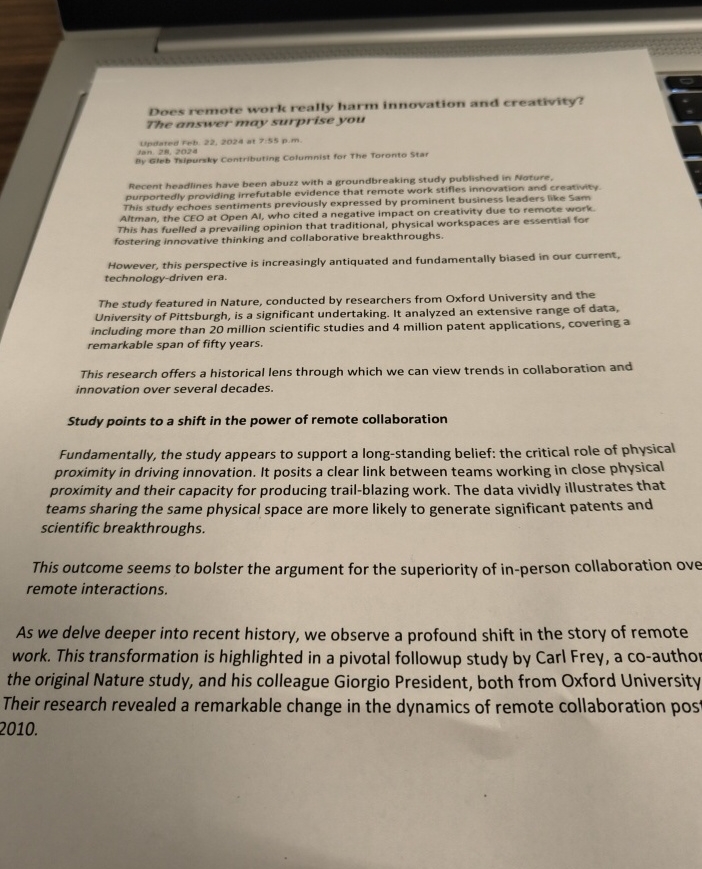
Does remote work really harm innovation and creativity? The answer may surprise you
Updared reb at pm
san
By Gleb Tipursky contributing Columnist for The Toromto Stas
Recent headlines have been abuzz with a groundbreaking study published in Noture, purportedly providing irrefutable evidence that remote work stifles innovation and creativity. This study echoes sentiments previously expressed by prominent business leaders like sam Altman, the CEO at Open Al who cited a negative impact on creativity due to remote work. This has fuelled a prevailing opinion that traditional, physical workspaces are essential for fostering innovative thinking and collaborative breakthroughs.
However, this perspective is increasingly antiquated and fundamentally biased in our current, technologydriven era.
The study featured in Nature, conducted by researchers from Oxford University and the University of Pittsburgh, is a significant undertaking. It analyzed an extensive range of data, including more than million scientific studies and million patent applications, covering a remarkable span of fifty years.
This research offers a historical lens through which we can view trends in collaboration and innovation over several decades.
Study points to a shift in the power of remote collaboration
Fundamentally, the study appears to support a longstanding belief: the critical role of physical proximity in driving innovation. It posits a clear link between teams working in close physical proximity and their capacity for producing trailblazing work. The data vividly illustrates that teams sharing the same physical space are more likely to generate significant patents and scientific breakthroughs.
This outcome seems to bolster the argument for the superiority of inperson collaboration ove remote interactions.
As we delve deeper into recent history, we observe a profound shift in the story of remote work. This transformation is highlighted in a pivotal followup study by Carl Frey, a coauthor the original Nature study, and his colleague Giorgio President, both from Oxford University Their research revealed a remarkable change in the dynamics of remote collaboration pos
sumnarised in own word
Step by Step Solution
There are 3 Steps involved in it
1 Expert Approved Answer
Step: 1 Unlock

Question Has Been Solved by an Expert!
Get step-by-step solutions from verified subject matter experts
Step: 2 Unlock
Step: 3 Unlock
 Study Help