



Question: Does the wording of a question influence a person's response? To investigate, a student asked 50 customers at a sporting goods store if Barry Bonds
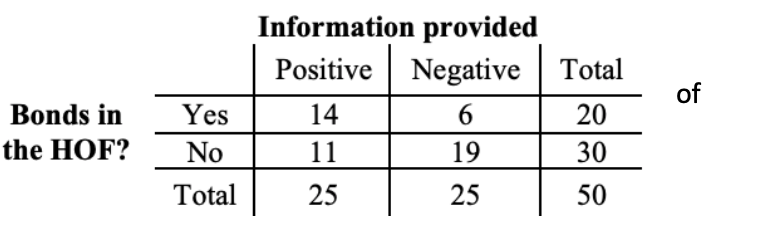
Does the wording of a question influence a person's response? To investigate, a student asked 50 customers at a sporting goods store if Barry Bonds should be elected to the Baseball Hall of Fame. There were two different versions of the question: Version A started by listing some of Bonds's most impressive accomplishments. Version B started by mentioning Bonds's alleged use of performance-enhancing drugs. The version of the question asked was determined at random for each of the 50 customers. Is there convincing evidence that respondents like these are more likely to say Bonds should be in the Hall of Fame if the question includes positive statements about his accomplishments rather than negative statements? The results of the experiment are to the right.
- State the appropriate null and alternative hypothesis, using "equally likely" and "more likely" instead of sameABILITY and greaterABILITY.
- What is the evidence for the alternative hypothesis?
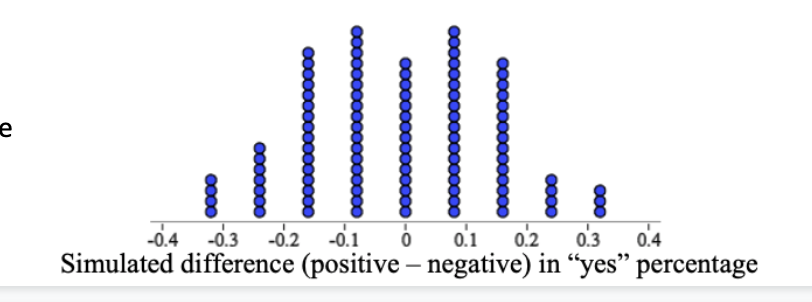
- Explain how to use note cards to simulate the difference (positive - negative) in "yes" percentage, assuming that respondents are equally likely to say "yes" when the question has positive information and when the question has negative information.
- The dotplot to the right shows the results of 100 simulated experiments, as described above. Use the dotplot to estimate thep-value.
Information provided Positive Negative Total Bonds in of Yes 14 20 the HOF? No 11 19 30 Total 25 25 50...... .. .......... e CO.............. CO............. -............... ....... 0.4 -0.3 -0.2 -0.1 0.1 0.2 0.3 0.4 Simulated difference (positive - negative) in "yes" percentage
Step by Step Solution
There are 3 Steps involved in it

Get step-by-step solutions from verified subject matter experts