





Question: does this article align with - Understanding Memory SystemsTypes of Memory: Memory can primarily be divided into three types: sensory memory, working memory, and long-term

does this article align with - Understanding Memory SystemsTypes of Memory: Memory can primarily be divided into three types: sensory memory, working memory, and long-term memory.Sensory Memory is the brief retention of sensory information that lasts only a few seconds and helps us perceive the environment.Working Memory is a limited-capacity system that temporarily holds and manipulates information required for cognitive tasks, essential for reasoning, comprehension, and learning.Long-Term Memory involves the storage of information over extended periods, which can be further categorized into explicit (declarative) memory and implicit (procedural) memory.Functionality: Each memory system plays a crucial role in our cognitive functions. For instance, working memory is pivotal for daily tasks requiring active thinking, while long-term memory is critical for retaining knowledge and experiences.
does this article align with - Understanding
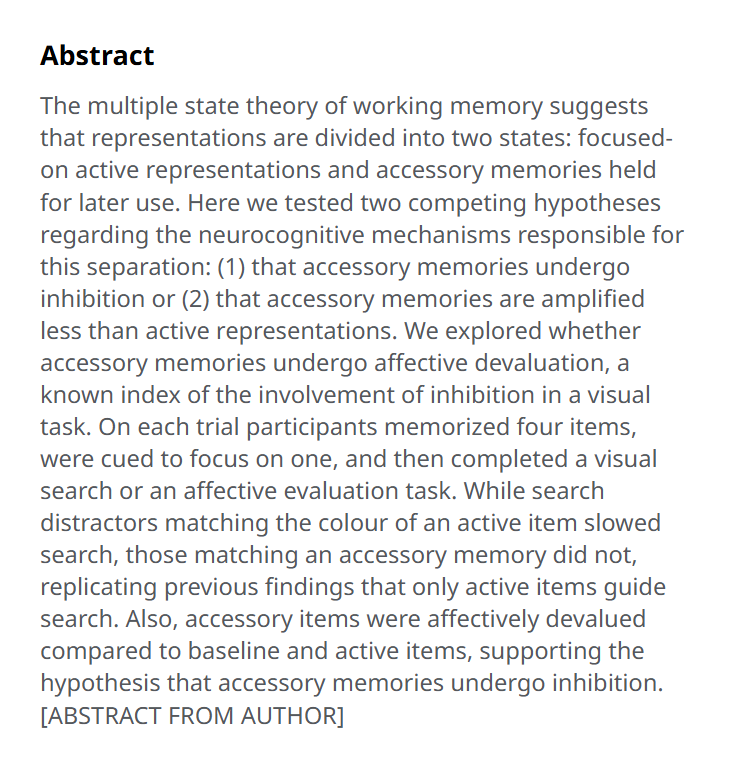
Abstract The multiple state theory of working memory suggests that representations are divided into two states: focused- on active representations and accessory memories held for later use. Here we tested two competing hypotheses regarding the neurocognitive mechanisms responsible for this separation: (1) that accessory memories undergo inhibition or (2) that accessory memories are amplified less than active representations. We explored whether accessory memories undergo affective devaluation, a known index of the involvement of inhibition in a visual task. On each trial participants memorized four items, were cued to focus on one, and then completed a visual search or an affective evaluation task. While search distractors matching the colour of an active item slowed search, those matching an accessory memory did not, replicating previous findings that only active items guide search. Also, accessory items were affectively devalued compared to baseline and active items, supporting the hypothesis that accessory memories undergo inhibition. [ABSTRACT FROM AUTHOR]

Step by Step Solution

There are 3 Steps involved in it

1 Expert Approved Answer
Step: 1 Unlock blur-text-image
Question Has Been Solved by an Expert!

Get step-by-step solutions from verified subject matter experts

Step: 2 Unlock
Step: 3 Unlock

Students Have Also Explored These Related Accounting Questions!