







Question: DONT POST ANY IRRELEVANT ANSWER OR COPIED ANSWER. I WILL DISLIKE 6 TIMES Case Study Quality at Jet T: The liberalization process of the airline
DONT POST ANY IRRELEVANT ANSWER OR COPIED ANSWER. I WILL DISLIKE 6 TIMES
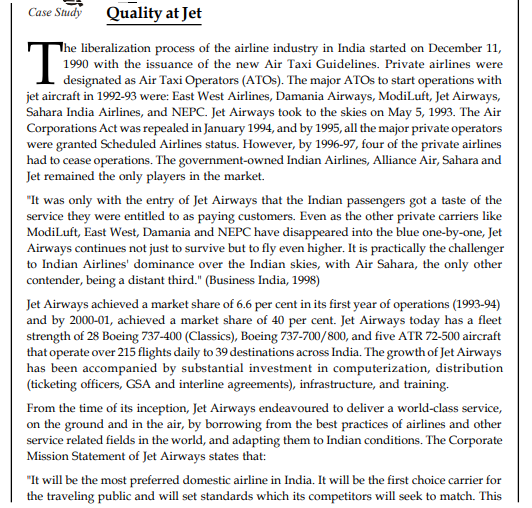
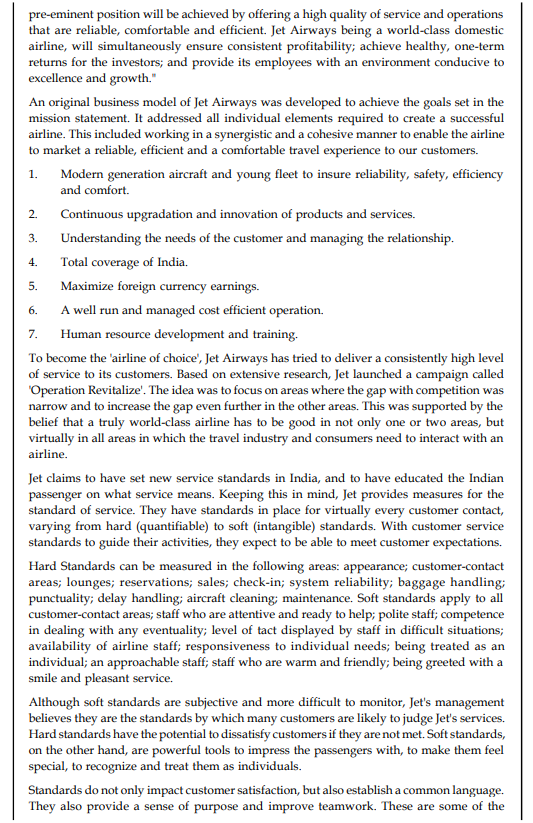
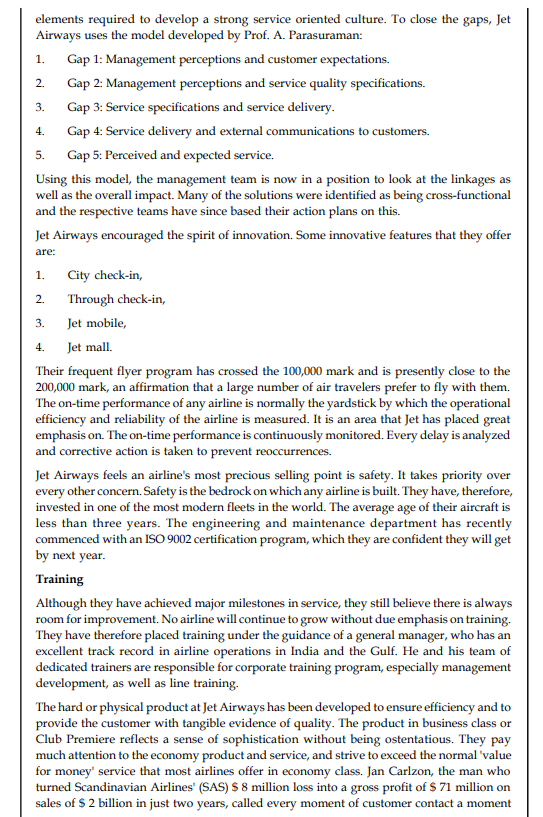
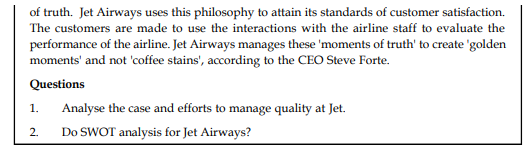
Case Study Quality at Jet T: The liberalization process of the airline industry in India started on December 11, I 1990 with the issuance of the new Air Taxi Guidelines. Private airlines were designated as Air Taxi Operators (ATOS). The major ATOs to start operations with jet aircraft in 1992-93 were: East West Airlines, Damania Airways, ModiLuft, Jet Airways, Sahara India Airlines, and NEPC. Jet Airways took to the skies on May 5, 1993. The Air Corporations Act was repealed in January 1994, and by 1995, all the major private operators were granted Scheduled Airlines status. However, by 1996-97, four of the private airlines had to cease operations. The government-owned Indian Airlines, Alliance Air, Sahara and Jet remained the only players in the market. "It was only with the entry of Jet Airways that the Indian passengers got a taste of the service they were entitled to as paying customers. Even as the other private carriers like ModiLuft, East West, Damania and NEPC have disappeared into the blue one-by-one, Jet Airways continues not just to survive but to fly even higher. It is practically the challenger to Indian Airlines' dominance over the Indian skies, with Air Sahara, the only other contender, being a distant third." (Business India, 1998) Jet Airways achieved a market share of 6.6 per cent in its first year of operations (1993-94) and by 2000-01, achieved a market share of 40 per cent. Jet Airways today has a fleet strength of 28 Boeing 737-400 (Classics), Boeing 737-700/800, and five ATR 72-500 aircraft that operate over 215 flights daily to 39 destinations across India. The growth of Jet Airways has been accompanied by substantial investment in computerization, distribution (ticketing officers, GSA and interline agreements), infrastructure, and training. From the time of its inception, Jet Airways endeavoured to deliver a world-class service, on the ground and in the air, by borrowing from the best practices of airlines and other service related fields in the world, and adapting them to Indian conditions. The Corporate Mission Statement of Jet Airways states that: "It will be the most preferred domestic airline in India. It will be the first choice carrier for the traveling public and will set standards which its competitors will seek to match. This 1. 2. 3. 4. 5. pre-eminent position will be achieved by offering a high quality of service and operations that are reliable, comfortable and efficient. Jet Airways being a world-class domestic airline, will simultaneously ensure consistent profitability, achieve healthy, one-term returns for the investors; and provide its employees with an environment conducive to excellence and growth." An original business model of Jet Airways was developed to achieve the goals set in the mission statement. It addressed all individual elements required to create a successful airline. This included working in a synergistic and a cohesive manner to enable the airline to market a reliable, efficient and a comfortable travel experience to our customers. Modern generation aircraft and young fleet to insure reliability, safety, efficiency and comfort. Continuous upgradation and innovation of products and services. Understanding the needs of the customer and managing the relationship. Total coverage of India. Maximize foreign currency earnings. 6. A well run and managed cost efficient operation. 7. Human resource development and training. To become the 'airline of choice', Jet Airways has tried to deliver a consistently high level of service to its customers. Based on extensive research, Jet launched a campaign called Operation Revitalize'. The idea was to focus on areas where the gap with competition was narrow and to increase the gap even further in the other areas. This was supported by the belief that a truly world-class airline has to be good in not only one or two areas, but virtually in all areas in which the travel industry and consumers need to interact with an airline. Jet claims to have set new service standards in India, and to have educated the Indian passenger on what service means. Keeping this in mind, Jet provides measures for the standard of service. They have standards in place for virtually every customer contact, varying from hard (quantifiable) to soft (intangible) standards. With customer service standards to guide their activities, they expect to be able to meet customer expectations. Hard Standards can be measured in the following areas: appearance; customer-contact areas; lounges; reservations; sales; check-in; system reliability; baggage handling punctuality; delay handling, aircraft cleaning; maintenance. Soft standards apply to all customer-contact areas; staff who are attentive and ready to help; polite staff; competence in dealing with any eventuality; level of tact displayed by staff in difficult situations; availability of airline staff; responsiveness to individual needs; being treated as an individual; an approachable staff; staff who are warm and friendly; being greeted with a smile and pleasant service. Although soft standards are subjective and more difficult to monitor, Jet's management believes they are the standards by which many customers are likely to judge Jet's services. Hard standards have the potential to dissatisfy customers if they are not met. Soft standards, on the other hand, are powerful tools to impress the passengers with, to make them feel special, to recognize and treat them as individuals. Standards do not only impact customer satisfaction, but also establish a common language. They also provide a sense of purpose and improve teamwork. These are some of the 1. 3. elements required to develop a strong service oriented culture. To close the gaps, Jet Airways uses the model developed by Prof. A. Parasuraman: Gap 1: Management perceptions and customer expectations. 2. Gap 2: Management perceptions and service quality specifications. Gap 3: Service specifications and service delivery. Gap 4: Service delivery and external communications to customers. Gap 5: Perceived and expected service. p : Using this model, the management team is now in a position to look at the linkages as well as the overall impact. Many of the solutions were identified as being cross-functional and the respective teams have since based their action plans on this. Jet Airways encouraged the spirit of innovation. Some innovative features that they offer 4. 5. are: 1. 2. 3. 4. City check-in, Through check-in, Jet mobile, Jet mall Their frequent flyer program has crossed the 100,000 mark and is presently close to the 200,000 mark, an affirmation that a large number of air travelers prefer to fly with them. The on-time performance of any airline is normally the yardstick by which the operational efficiency and reliability of the airline is measured. It is an area that Jet has placed great emphasis on. The on-time performance is continuously monitored. Every delay is analyzed and corrective action is taken to prevent reoccurrences. Jet Airways feels an airline's most precious selling point is safety. It takes priority over every other concern. Safety is the bedrock on which any airline is built. They have, therefore, invested in one of the most modern fleets in the world. The average age of their aircraft is less than three years. The engineering and maintenance department has recently commenced with an ISO 9002 certification program, which they are confident they will get by next year. Training Although they have achieved major milestones in service, they still believe there is always room for improvement. No airline will continue to grow without due emphasis on training. They have therefore placed training under the guidance of a general manager, who has an excellent track record in airline operations in India and the Gulf. He and his team of dedicated trainers are responsible for corporate training program, especially management development, as well as line training, The hard or physical product at Jet Airways has been developed to ensure efficiency and to provide the customer with tangible evidence of quality. The product in business class or Club Premiere reflects a sense of sophistication without being ostentatious. They pay much attention to the economy product and service, and strive to exceed the normal value for money' service that most airlines offer in economy class. Jan Carlzon, the man who turned Scandinavian Airlines' (SAS) $ 8 million loss into a gross profit of $ 71 million on sales of $ 2 billion in just two years, called every moment of customer contact a moment of truth. Jet Airways uses this philosophy to attain its standards of customer satisfaction. The customers are made to use the interactions with the airline staff to evaluate the performance of the airline. Jet Airways manages these 'moments of truth' to create 'golden moments' and not coffee stains', according to the CEO Steve Forte. Questions Analyse the case and efforts to manage quality at Jet. Do SWOT analysis for Jet Airways? 1. 2
Step by Step Solution
There are 3 Steps involved in it
1 Expert Approved Answer
Step: 1 Unlock

Question Has Been Solved by an Expert!
Get step-by-step solutions from verified subject matter experts
Step: 2 Unlock
Step: 3 Unlock
 Study Help