Question: DONT USE PICTURE Read the Article Below and answer questions How did Jergens, Inc., use an activity based costing approach to justify the price for
DONT USE PICTURE
Read the Article Below and answer questions
How did Jergens, Inc., use an activity based costing approach to justify the price for an order of odd-sized metal locating fasteners?
What issues arose in Goodyear Tire and Rubber's pricing to distributors? What was Goodyear's response?
What was the outcome of Emerson Electric's decision to depart from cost-based pricing? How can a product costing system contribute to under costing a low-volume or customized product?
How did Wildeck influence customers to purchase products and services that at more profitable to Wildeck? How did Wildeck respond to a competitor's lower priced storage-rack protector? What role should a cost system play in such decisions?
Why was Union Pacific not concerned if it lost its less profitable customers? Will dropping unprofitable customers always lead to an immediate increase in profit?
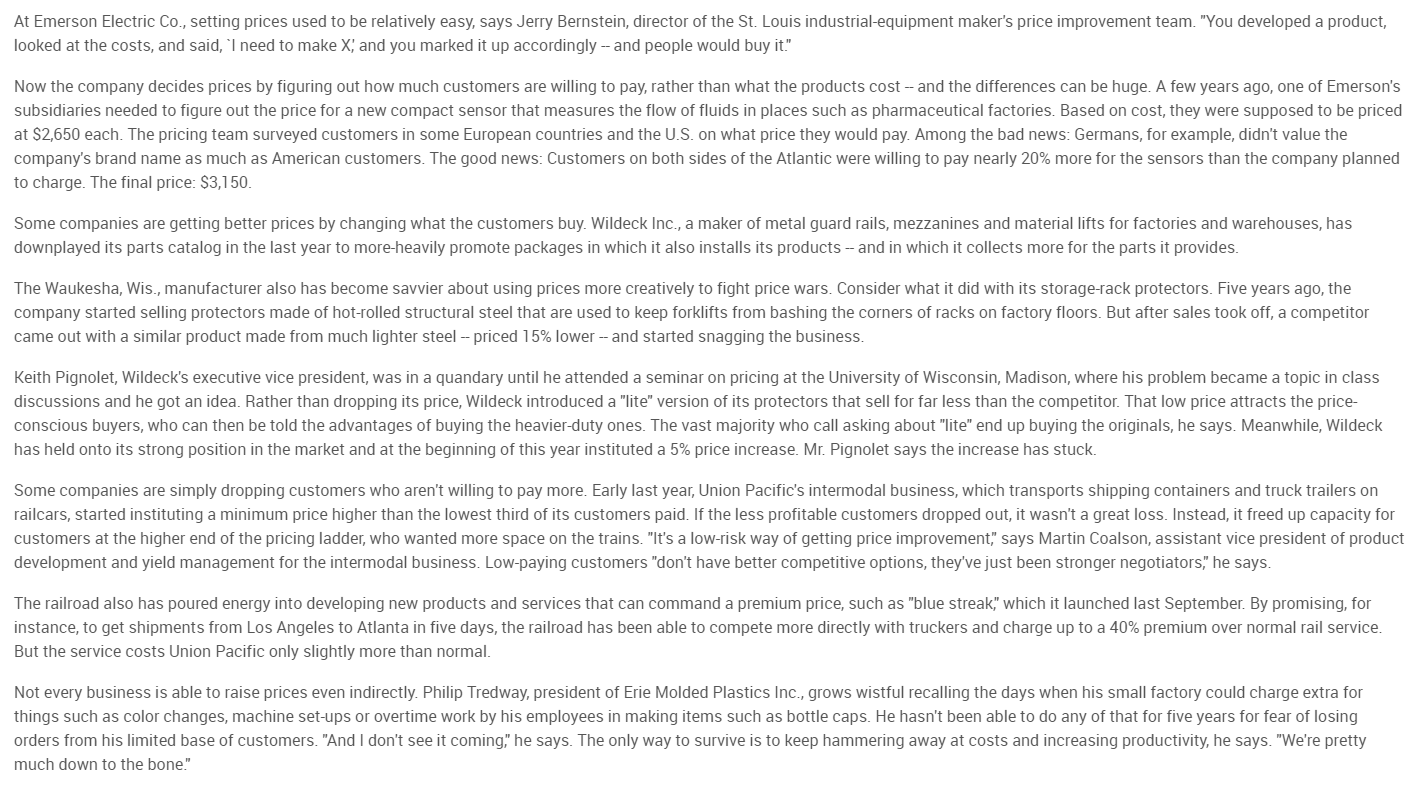
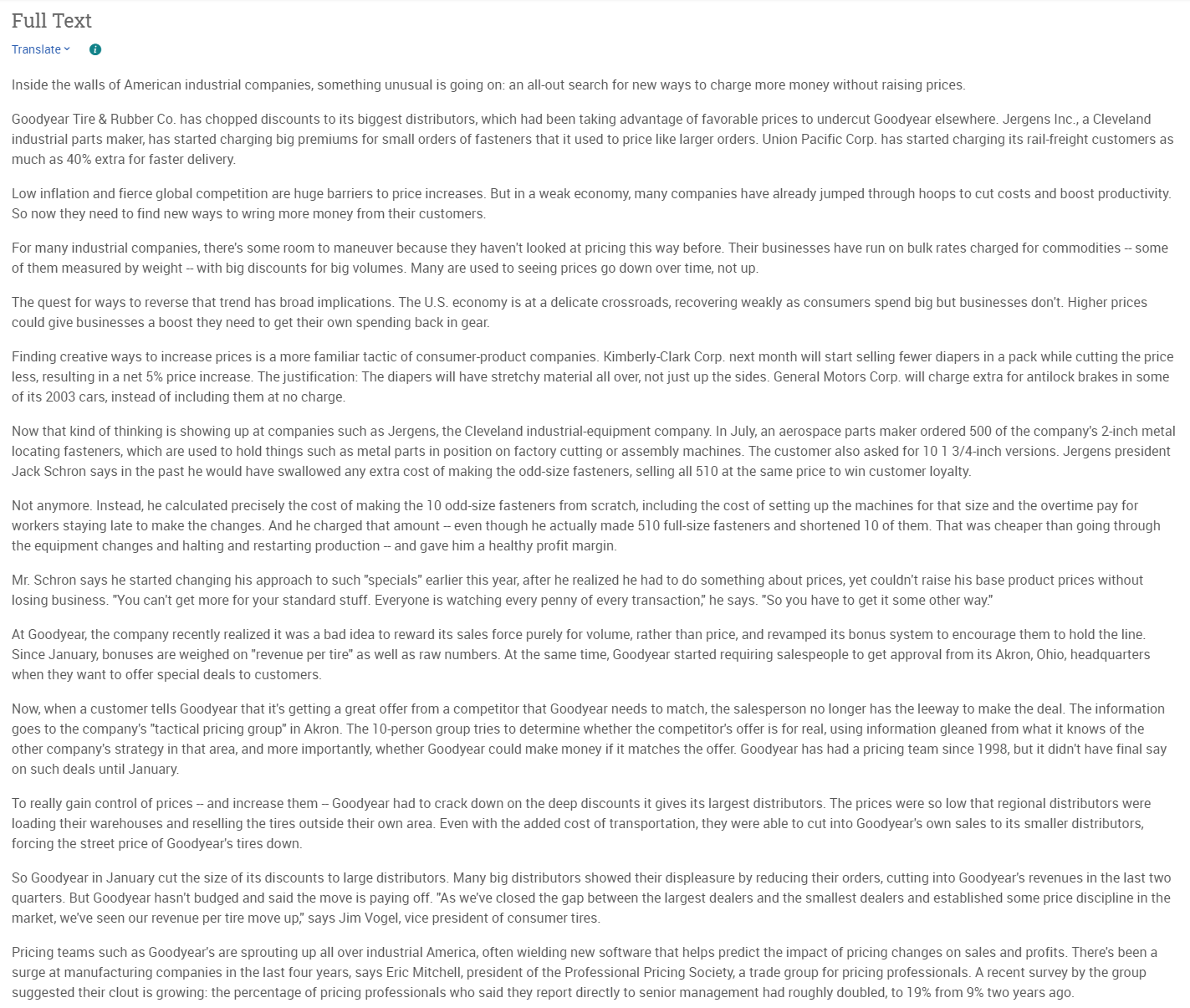
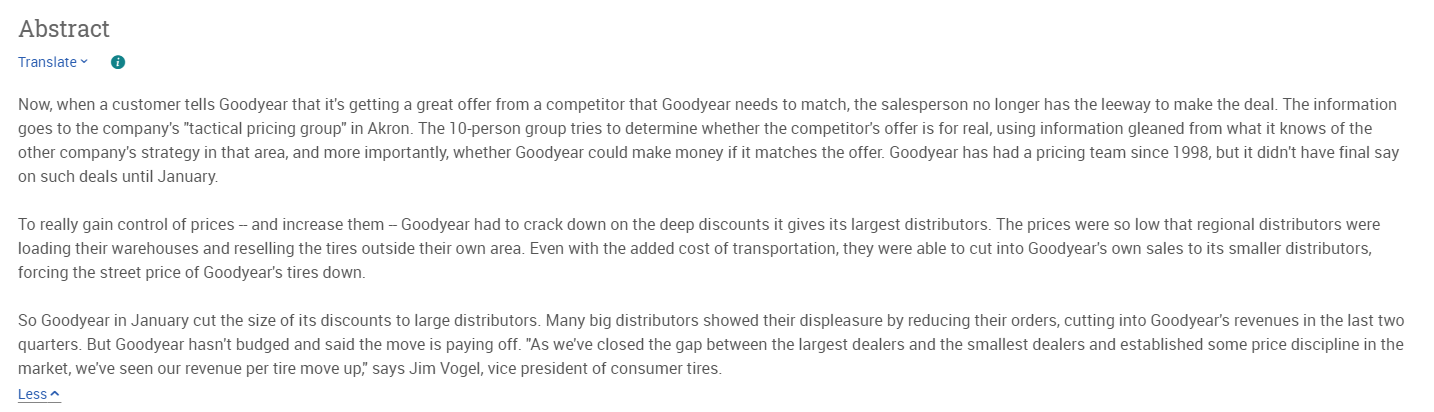
At Emerson Electric Co,, setting prices used to be relatively easy, says Jerry Bernstein, director of the St. Louis industrial-equipment maker's price improvement team. "You developed a product, looked at the costs, and said, | need to make X; and you marked it up accordingly and people would buy 1t\" Now the company decides prices by figuring out how much customers are willing to pay, rather than what the products cost and the differences can be huge A few years ago, one of Emerson's subsidiaries needed to figure out the price for a new compact sensor that measures the flow of fluids in places such as pharmaceutical factories. Based on cost, they were supposed to be priced at 2,650 each. The pricing team surveyed customers in some European countries and the U.S. on what price they would pay. Among the bad news: Germans, for example, didn't value the company's brand name as much as American customers. The good news: Customers on both sides of the Atlantic were willing to pay nearly 20% more for the sensors than the company planned to charge. The final price: $3,150. Some companies are getting better prices by changing what the customers buy. Wildeck Inc_, a maker of metal guard rails, mezzanines and matenal lifts for factonies and warehouses, has downplayed its parts catalog in the last year to more-heavily promote packages in which it also installs its products - and in which it collects more for the parts it provides. The Waukesha, Wis_, manufacturer also has become savvier about using prices more creatively to fight price wars. Consider what it did with its storage-rack protectors. Five years ago, the company started selling protectors made of hot-rolled structural steel that are used to keep forklifts from bashing the corners of racks on factory floors. But after sales took off, a competitor came out with a similar product made from much lighter steel - priced 15% lower and started snagging the business Keith Pignolet, Wildeck's executive vice president, was in a quandary until he attended a seminar on pricing at the University of Wisconsin, Madison, where his problem became a topic in class discussions and he got an idea. Rather than dropping its price, Wildeck introduced a "lite\" version of its protectors that sell for far less than the competitor. That low price attracts the price- conscious buyers, who can then be told the advantages of buying the heavier-duty ones. The vast majority who call asking about "lite\" end up buying the originals, he says. Meanwhile, Wildeck has held onto Its strong position in the market and at the beginning of this year instituted a 5% price increase. Mr. Pignolet says the increase has stuck. Some companies are simply dropping customers who aren't willing to pay more. Early last year, Union Pacific's intermodal business, which transports shipping containers and truck trailers on railcars, started instituting a minimum price higher than the lowest third of its customers paid. If the less profitable customers dropped out, it wasn't a great loss. Instead, it freed up capacity for customers at the higher end of the pricing ladder, who wanted more space on the trains. "It's a low-risk way of getting price improvement,' says Martin Coalson, assistant vice president of product development and yield management for the intermodal business. Low-paying customers "don't have better competitive options, they've just been stronger negotiators;\" he says The railroad also has poured energy into developing new products and services that can command a premium price, such as "blue streak,' which it launched last September. By promising, for instance, to get shipments from Los Angeles to Atlanta in five days, the railroad has been able to compete more directly with truckers and charge up to a 40% premium over normal rail service But the service costs Union Pacific only slightly more than normal. Not every business is able to raise prices even indirectly. Philip Tredway, president of Erie Molded Plastics Inc,, grows wistful recalling the days when his small factory could charge extra for things such as color changes, machine set-ups or overtime work by his employees in making items such as bottle caps. He hasn't been able to do any of that for five years for fear of losing orders from his limited base of customers. "And | don't see it coming,' he says. The only way to survive is to keep hammering away at costs and increasing productivity, he says. "We're pretty much down to the bone\" Full Text Translate~ @ Inside the walls of American industrial companies, something unusual is going on- an all-out search for new ways to charge more money without raising prices. Goodyear Tire & Rubber Co. has chopped discounts to its biggest distributors, which had been taking advantage of favorable prices to undercut Goodyear elsewhere. Jergens Inc., a Cleveland industrial parts maker, has started charging big premiums for small orders of fasteners that it used to price like larger orders. Union Pacific Corp. has started charging its rail-freight customers as much as 40% extra for faster delivery. Low inflation and fierce global competition are huge barriers to price increases. But in a weak economy, many companies have already jumped through hoops to cut costs and boost productivity. So now they need to find new ways to wring more money from their customers For many industrial companies, there's some room to maneuver because they haven't looked at pricing this way before. Their businesses have run on bulk rates charged for commodities some of them measured by weight with big discounts for big volumes. Many are used to seeing prices go down over time, not up The quest for ways to reverse that trend has broad implications. The U.S. economy is at a delicate crossroads, recovering weakly as consumers spend big but businesses don't. Higher prices could give businesses a boost they need to get their own spending back in gear. Finding creative ways to increase prices is a more familiar tactic of consumer-product companies. Kimberly-Clark Corp. next month will start selling fewer diapers in a pack while cutting the price less, resulting in a net 6% price increase. The justification: The diapers will have stretchy material all over, not just up the sides. General Motors Corp. will charge extra for antilock brakes in some of its 2003 cars, instead of including them at no charge. Now that kind of thinking is showing up at companies such as Jergens, the Cleveland industrial-equipment company. In July, an aerospace parts maker ordered 500 of the company's 2-inch metal locating fasteners, which are used to hold things such as metal parts in position on factory cutting or assembly machines. The customer also asked for 10 1 3/4-inch versions. Jergens president Jack Schron says in the past he would have swallowed any extra cost of making the odd-size fasteners, selling all 510 at the same price to win customer loyalty. MNot anymore. Instead, he calculated precisely the cost of making the 10 odd-size fasteners from scratch, including the cost of setting up the machines for that size and the overtime pay for workers staying late to make the changes. And he charged that amount - even though he actually made 510 full-size fasteners and shortened 10 of them. That was cheaper than going through the equipment changes and halting and restarting production and gave him a healthy profit margin. Mr. Schron says he started changing his approach to such "specials\" earlier this year, after he realized he had to do something about prices, yet couldn't raise his base product prices without losing business. "You can't get more for your standard stuff. Everyone is watching every penny of every transaction; he says. "So you have to get it some other way." At Goodyear, the company recently realized it was a bad idea to reward its sales force purely for volume, rather than price, and revamped its bonus system to encourage them to hold the line. Since January, bonuses are weighed on "revenue per tire" as well as raw numbers. At the same time, Goodyear started requiring salespeople to get approval from its Akron, Ohio, headquarters when they want to offer special deals to customers. MNow, when a customer tells Goodyear that it's getting a great offer from a competitor that Goodyear needs to match, the salesperson no longer has the leeway to make the deal. The information goes to the company's "tactical pricing group\" in Akron. The 10-person group tries to determine whether the competitor's offer is for real, using information gleaned from what it knows of the other company's strategy in that area, and more importantly, whether Goodyear could make money If it matches the offer. Goodyear has had a pricing team since 1998, but it didn't have final say on such deals until January. To really gain control of prices and increase them Goodyear had to crack down on the deep discounts it gives its largest distributors. The prices were so low that regional distributors were loading their warehouses and reselling the tires outside their own area. Even with the added cost of transportation, they were able to cut into Goodyear's own sales to its smaller distributors, forcing the street price of Goodyear's tires down. So Goodyear in January cut the size of its discounts to large distributors. Many big distributors showed their displeasure by reducing their orders, cutting into Goodyear's revenues in the last two quarters. But Goodyear hasn't budged and said the move is paying off. "As we've closed the gap between the largest dealers and the smallest dealers and established some price discipline in the market, we've seen our revenue per tire move up,' says Jim Vogel, vice president of consumer tires. Pricing teams such as Goodyear's are sprouting up all over industrial America, often wielding new software that helps predict the impact of pricing changes on sales and profits. There's been a surge at manufacturing companies in the last four years, says Eric Mitchell, president of the Professional Pricing Society, a trade group for pricing professionals. A recent survey by the group suggested their clout is growing: the percentage of pricing professionals who said they report directly to senior management had roughly doubled, to 19% from 9% two years ago. Abstract Translate~ @ Now, when a customer tells Goodyear that it's getting a great offer from a competitor that Goodyear needs to match, the salesperson no longer has the leeway to make the deal. The information goes to the company's "tactical pricing group\" in Akron. The 10-person group tries to determine whether the competitor's offer is for real, using information gleaned from what it knows of the other company's strategy in that area, and more importantly, whether Goodyear could make money if it matches the offer Goodyear has had a pricing team since 1998, but it didn't have final say on such deals until January. To really gain control of prices and increase them Goodyear had to crack down on the deep discounts it gives its largest distributors. The prices were so low that regional distributors were loading their warehouses and reselling the tires outside their own area. Even with the added cost of transportation, they were able to cut into Goodyear's own sales to its smaller distributors, forcing the street price of Goodyear's tires down. So Goodyear in January cut the size of its discounts to large distributors. Many big distributors showed their displeasure by reducing their orders, cutting into Goodyear's revenues in the last two quarters. But Goodyear hasn't budged and said the move is paying off. "As we've closed the gap between the largest dealers and the smallest dealers and established some price discipline in the market, we've seen our revenue per tire move up,' says Jim Vogel, vice president of consumer tires. Less ~
Step by Step Solution
There are 3 Steps involved in it
1 Expert Approved Answer
Step: 1 Unlock
Question Has Been Solved by an Expert!
Get step-by-step solutions from verified subject matter experts
Step: 2 Unlock
Step: 3 Unlock
Students Have Also Explored These Related Accounting Questions!









 Study Help