







Question: Double Integrator PID Model Suppose we are given double integrator dynamics, my(t) = u(t) + d(t) where disturbance is given by d(t). We consider using
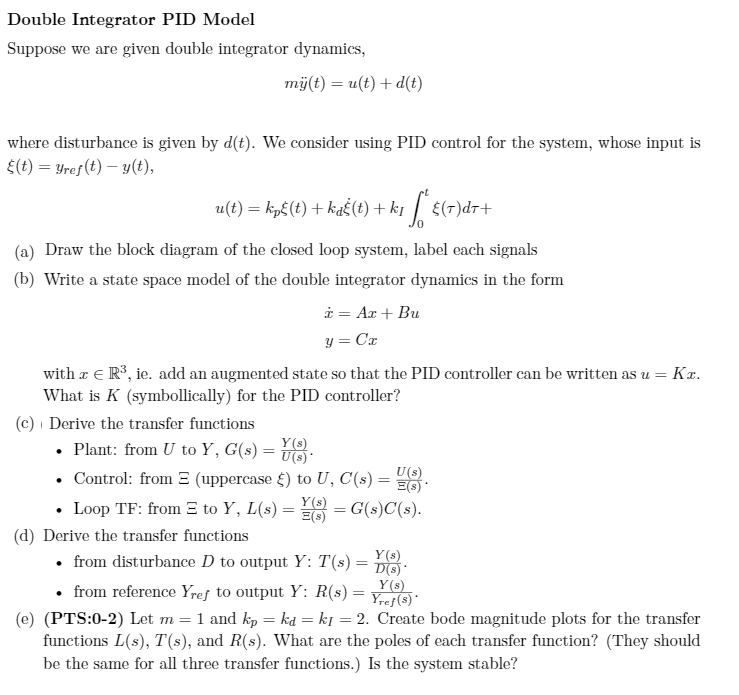
Double Integrator PID Model Suppose we are given double integrator dynamics, my(t) = u(t) + d(t) where disturbance is given by d(t). We consider using PID control for the system, whose input is $(t) = Yref(t) - y(t), u(t) = ky[e) + kale) + ki [*e()dr+ (a) Draw the block diagram of the closed loop system, label each signals (b) Write a state space model of the double integrator dynamics in the form * = A.c + Bu y=C. with x R3, ie, add an augmented state so that the PID controller can be written as u = Kr. What is K (symbollically) for the PID controller? (c) Derive the transfer functions . Plant: from U to Y, G(s) = 16- Y(3) U (3) Control: from 3 (uppercase &) to U, C(s) = E(S) Y(S) Loop TF: from 5 to Y, L(s) = 3(3) = G(s)C(s). (d) Derive the transfer functions . from disturbance D to output Y: T(S) = DO Y() Y() from reference Yref to output Y: R(8) = Ye6 (0) (PTS:0-2) Let m= 1 and kp = kd = kj = 2. Create bode magnitude plots for the transfer functions L(s), T(s), and R(s). What are the poles of each transfer function? (They should be the same for all three transfer functions.) Is the system stable? Double Integrator PID Model Suppose we are given double integrator dynamics, my(t) = u(t) + d(t) where disturbance is given by d(t). We consider using PID control for the system, whose input is $(t) = Yref(t) - y(t), u(t) = ky[e) + kale) + ki [*e()dr+ (a) Draw the block diagram of the closed loop system, label each signals (b) Write a state space model of the double integrator dynamics in the form * = A.c + Bu y=C. with x R3, ie, add an augmented state so that the PID controller can be written as u = Kr. What is K (symbollically) for the PID controller? (c) Derive the transfer functions . Plant: from U to Y, G(s) = 16- Y(3) U (3) Control: from 3 (uppercase &) to U, C(s) = E(S) Y(S) Loop TF: from 5 to Y, L(s) = 3(3) = G(s)C(s). (d) Derive the transfer functions . from disturbance D to output Y: T(S) = DO Y() Y() from reference Yref to output Y: R(8) = Ye6 (0) (PTS:0-2) Let m= 1 and kp = kd = kj = 2. Create bode magnitude plots for the transfer functions L(s), T(s), and R(s). What are the poles of each transfer function? (They should be the same for all three transfer functions.) Is the system stable
Step by Step Solution
There are 3 Steps involved in it

Get step-by-step solutions from verified subject matter experts
 Study Help