







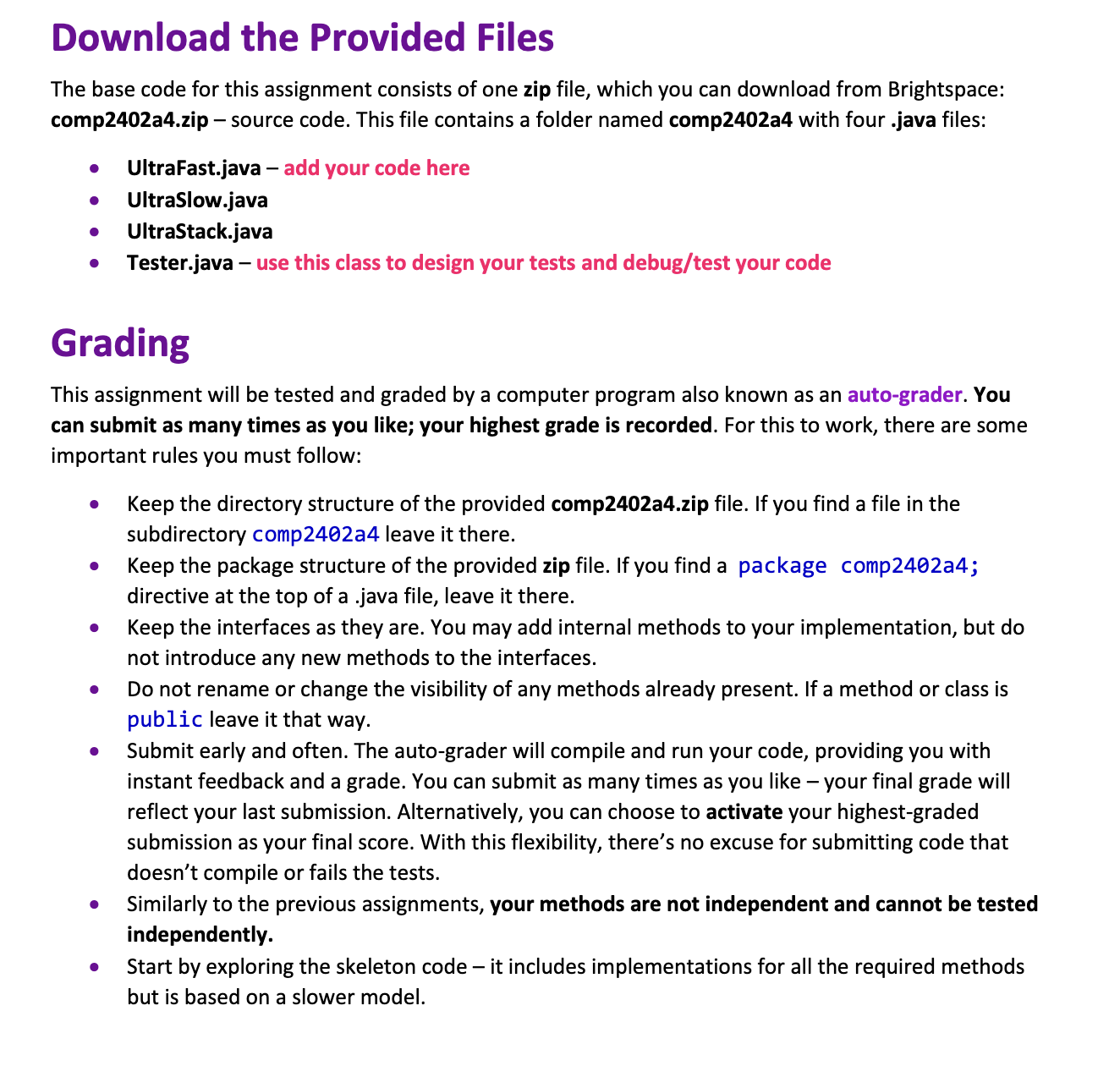
Question: Download the Provided Files The base code for this assignment consists of one zip file, which you can download from Brightspace: comp 2 4 0
Download the Provided Files
The base code for this assignment consists of one zip file, which you can download from Brightspace:
compazip source code. This file contains a folder named compa with four java files:
UltraFast.java add your code here
UltraSlow.java
UltraStack.java
Tester.java use this class to design your tests and debugtest your code
Grading
This assignment will be tested and graded by a computer program also known as an autograder. You
can submit as many times as you like; your highest grade is recorded. For this to work, there are some
important rules you must follow:
Keep the directory structure of the provided compazip file. If you find a file in the
subdirectory compa leave it there.
Keep the package structure of the provided zip file. If you find a package compa;
directive at the top of a java file, leave it there.
Keep the interfaces as they are. You may add internal methods to your implementation, but do
not introduce any new methods to the interfaces.
Do not rename or change the visibility of any methods already present. If a method or class is
public leave it that way.
Submit early and often. The autograder will compile and run your code, providing you with
instant feedback and a grade. You can submit as many times as you like your final grade will
reflect your last submission. Alternatively, you can choose to activate your highestgraded
submission as your final score. With this flexibility, there's no excuse for submitting code that
doesn't compile or fails the tests.
Similarly to the previous assignments, your methods are not independent and cannot be tested
independently.
Start by exploring the skeleton code it includes implementations for all the required methods
but is based on a slower model.
The Assignment
This assignment contains only one part worth marks.
The data values we will maintain are integers, both negative and positive.
An UltraStack is an extended stack that supports eight main operations: the standard Stack
operations push x and pop and the following nonstandard operations:
geti: returns the ith element from the bottom on the Stack.
setix : sets the value of the ith element from the bottom on the Stack to x and
returns the element that was previously stored at the same position.
doubleTop: reads the top element x from the Stack and adds a new element x to the top
of the Stack.
swapTop: swaps the top two elements of the Stack.
max : returns the maximum value stored on the Stack.
ksumk : returns the sum of the top k elements on the Stack.
The zip file gives an implementation of UltraSlow, which correctly implements these operations so
that pushx pop geti doubleTop swapTop and set i x each run in O time,
but max and ksumk run in On time. The provided implementation of the UltraFast is just a
copy of UltraSlow implementation.
You must complete the implementation of UltraFast by correctly coding all eight operations and
optimizing their efficiency. For UltraFast, the running time for get i and max must be O and
for pushx pop set i x doubleTop swapTop and ksumk running time must not
exceed Olog n
You may assume that the Stack elements will be in the range
As part of your implementation, you may use any of the classes in the Java Collections Framework and
you may use any of the source code provided with the Java version of the ODS textbook.
Remember to implement both the size and iterator methods. The iterator method
should return an Iterator that iterates over the values in order, starting from the bottom
and ending at the top of the Stack. Your iterator must support the following two methods:
next that returns the next element in the iteration.
hasNext that returns true if this list iterator has more elements when traversing the list in the forward direction. In other words, returns true if next would return an element rather than throwing an exception.
Tips, Tricks, and FAQs
Take time to plan your solution carefully before starting to code. Here are two hints to guide you:
Storing partial sums and partial maximums can significantly reduce computation when updating an element in the stack. Refer to the figure below for a visual aid. Complete binary trees can be efficiently stored using arrays. Heaps leverage this approach to organize their elements. This means you do NOT need to rely on pointerbased DSs For additional insights on indexbased parentchild access, refer to Lecture The Stack elements will be in the range You can leverage this by initializing the max data structure with Integer. MINVALUE to help implement the max efficiently.
Step by Step Solution
There are 3 Steps involved in it
1 Expert Approved Answer
Step: 1 Unlock

Question Has Been Solved by an Expert!
Get step-by-step solutions from verified subject matter experts
Step: 2 Unlock
Step: 3 Unlock
 Study Help