



Question: dP Answer parts (a) and (b) using the inhibited growth model dt = k(L - P). Let L = 4000, and assume that P
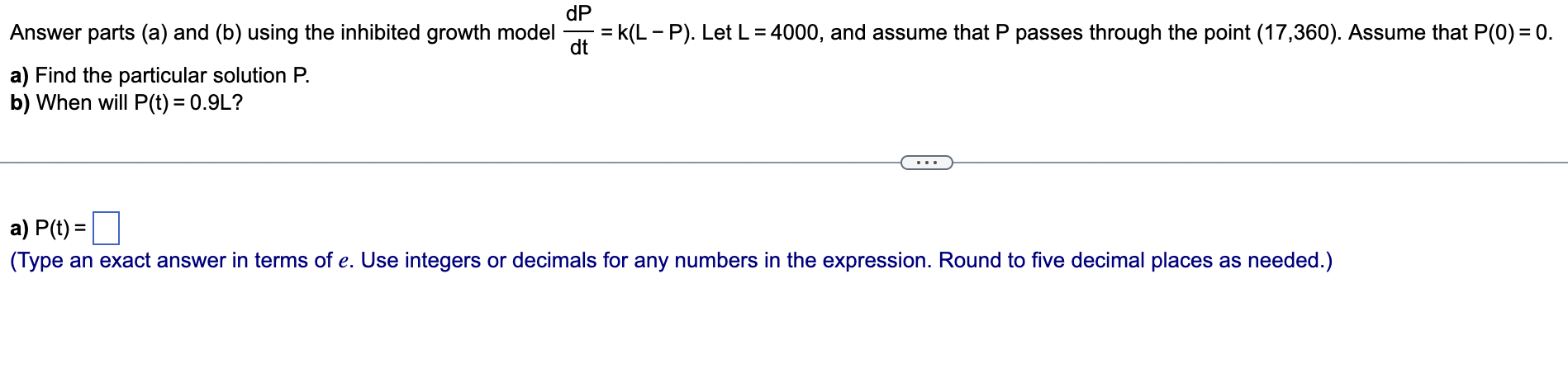
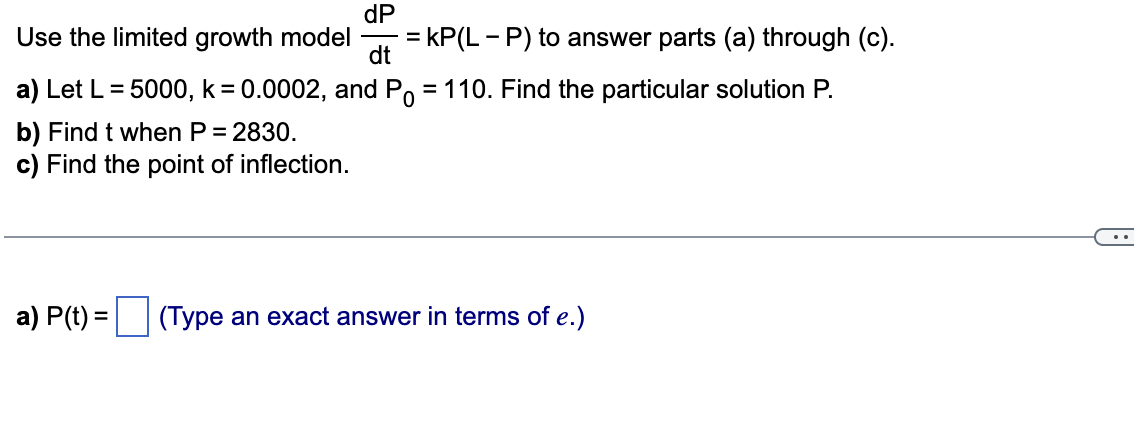
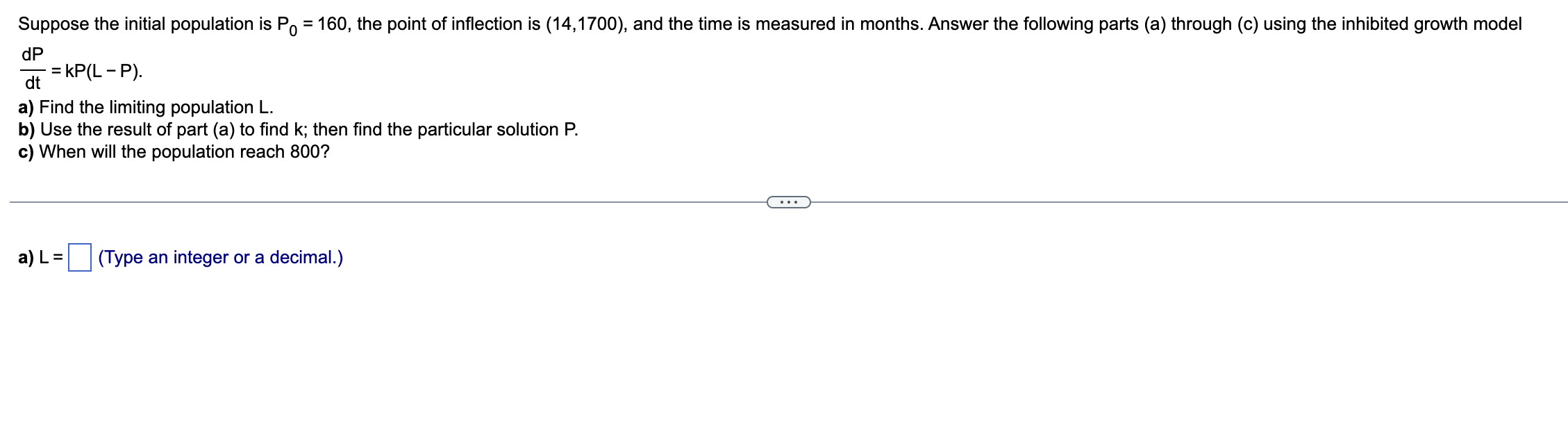
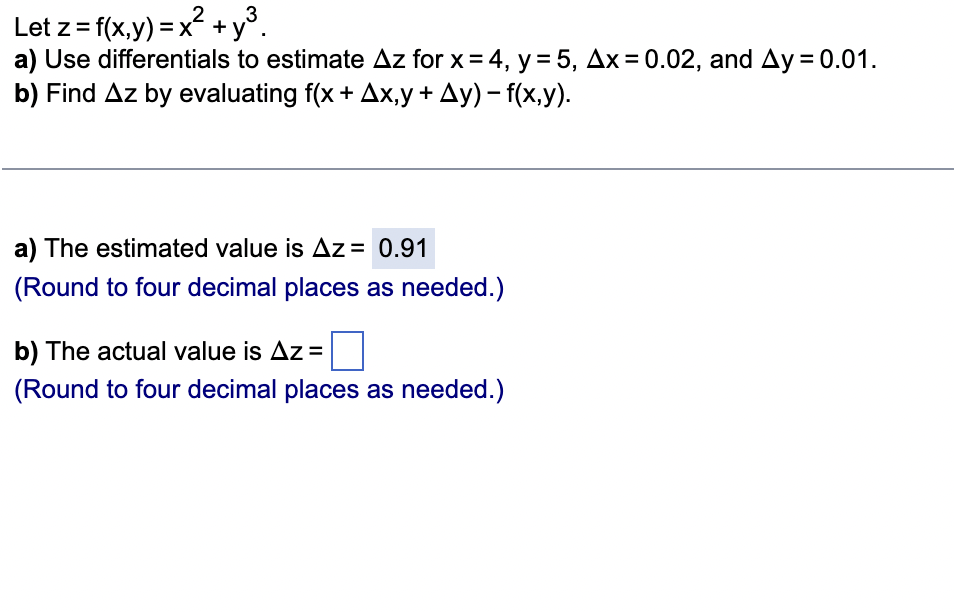
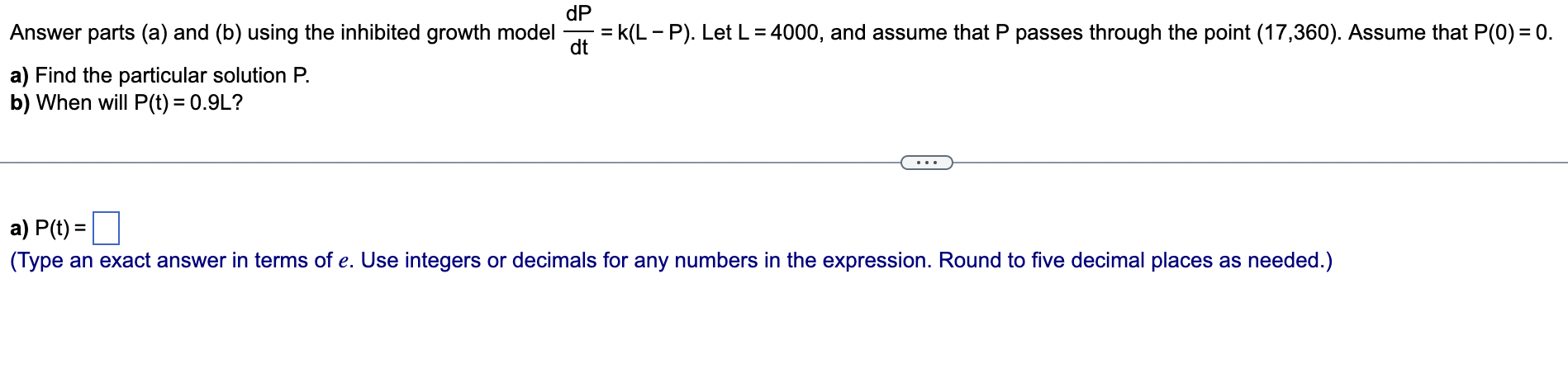
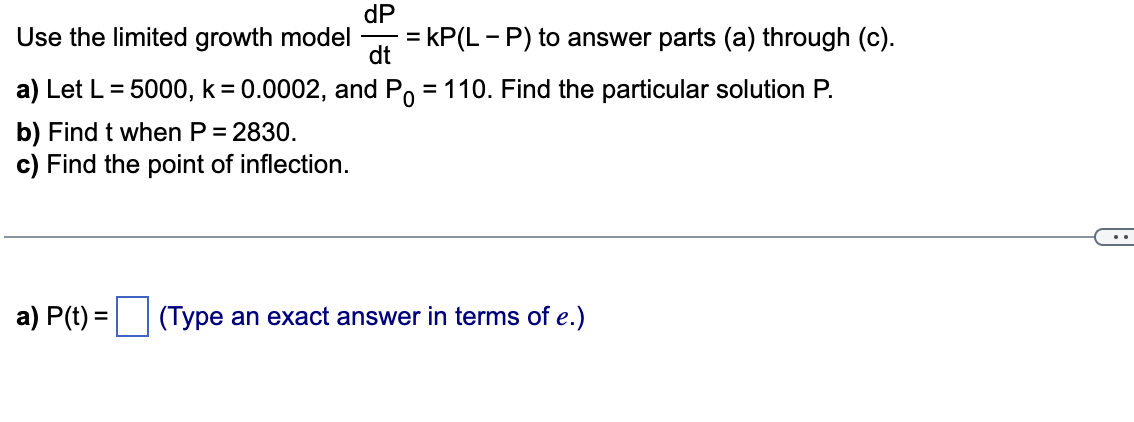
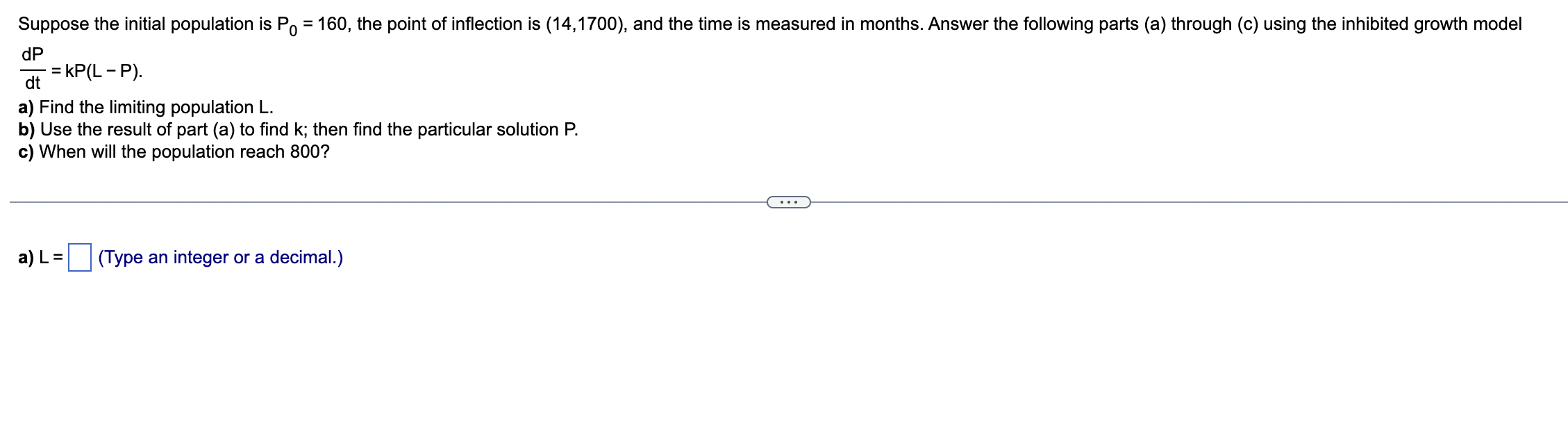
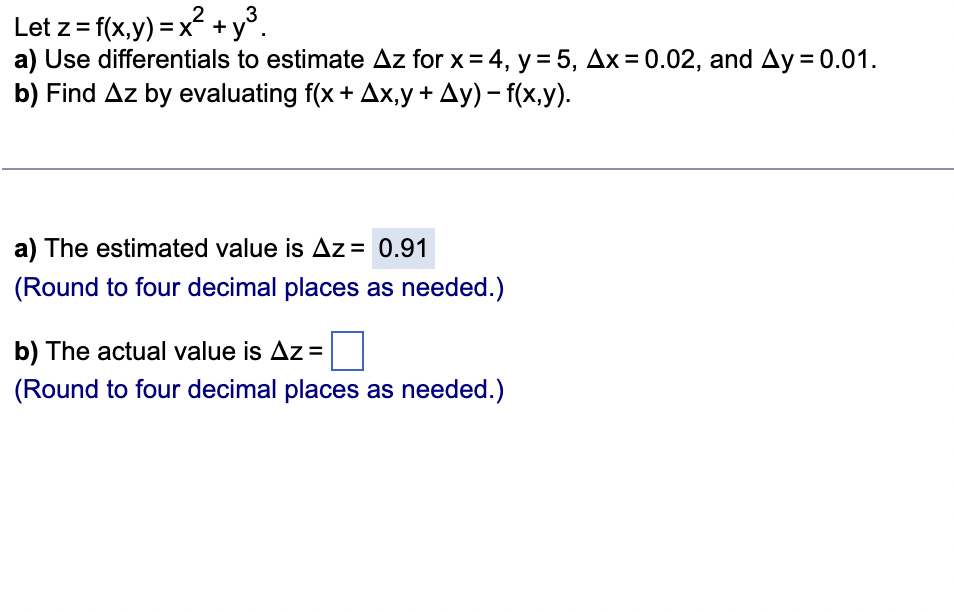
dP Answer parts (a) and (b) using the inhibited growth model dt " = k(L - P). Let L = 4000, and assume that P passes through the point (17,360). Assume that P(0) = 0. a) Find the particular solution P. b) When will P(t) = 0.9L? . . . a) P(t) = (Type an exact answer in terms of e. Use integers or decimals for any numbers in the expression. Round to five decimal places as needed.)dP Use the limited growth model dt - = kP(L - P) to answer parts (a) through (c). a) Let L = 5000, k = 0.0002, and Po = 110. Find the particular solution P. b) Find t when P = 2830. c) Find the point of inflection. . . a) P(t) = (Type an exact answer in terms of e.)Suppose the initial population is Po = 160, the point of inflection is (14, 1700), and the time is measured in months. Answer the following parts (a) through (c) using the inhibited growth model dP dt - = KP(L - P). a) Find the limiting population L. b) Use the result of part (a) to find k; then find the particular solution P. c) When will the population reach 800? a) L = (Type an integer or a decimal.)Let z = f(x,y) = x+ys a) Use differentials to estimate Az for x = 4, y = 5, Ax = 0.02, and Ay = 0.01. b) Find Az by evaluating f(x + Ax,y + Ay) - f(x,y). a) The estimated value is Az = 0.91 (Round to four decimal places as needed.) b) The actual value is AZ = (Round to four decimal places as needed.)
Step by Step Solution
There are 3 Steps involved in it

Get step-by-step solutions from verified subject matter experts