







Question: dp/dt = q( E + v/c x B) 1. This problem seeks to demonstrate that Gauss' law for electrostatics, V.E = 47p (in Gaussian units),
dp/dt = q( E + v/c x B)
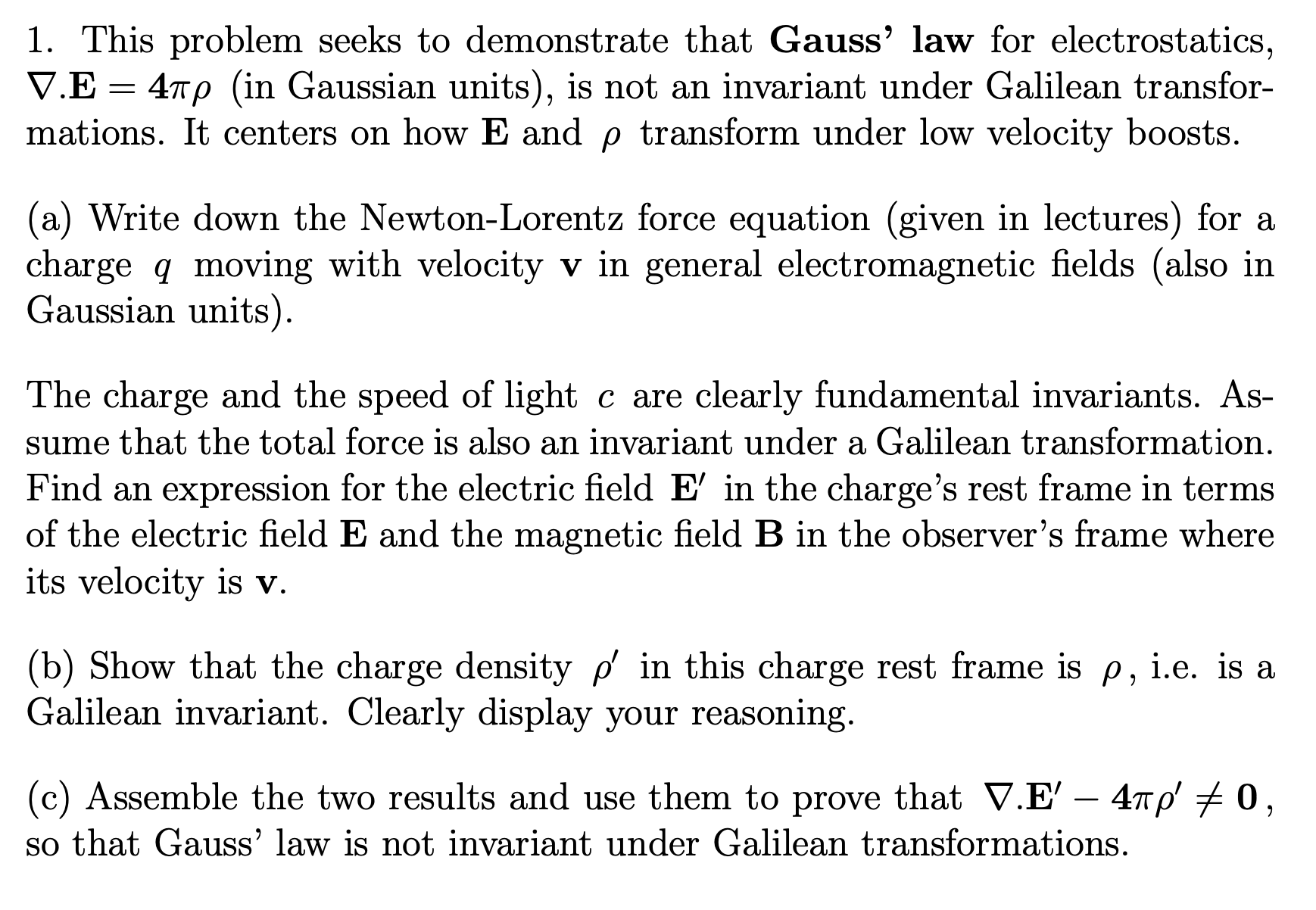
1. This problem seeks to demonstrate that Gauss' law for electrostatics, V.E = 47p (in Gaussian units), is not an invariant under Galilean transfor- mations. It centers on how E and p transform under low velocity boosts. (a) Write down the Newton-Lorentz force equation (given in lectures) for a charge q moving with velocity v in general electromagnetic fields (also in Gaussian units). The charge and the speed of light c are clearly fundamental invariants. As- sume that the total force is also an invariant under a Galilean transformation. Find an expression for the electric field E' in the charge's rest frame in terms of the electric field E and the magnetic field B in the observer's frame where its velocity is v. (b) Show that the charge density p' in this charge rest frame is p, i.e. is a Galilean invariant. Clearly display your reasoning. (c) Assemble the two results and use them to prove that V.E' - 47p' * 0, so that Gauss' law is not invariant under Galilean transformations
Step by Step Solution
There are 3 Steps involved in it

Get step-by-step solutions from verified subject matter experts
 Study Help