







Question: DPs should a. not appear on prints b. avoid clear physical interpretations. c. be equal in number to the CNs. d. be equal in number
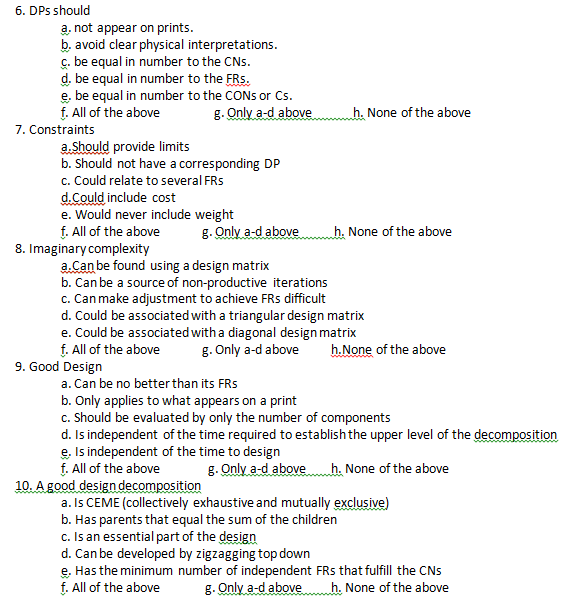
DPs should a. not appear on prints b. avoid clear physical interpretations. c. be equal in number to the CNs. d. be equal in number to the FRs, e. be equal in number to the CONs or Cs. f. All of the above g. Only a-d above h. None of the above Constraints a. should provide limits b. Should not have a corresponding DP c. Could relate to several FRs d. Could include cost e. Would never include weight f. All of the above g. Only a-d above h. None of the above Imaginary complexity a. can be found using a design matrix b. Can be a source of non-productive iterations c. Can make adjustment to achieve FRs difficult d. Could be associated with a triangular design matrix e. Could be associated with a diagonal design matrix f. All of the above g. Only a d above h. None of the above Good Design a. Can be no better than its FRs b. Only applies to what appears on a print c. Should be evaluated by only the number of components d. Is independent of the time required to establish the upper level of the decomposition e. Is independent of the time to design f. All of the above g. On a-d above h. None of the above A good design decomposition a. Is CEME (collectively exhaustive and mutually exclusive) b. Has parents that equal the sum of the children c. Is an essential part of the design d. Can be developed by zigzagging top down e. Has the minimum number of Independent FRs that fulfill the CNs f. All od the above g. Only a-d above h. None of the above
Step by Step Solution
There are 3 Steps involved in it

Get step-by-step solutions from verified subject matter experts
 Study Help